
Recent from talks
Kami
Knowledge base stats:
Talk channels stats:
Members stats:
Kami
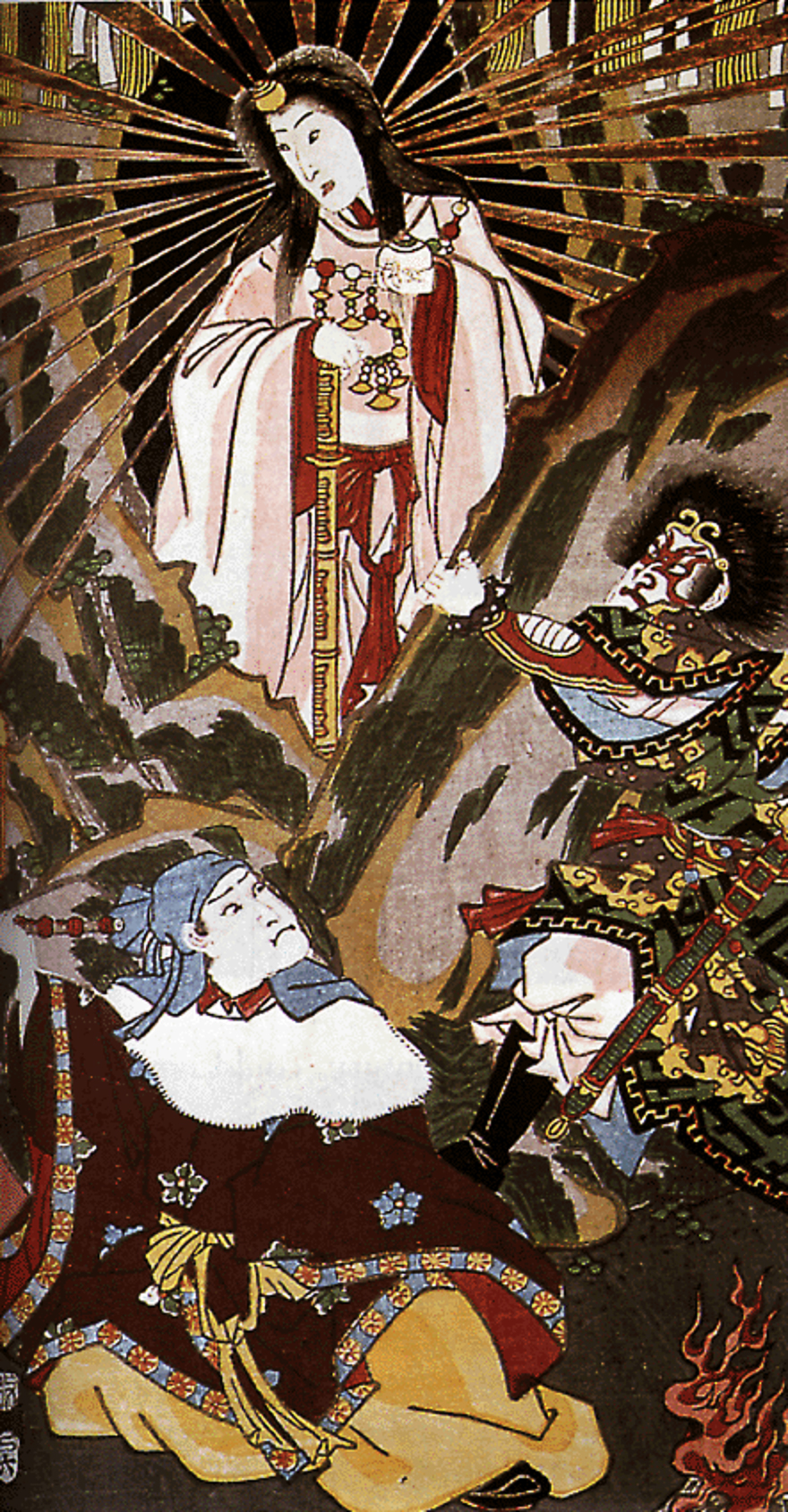
Kami (Japanese: 神; [kaꜜmi]) are the deities, divinities, spirits, mythological, spiritual, or natural phenomena that are venerated in the traditional Shinto religion of Japan. Kami can be elements of the landscape, forces of nature, beings and the qualities that these beings express, and/or the spirits of venerated dead people. Many kami are considered the ancient ancestors of entire clans (some ancestors became kami upon their death if they were able to embody the values and virtues of kami in life). Traditionally, great leaders like the Emperor could be or became kami.
In Shinto, kami are not separate from nature, but are of nature, possessing positive and negative, and good and evil characteristics. They are manifestations of musubi (結び), the interconnecting energy of the universe, and are considered exemplary of what humanity should strive towards. Kami are believed to be "hidden" from this world, and inhabit a complementary existence that mirrors our own: shinkai (神界; "the world of the kami"). To be in harmony with the awe-inspiring aspects of nature is to be conscious of kannagara no michi (随神の道 or 惟神の道; "the way of the kami").
Kami is the Japanese word for a deity, divinity, or spirit. It has been used to describe mind, God, Supreme Being, one of the Shinto deities, an effigy, a principle, and anything that is worshipped.
Although deity is the common interpretation of kami, some Shinto scholars argue that such a translation can cause a misunderstanding of the term.[page needed]
Some etymological suggestions are:
In terms of meaning, in his Kojiki-den, Motoori Norinaga gave a definition of kami as: "any being whatsoever which possesses some eminent quality out of the ordinary, and is awe-inspiring, is called kami."
Because Japanese does not normally distinguish grammatical number in nouns (most do not have singular and plural forms), it is sometimes unclear whether kami refers to a single or multiple entities. When a singular concept is needed, -kami (神) is used as a suffix. The reduplicated term generally used to refer to multiple kami is kamigami.
While Shinto has no founder, no overarching doctrine, and no religious texts, the Kojiki (Records of Ancient Matters), written in 712 CE, and the Nihon Shoki (Chronicles of Japan), written in 720 CE, contain the earliest record of Japanese creation myths. The Kojiki also includes descriptions of various kami.
Hub AI
Kami AI simulator
(@Kami_simulator)
Kami
Kami (Japanese: 神; [kaꜜmi]) are the deities, divinities, spirits, mythological, spiritual, or natural phenomena that are venerated in the traditional Shinto religion of Japan. Kami can be elements of the landscape, forces of nature, beings and the qualities that these beings express, and/or the spirits of venerated dead people. Many kami are considered the ancient ancestors of entire clans (some ancestors became kami upon their death if they were able to embody the values and virtues of kami in life). Traditionally, great leaders like the Emperor could be or became kami.
In Shinto, kami are not separate from nature, but are of nature, possessing positive and negative, and good and evil characteristics. They are manifestations of musubi (結び), the interconnecting energy of the universe, and are considered exemplary of what humanity should strive towards. Kami are believed to be "hidden" from this world, and inhabit a complementary existence that mirrors our own: shinkai (神界; "the world of the kami"). To be in harmony with the awe-inspiring aspects of nature is to be conscious of kannagara no michi (随神の道 or 惟神の道; "the way of the kami").
Kami is the Japanese word for a deity, divinity, or spirit. It has been used to describe mind, God, Supreme Being, one of the Shinto deities, an effigy, a principle, and anything that is worshipped.
Although deity is the common interpretation of kami, some Shinto scholars argue that such a translation can cause a misunderstanding of the term.[page needed]
Some etymological suggestions are:
In terms of meaning, in his Kojiki-den, Motoori Norinaga gave a definition of kami as: "any being whatsoever which possesses some eminent quality out of the ordinary, and is awe-inspiring, is called kami."
Because Japanese does not normally distinguish grammatical number in nouns (most do not have singular and plural forms), it is sometimes unclear whether kami refers to a single or multiple entities. When a singular concept is needed, -kami (神) is used as a suffix. The reduplicated term generally used to refer to multiple kami is kamigami.
While Shinto has no founder, no overarching doctrine, and no religious texts, the Kojiki (Records of Ancient Matters), written in 712 CE, and the Nihon Shoki (Chronicles of Japan), written in 720 CE, contain the earliest record of Japanese creation myths. The Kojiki also includes descriptions of various kami.
Recent media