Hubbry Logo
Sune MangsSune MangsMain
Open search
Sune Mangs
Community hub
Sune Mangs
logo
8 pages, 0 posts
0 subscribers
Be the first to start a discussion here.
Sune Mangs
Sune Mangs
from Wikipedia

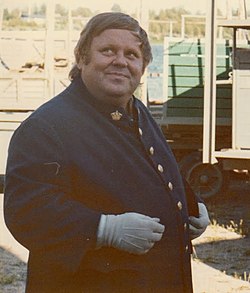
Bengt Sune Mangs (31 December 1932 – 11 February 1994) was a Swedish actor.[1] He appeared in more than 35 films and television shows between 1953 and 1990. Born in Finland, Mangs' parents divorced in the midst of the Winter War, and eight-year-old Mangs moved to Stockholm with his mother and siblings.[2]

Key Information

Partial filmography

[edit]

References

[edit]
[edit]
Revisions and contributorsEdit on WikipediaRead on Wikipedia
from Grokipedia
Sune Mangs was a Swedish actor and revue artist known for his versatile performances across film, television, and stage in Sweden. Born in Kaskinen, Finland, on December 31, 1932, he relocated to Stockholm as a child following his parents' divorce during World War II and built his career primarily in Swedish entertainment. He gained recognition for his comedic timing and character work, appearing in notable films such as Ingmar Bergman's Fanny and Alexander (1982) and Tage Danielsson's The Adventures of Picasso (1978), as well as contributing to popular revue productions and television series. Mangs began his acting career in the 1950s and remained active until the early 1990s, earning a reputation as a familiar and beloved presence in Swedish theater and media through his work with prominent directors and performers. His roots in Finland's Swedish-speaking community and early life experiences influenced his path, though he is remembered chiefly for his contributions to Sweden's cultural landscape. He died on February 11, 1994, in Stockholm.

Early life

Childhood in Finland

Bengt Sune Mangs was born on 31 December 1932 in Kaskinen (also known as Kaskö), Finland. He was the son of furniture dealer Runar Mangs, owner of the town's only carpentry and furniture business located at Rådhusgatan 51, and Edith Lindborg. During his childhood in Kaskinen, Mangs—known locally as Bengt—often fished and sold his catch to earn pocket money while also rowing partygoers across the strait to the dance pavilion on Eskilsö during summer evenings. Amid the food shortages of the Second World War years, he and other children benefited from ready access to fresh Baltic herring, biking to the harbor to buy and clean the fish when shipments arrived. Described as small yet sturdy, he built physical strength through outdoor play, sports, and a diet heavy in herring. Mangs' early interest in performing emerged from watching Charlie Chaplin films and Laurel and Hardy comedies (known as Helan och Halvan) at the local Bio Espis cinema. His parents divorced during the Winter War when he was eight years old, after which he relocated to Sweden with his mother and siblings.

Relocation to Sweden

Following his parents' divorce amid the Winter War, eight-year-old Mangs relocated to Stockholm with his mother and siblings. He became known as "Sune" after the move to Sweden. Mangs continued to spend holidays with his father in Kaskinen. In Stockholm, he took acting lessons at Lilla Scenens teaterskola. His childhood interest in acting, sparked by watching Charlie Chaplin and Laurel and Hardy films in Kaskinen, continued to develop after the move. He maintained ties to his Finnish roots by spending holidays with his father in Kaskinen. This transition marked the beginning of his path toward professional acting in Sweden.

Acting career

Early theatre and stage work

Sune Mangs made his Swedish stage debut in 1950, playing the role of Tommy in Astrid Lindgren's Pippi Långstrump during a touring production with Malmö Barnteater. He returned to Landsteatern in 1951. In 1953, he performed in Hans nåds testamente at Skansenteatern. He also made his film debut that year, though his early focus remained on stage work. In 1956, he appeared in the touring production Kärlek och television for Riksteatern. Mangs' revue debut came in autumn 1958 with Revy-Tut at Casinoteatern, where he shared the stage with Birgitta Andersson and Stig Grybe. In 1959, he served as a guest singer in Tabaré and took a role in the musical Irma la Douce at Scalateatern. He joined Lars-Levi Laestadius’ ensemble at Stockholms stadsteater in 1960, appearing in productions including Tuppen and Akilles och jungfruarna.

Revue breakthrough and Knäppupp collaborations

Sune Mangs achieved his major breakthrough in Swedish revue theatre through his long-term collaboration with Povel Ramel and the Knäppupp ensemble, beginning in 1961 with the Karl Gerhard-inspired revue Ursäkta handsken at Idéonteatern. Directed by Tage Danielsson and incorporating material from Hasse and Tage, this production launched Mangs into prominence within Knäppupp's satirical and musical revues. He immediately followed with I hatt och strumpa in 1961–62, and continued participating in Knäppupp revues and tent tours through 1968, culminating in De sista entusiasterna. Among his most memorable contributions during this era were comedic numbers such as "Vad heter det nu igen?" performed alongside Stig Grybe in 1965, a lengthy sketch highlighting his timing and character work. He also featured prominently in ensemble pieces like those in De sista entusiasterna, including "Lite fantasi." In 1968, Mangs gained further acclaim for his parody of Hovsångerskan in Hagge Geigert's revue Under täcket at Lisebergsteatern, showcasing his versatility in satirical roles. Mangs also took part in other notable 1960s stage productions. He continued making occasional revue appearances into the 1980s.

Film roles

Sune Mangs made his film debut in the 1953 Swedish drama Fartfeber, where he played a pupil. He went on to appear in numerous small and often uncredited roles throughout the 1950s and 1960s in Swedish cinema, including as Heikki, Benkan's Friend in Blockerat spår (1955), Herr Paavo in Äktenskapsbrottaren (1964), and Behrman in Calle P. (1965). These early parts were typically minor, reflecting his initial foothold in the industry before gaining more visibility later in his career. In the late 1970s and 1980s, Mangs secured several prominent roles in notable feature films. He portrayed Winston Churchill in the satirical comedy Picassos äventyr (The Adventures of Picasso, 1978). He played the theater actor Salenius in Ingmar Bergman's Fanny och Alexander (1982). His other credits from this period include the man with the sausages in Barnförbjudet (1979), a serviceman in Göta kanal eller Vem drog ur proppen? (1981), and the sinister bishop in Korpens skugga (In the Shadow of the Raven, 1988). These roles showcased his versatility in both Swedish and international co-productions.

Television appearances

Sune Mangs frequently appeared in Swedish television productions from the late 1960s onward, contributing to both series and specials that showcased his comedic timing and character versatility. His early television work included a role in the variety program Fri entré in 1967 and a part in the children's Christmas advent calendar Klart spår till Tomteboda in 1968. He gained wider recognition for portraying Polisman Karlsson in the series Söderkåkar (1970), followed by recurring roles in Herrarna i hagen from 1972 to 1974 and Grabbarna i 57:an in 1978. In the 1980s and 1990s, Mangs continued his television career with notable guest and supporting parts. He played Monsieur Vidauban in the TV movie adaptation of Räkan från Maxim (1980). He appeared as a luffare in an episode of Träpatronerna (1984). In 1990, he guest-starred as the electrician in SMASH. His later credits include Eilert in Kusiner i kubik (1992) and multiple roles such as Den blyge pojken, Festarrangören, and Studiomannen across three episodes of Vennerman & Winge (1992).

Musical career

Kupletter and recordings

Sune Mangs was a prominent interpreter of kupletter, the humorous Swedish couplet songs often delivered with spoken-sung flair and witty wordplay. His recordings in the genre spanned the late 1960s and 1970s, featuring signature pieces such as "Någonting att äta – någonting att dricka", "Det ordnar sig alltid", and "Härligt härligt härligt men farligt farligt". He released the single "Någonting att äta, någonting att dricka" / "Tutte Timmelin" in 1970 on Imas Records. Earlier, in 1967, he recorded "Det ordnar sig alltid" as a single on Knäppupp. Mangs also performed his kupletter on television in programs including Hylands hörna and Två och en flygel. With "Tutte Timmelin", he entered the Svensktoppen radio chart in 1971, where it spent two weeks peaking at position 10. In 1980, Sveriges Radio issued the LP Lite gladare om jag får be, a compilation drawn from his recordings between 1967 and 1979 that gathered many of his best-known kupletter. The album featured tracks such as "Någonting att äta, någonting att dricka", "Får jag låna nyckeln, Ann-Marie", "Anne-Marie", "Fy på sig gamla människan", and the title song "Lite gladare om jag får be", among others, showcasing his characteristic style in the genre.

Personal life

Death

Add your contribution
Related Hubs
User Avatar
No comments yet.