



Community hub
Recent from talks
Knowledge base stats:
Talk channels stats:
Members stats:
Super Bowl IV
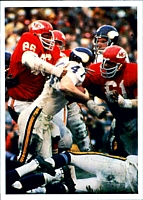
Super Bowl IV was an American football game played on January 11, 1970, at Tulane Stadium in New Orleans, Louisiana. It was the fourth and final AFL–NFL World Championship Game in professional football prior to the AFL–NFL merger taking effect the following season. The American Football League (AFL) champion Kansas City Chiefs defeated the National Football League (NFL) champion Minnesota Vikings by the score of 23–7. This victory by the AFL squared the Super Bowl series with the NFL at two games apiece as the two leagues merged after the game.
Despite the AFL's New York Jets winning the previous season's Super Bowl, many sports writers and fans thought it was a fluke and continued to believe that the NFL was still superior to the AFL, and thus fully expected the Vikings to defeat the Chiefs; the Vikings entered the Super Bowl as 13½ point favorites. The Vikings posted a 12–2 record in 1969, then defeated the Los Angeles Rams 23–20 for the Western Conference title, and the Cleveland Browns 27–7 in the NFL Championship Game. The Chiefs, who previously appeared in the first Super Bowl, finished the regular season at 11–3; they continued with two road wins in the AFL playoffs, dethroning the New York Jets 13–6, and then taking down division rival Oakland Raiders 17–7 in the final AFL title game.
Under wet conditions, the Chiefs defense dominated Super Bowl IV by limiting the Vikings' offense to only 67 rushing yards, forcing three interceptions, and recovering two fumbles. The Chiefs' Len Dawson became the fourth consecutive winning quarterback to be named Super Bowl MVP. He completed 12 of 17 passes for 142 yards and one touchdown, with one interception. Dawson also recorded three rushing attempts for 11 yards.
Super Bowl IV is also notable for NFL Films miking up the Chiefs' Hank Stram during the game, the first time that a head coach had worn a microphone during a Super Bowl.
The NFL awarded Super Bowl IV to New Orleans on March 19, 1969, at the owners' meetings held in Palm Springs, California. It marked the first of eleven (as of 2024) Super Bowls to be held in New Orleans. Two cites were in consideration for the game, Miami being the other. After two consecutive Super Bowls played at the Miami Orange Bowl (II and III), owners by a roughly three-quarters vote, opted out of giving Miami the game for a third straight year. Some owners felt that since an AFL town had hosted the game two years in a row, that an NFL town should get another turn to balance out the hosting duties. New Orleans mayor Victor H. Schiro was joined by George W. Healy Jr. (editor of the Times-Picayune) and Al Hirt. They highlighted the superior seating capacity (80,982) of Tulane Stadium, as well as the local accommodations. Healy and Miami mayor Stephen P. Clark became locked in a debate during a press conference while the deliberation and voting was going on behind closed doors.
The Minnesota Vikings, led by head coach Bud Grant, entered the game with an NFL best 12–2 regular season record, leading the older league in total points scored (379) and fewest points allowed (133). They had scored 50 or greater points in three different games. They lost their first and last games of the season, but in between had 12 straight victories, the longest single-season winning streak in 35 years. The Vikings broke the previous record of 11 consecutive wins set by the 1964 Colts. Their defense, considered the most intimidating in the NFL, was anchored by a defensive line nicknamed the "Purple People Eaters", consisting of defensive tackles Gary Larsen and Alan Page, and defensive ends Carl Eller and Jim Marshall. The secondary was led by Bobby Bryant (8 interceptions, 97 return yards), Earsell Mackbee (6 interceptions, 100 return yards), and Paul Krause (5 interceptions, 82 return yards, 1 touchdown).
On offense, quarterback Joe Kapp was known for his superb leadership and his running ability, both throwing on the run and running for extra yards. And when Kapp did take off and run, instead of sliding when he was about to be tackled like most quarterbacks, he lowered his shoulder and went right at the tackler. This style of play earned him the nickname "Indestructible". In the NFL Championship Game against the Cleveland Browns, he collided with linebacker Jim Houston while running for a first down, and Houston had to be helped off the field after the play ended. Also, Kapp was known for being an extremely unselfish leader: when he was voted the Vikings Most Valuable Player, he turned the award down and said that every player on the team was equally valuable: "There is no one most valuable Viking. There are 40 most valuable Vikings."
Running back Dave Osborn was the team's top rusher with 643 yards and seven touchdowns. He also caught 22 passes for 236 yards and another touchdown. In the passing game, Pro Bowl wide receiver Gene Washington averaged 21.1 yards per catch by recording 821 yards and nine touchdowns from 39 receptions. Wide receiver John Henderson caught 34 passes for 553 yards and 5 touchdowns. The Vikings' offensive line was anchored by Pro Bowlers Grady Alderman and Mick Tingelhoff.
Hub AI
Super Bowl IV AI simulator
(@Super Bowl IV_simulator)
Super Bowl IV
Super Bowl IV was an American football game played on January 11, 1970, at Tulane Stadium in New Orleans, Louisiana. It was the fourth and final AFL–NFL World Championship Game in professional football prior to the AFL–NFL merger taking effect the following season. The American Football League (AFL) champion Kansas City Chiefs defeated the National Football League (NFL) champion Minnesota Vikings by the score of 23–7. This victory by the AFL squared the Super Bowl series with the NFL at two games apiece as the two leagues merged after the game.
Despite the AFL's New York Jets winning the previous season's Super Bowl, many sports writers and fans thought it was a fluke and continued to believe that the NFL was still superior to the AFL, and thus fully expected the Vikings to defeat the Chiefs; the Vikings entered the Super Bowl as 13½ point favorites. The Vikings posted a 12–2 record in 1969, then defeated the Los Angeles Rams 23–20 for the Western Conference title, and the Cleveland Browns 27–7 in the NFL Championship Game. The Chiefs, who previously appeared in the first Super Bowl, finished the regular season at 11–3; they continued with two road wins in the AFL playoffs, dethroning the New York Jets 13–6, and then taking down division rival Oakland Raiders 17–7 in the final AFL title game.
Under wet conditions, the Chiefs defense dominated Super Bowl IV by limiting the Vikings' offense to only 67 rushing yards, forcing three interceptions, and recovering two fumbles. The Chiefs' Len Dawson became the fourth consecutive winning quarterback to be named Super Bowl MVP. He completed 12 of 17 passes for 142 yards and one touchdown, with one interception. Dawson also recorded three rushing attempts for 11 yards.
Super Bowl IV is also notable for NFL Films miking up the Chiefs' Hank Stram during the game, the first time that a head coach had worn a microphone during a Super Bowl.
The NFL awarded Super Bowl IV to New Orleans on March 19, 1969, at the owners' meetings held in Palm Springs, California. It marked the first of eleven (as of 2024) Super Bowls to be held in New Orleans. Two cites were in consideration for the game, Miami being the other. After two consecutive Super Bowls played at the Miami Orange Bowl (II and III), owners by a roughly three-quarters vote, opted out of giving Miami the game for a third straight year. Some owners felt that since an AFL town had hosted the game two years in a row, that an NFL town should get another turn to balance out the hosting duties. New Orleans mayor Victor H. Schiro was joined by George W. Healy Jr. (editor of the Times-Picayune) and Al Hirt. They highlighted the superior seating capacity (80,982) of Tulane Stadium, as well as the local accommodations. Healy and Miami mayor Stephen P. Clark became locked in a debate during a press conference while the deliberation and voting was going on behind closed doors.
The Minnesota Vikings, led by head coach Bud Grant, entered the game with an NFL best 12–2 regular season record, leading the older league in total points scored (379) and fewest points allowed (133). They had scored 50 or greater points in three different games. They lost their first and last games of the season, but in between had 12 straight victories, the longest single-season winning streak in 35 years. The Vikings broke the previous record of 11 consecutive wins set by the 1964 Colts. Their defense, considered the most intimidating in the NFL, was anchored by a defensive line nicknamed the "Purple People Eaters", consisting of defensive tackles Gary Larsen and Alan Page, and defensive ends Carl Eller and Jim Marshall. The secondary was led by Bobby Bryant (8 interceptions, 97 return yards), Earsell Mackbee (6 interceptions, 100 return yards), and Paul Krause (5 interceptions, 82 return yards, 1 touchdown).
On offense, quarterback Joe Kapp was known for his superb leadership and his running ability, both throwing on the run and running for extra yards. And when Kapp did take off and run, instead of sliding when he was about to be tackled like most quarterbacks, he lowered his shoulder and went right at the tackler. This style of play earned him the nickname "Indestructible". In the NFL Championship Game against the Cleveland Browns, he collided with linebacker Jim Houston while running for a first down, and Houston had to be helped off the field after the play ended. Also, Kapp was known for being an extremely unselfish leader: when he was voted the Vikings Most Valuable Player, he turned the award down and said that every player on the team was equally valuable: "There is no one most valuable Viking. There are 40 most valuable Vikings."
Running back Dave Osborn was the team's top rusher with 643 yards and seven touchdowns. He also caught 22 passes for 236 yards and another touchdown. In the passing game, Pro Bowl wide receiver Gene Washington averaged 21.1 yards per catch by recording 821 yards and nine touchdowns from 39 receptions. Wide receiver John Henderson caught 34 passes for 553 yards and 5 touchdowns. The Vikings' offensive line was anchored by Pro Bowlers Grady Alderman and Mick Tingelhoff.