
Recent from talks
Supermaneuverability
Knowledge base stats:
Talk channels stats:
Members stats:
Supermaneuverability
Supermaneuverability is the capability of fighter aircraft to execute tactical maneuvers that are not possible with purely aerodynamic techniques. Such maneuvers can involve controlled side-slipping or angles of attack beyond maximum lift.
This capability was researched beginning in 1975 at the Langley Research Center in the United States, and eventually resulted in the development of the McDonnell Douglas F-15 STOL/MTD as a proof of concept aircraft. The Saab 35 Draken was another early aircraft with limited supermaneuverable capabilities.
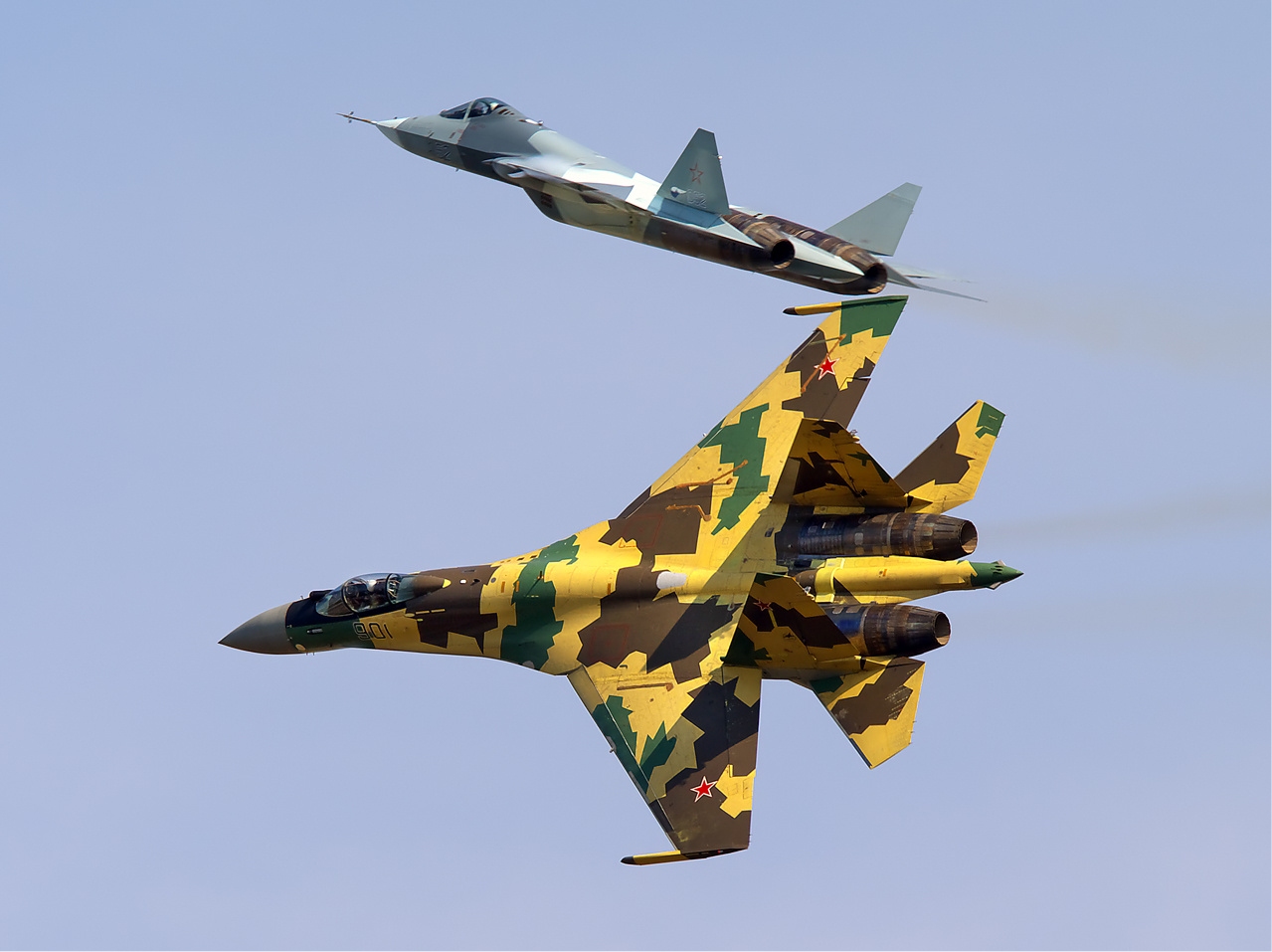
In 1983, the MiG-29 and in 1986, the Sukhoi Su-27 were deployed with this capability, which has since become standard in all of Russia's fourth- and fifth-generation aircraft. There has been some speculation, but the mechanism behind the supermaneuverability of the Russian-built aircraft has not been publicly disclosed. However, post-stall analyses have been increasingly used in recent years to advance maneuverability via the use of thrust vectoring engine nozzles.
The USAF abandoned the concept as counter-productive to BVR engagements as the Cobra maneuver leaves the aircraft in a state of near-zero energy, having bled off most of its speed without gaining any compensating altitude in the process. Except in one-on-one engagements, this leaves the aircraft very vulnerable to both missile and gun attack by a wingman or other hostile, even if the initial threat overshoots the supermaneuvered aircraft.[citation needed]
Traditional aircraft maneuvering is accomplished by altering the flow of air passing over the control surfaces of the aircraft—the ailerons, elevators, flaps, air brakes and rudder. Some of these control surfaces can be combined—such as in the "ruddervators" of a V-tail configuration—but the basic properties are unaffected. When a control surface is moved to present an angle to the oncoming airflow, it alters the airflow around the surface, changing its pressure distribution, and thus applying a pitching, rolling, or yawing moment to the aircraft.
The angle of control surface deflection and resulting directional force on the aircraft are controlled both by the pilot and the aircraft's inbuilt control systems to maintain the desired attitude, such as pitch, roll and heading, and also to perform aerobatic maneuvers that rapidly change the aircraft's attitude. For traditional maneuvering control to be maintained, the aircraft must maintain sufficient forward velocity and a sufficiently low angle of attack to provide airflow over the wings (maintaining lift) and also over its control surfaces.
As airflow decreases so does effectiveness of the control surfaces and thus the maneuverability. If the angle of attack exceeds its critical value, the airplane will stall. Pilots are trained to avoid stalls during aerobatic maneuvering and especially in combat, as a stall can permit an opponent to gain an advantageous position while the stalled aircraft's pilot attempts to recover.
The speed at which an aircraft is capable of its maximum aerodynamic maneuverability is known as the corner airspeed; at any greater speed the control surfaces cannot operate at maximum effect due to either airframe stresses or induced instability from turbulent airflow over the control surface. At lower speeds the redirection of air over control surfaces, and thus the force applied to maneuver the aircraft, is reduced below the airframe's maximum capacity and thus the aircraft will not turn at its maximum rate. It is therefore desirable in aerobatic maneuvering to maintain corner velocity.
Hub AI
Supermaneuverability AI simulator
(@Supermaneuverability_simulator)
Supermaneuverability
Supermaneuverability is the capability of fighter aircraft to execute tactical maneuvers that are not possible with purely aerodynamic techniques. Such maneuvers can involve controlled side-slipping or angles of attack beyond maximum lift.
This capability was researched beginning in 1975 at the Langley Research Center in the United States, and eventually resulted in the development of the McDonnell Douglas F-15 STOL/MTD as a proof of concept aircraft. The Saab 35 Draken was another early aircraft with limited supermaneuverable capabilities.
In 1983, the MiG-29 and in 1986, the Sukhoi Su-27 were deployed with this capability, which has since become standard in all of Russia's fourth- and fifth-generation aircraft. There has been some speculation, but the mechanism behind the supermaneuverability of the Russian-built aircraft has not been publicly disclosed. However, post-stall analyses have been increasingly used in recent years to advance maneuverability via the use of thrust vectoring engine nozzles.
The USAF abandoned the concept as counter-productive to BVR engagements as the Cobra maneuver leaves the aircraft in a state of near-zero energy, having bled off most of its speed without gaining any compensating altitude in the process. Except in one-on-one engagements, this leaves the aircraft very vulnerable to both missile and gun attack by a wingman or other hostile, even if the initial threat overshoots the supermaneuvered aircraft.[citation needed]
Traditional aircraft maneuvering is accomplished by altering the flow of air passing over the control surfaces of the aircraft—the ailerons, elevators, flaps, air brakes and rudder. Some of these control surfaces can be combined—such as in the "ruddervators" of a V-tail configuration—but the basic properties are unaffected. When a control surface is moved to present an angle to the oncoming airflow, it alters the airflow around the surface, changing its pressure distribution, and thus applying a pitching, rolling, or yawing moment to the aircraft.
The angle of control surface deflection and resulting directional force on the aircraft are controlled both by the pilot and the aircraft's inbuilt control systems to maintain the desired attitude, such as pitch, roll and heading, and also to perform aerobatic maneuvers that rapidly change the aircraft's attitude. For traditional maneuvering control to be maintained, the aircraft must maintain sufficient forward velocity and a sufficiently low angle of attack to provide airflow over the wings (maintaining lift) and also over its control surfaces.
As airflow decreases so does effectiveness of the control surfaces and thus the maneuverability. If the angle of attack exceeds its critical value, the airplane will stall. Pilots are trained to avoid stalls during aerobatic maneuvering and especially in combat, as a stall can permit an opponent to gain an advantageous position while the stalled aircraft's pilot attempts to recover.
The speed at which an aircraft is capable of its maximum aerodynamic maneuverability is known as the corner airspeed; at any greater speed the control surfaces cannot operate at maximum effect due to either airframe stresses or induced instability from turbulent airflow over the control surface. At lower speeds the redirection of air over control surfaces, and thus the force applied to maneuver the aircraft, is reduced below the airframe's maximum capacity and thus the aircraft will not turn at its maximum rate. It is therefore desirable in aerobatic maneuvering to maintain corner velocity.
Recent media