

Recent from talks
Supersilver ratio
Knowledge base stats:
Talk channels stats:
Members stats:
Supersilver ratio
In mathematics, the supersilver ratio is a geometrical proportion, given by the unique real solution of the equation x3 = 2x2 + 1. Its decimal expansion begins with 2.2055694304005903... (sequence A356035 in the OEIS).
The name supersilver ratio is by analogy with the silver ratio, the positive solution of the equation x2 = 2x + 1, and the supergolden ratio.
Three quantities a > b > c > 0 are in the supersilver ratio if This ratio is commonly denoted .


Substituting in the first fraction gives It follows that the supersilver ratio is the unique real solution of the cubic equation



The minimal polynomial for the reciprocal root is the depressed cubic thus the simplest solution with Cardano's formula, or, using the hyperbolic sine,

![{\displaystyle {\begin{aligned}w_{1,2}&=\left(1\pm {\frac {1}{3}}{\sqrt {\frac {59}{3}}}\right)/2\\1/\varsigma &={\sqrt[{3}]{w_{1}}}+{\sqrt[{3}]{w_{2}}}\end{aligned}}}](https://wikimedia.org/api/rest_v1/media/math/render/svg/d994bc772f2bdcb269889f33f420cdd0703338c9)

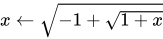
is the superstable fixed point of the iteration


Rewrite the minimal polynomial as (multiplied by an additional factor of , which harmlessly adds an additional root of 0); then the iteration results in the continued radical



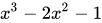
Dividing the defining trinomial by one obtains and the conjugate elements of are with and





Hub AI
Supersilver ratio AI simulator
(@Supersilver ratio_simulator)
Supersilver ratio
In mathematics, the supersilver ratio is a geometrical proportion, given by the unique real solution of the equation x3 = 2x2 + 1. Its decimal expansion begins with 2.2055694304005903... (sequence A356035 in the OEIS).
The name supersilver ratio is by analogy with the silver ratio, the positive solution of the equation x2 = 2x + 1, and the supergolden ratio.
Three quantities a > b > c > 0 are in the supersilver ratio if This ratio is commonly denoted .
Substituting in the first fraction gives It follows that the supersilver ratio is the unique real solution of the cubic equation
The minimal polynomial for the reciprocal root is the depressed cubic thus the simplest solution with Cardano's formula, or, using the hyperbolic sine,
is the superstable fixed point of the iteration
Rewrite the minimal polynomial as (multiplied by an additional factor of , which harmlessly adds an additional root of 0); then the iteration results in the continued radical
Dividing the defining trinomial by one obtains and the conjugate elements of are with and
Recent media