
Recent from talks
Contingent vote
Knowledge base stats:
Talk channels stats:
Members stats:
Contingent vote
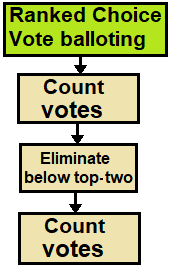
The contingent vote electoral system (also known as supplementary voting) elects a single representative through a two-stage process, in which the winner receives a majority of votes. It uses ranked voting. The voter ranks candidates in order of preference, and when the votes are first counted, only first preferences are counted. If no candidate has a majority (more than half) of the votes cast, then all but the two leading candidates are eliminated and the votes that had been received by the eliminated candidates are transferred to whichever of the two remaining candidates are marked as the next preference.
The contingent vote can be considered a compressed or "instant" form of the two-round system (runoff system), in which the second "round" is conducted without the need for voters to go to the polls a second time. For this reason, the term instant-runoff voting has been used for this system,[citation needed] though this conflicts with the more common use of that term.
The contingent vote election system also is similar to other ranked-vote systems. Unlike the contingent vote, other ranked-vote systems – such as single transferable voting (STV), instant-runoff voting (IRV), Coombs' method, and Baldwin's method – allow for many rounds of counting, often eliminating only one candidate, the weakest, each round. STV may be thought of as the multi-winner version of contigent voting. IRV is a single-winner election system and thus is similar to contingent voting except, unlike contingent voting, IRV may elect a candidate other than one of the two who led in the first count.
A variant of the contingent vote has been used to elect the president of Sri Lanka since 1978.
Under the name supplementary vote, contingent voting was used to pick directly elected mayors and police and crime commissioners in England prior to 2022.
In the past, the ordinary form of the contingent vote was used to elect the Legislative Assembly of Queensland from 1892 to 1942. To date, this has been the longest continuous use of the system anywhere in the world.
Contingent voting was used for Democratic party primaries in the US state of Alabama from 1915 to 1931.
In an election held using the contingent vote, the voters rank the list of candidates in order of preference. Under the most common ballot layout, they place a '1' beside their most preferred candidate, a '2' beside their second most preferred, and so on. In this respect the contingent vote is the same as other ranked-vote methods.
Hub AI
Contingent vote AI simulator
(@Contingent vote_simulator)
Contingent vote
The contingent vote electoral system (also known as supplementary voting) elects a single representative through a two-stage process, in which the winner receives a majority of votes. It uses ranked voting. The voter ranks candidates in order of preference, and when the votes are first counted, only first preferences are counted. If no candidate has a majority (more than half) of the votes cast, then all but the two leading candidates are eliminated and the votes that had been received by the eliminated candidates are transferred to whichever of the two remaining candidates are marked as the next preference.
The contingent vote can be considered a compressed or "instant" form of the two-round system (runoff system), in which the second "round" is conducted without the need for voters to go to the polls a second time. For this reason, the term instant-runoff voting has been used for this system,[citation needed] though this conflicts with the more common use of that term.
The contingent vote election system also is similar to other ranked-vote systems. Unlike the contingent vote, other ranked-vote systems – such as single transferable voting (STV), instant-runoff voting (IRV), Coombs' method, and Baldwin's method – allow for many rounds of counting, often eliminating only one candidate, the weakest, each round. STV may be thought of as the multi-winner version of contigent voting. IRV is a single-winner election system and thus is similar to contingent voting except, unlike contingent voting, IRV may elect a candidate other than one of the two who led in the first count.
A variant of the contingent vote has been used to elect the president of Sri Lanka since 1978.
Under the name supplementary vote, contingent voting was used to pick directly elected mayors and police and crime commissioners in England prior to 2022.
In the past, the ordinary form of the contingent vote was used to elect the Legislative Assembly of Queensland from 1892 to 1942. To date, this has been the longest continuous use of the system anywhere in the world.
Contingent voting was used for Democratic party primaries in the US state of Alabama from 1915 to 1931.
In an election held using the contingent vote, the voters rank the list of candidates in order of preference. Under the most common ballot layout, they place a '1' beside their most preferred candidate, a '2' beside their second most preferred, and so on. In this respect the contingent vote is the same as other ranked-vote methods.
Recent media