
Contingent vote
View on Wikipedia

| A joint Politics and Economics series |
| Social choice and electoral systems |
|---|
 |
 Mathematics portal Mathematics portal |


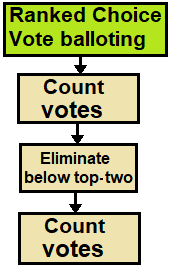
The contingent vote electoral system (also known as supplementary voting)[1] elects a single representative through a two-stage process, in which the winner receives a majority of votes. It uses ranked voting. The voter ranks candidates in order of preference, and when the votes are first counted, only first preferences are counted. If no candidate has a majority (more than half) of the votes cast, then all but the two leading candidates are eliminated and the votes that had been received by the eliminated candidates are transferred to whichever of the two remaining candidates are marked as the next preference.
The contingent vote can be considered a compressed or "instant" form of the two-round system (runoff system), in which the second "round" is conducted without the need for voters to go to the polls a second time. For this reason, the term instant-runoff voting has been used for this system,[citation needed] though this conflicts with the more common use of that term.
The contingent vote election system also is similar to other ranked-vote systems. Unlike the contingent vote, other ranked-vote systems – such as single transferable voting (STV), instant-runoff voting (IRV), Coombs' method, and Baldwin's method – allow for many rounds of counting, often eliminating only one candidate, the weakest, each round. STV may be thought of as the multi-winner version of contigent voting. IRV is a single-winner election system and thus is similar to contingent voting except, unlike contingent voting, IRV may elect a candidate other than one of the two who led in the first count.
Usage
[edit]A variant of the contingent vote has been used to elect the president of Sri Lanka since 1978.[2]
Under the name supplementary vote, contingent voting was used to pick directly elected mayors and police and crime commissioners in England prior to 2022.[2]
In the past, the ordinary form of the contingent vote was used to elect the Legislative Assembly of Queensland from 1892 to 1942. To date, this has been the longest continuous use of the system anywhere in the world.[2]
Contingent voting was used for Democratic party primaries in the US state of Alabama from 1915 to 1931.[2]
Voting and counting
[edit]
In an election held using the contingent vote, the voters rank the list of candidates in order of preference. Under the most common ballot layout, they place a '1' beside their most preferred candidate, a '2' beside their second most preferred, and so on. In this respect the contingent vote is the same as other ranked-vote methods.
Contingent voting entails a maximum of two rounds of counting. In the first round only first preferences are counted. Candidates receiving an absolute majority of first preferences (i.e. more than half) are immediately declared the winner, and the vote count process ends. However, if no candidate has a majority, then all but the two candidates with the most first preferences are eliminated, and the votes of the voters whose first preferences have been eliminated are transferred to whichever of the two remaining candidates they ranked the highest. The vote tallies of the two remaining candidates are then compared, and whichever candidate has the most (a majority) is declared elected.
Variants
[edit]The supplementary vote and the Sri Lankan contingent vote are two implementation variations, in which voters cannot rank all of the candidates but rather are only permitted to express two or three preferences, respectively.
This means that if a voter's marked preferences do not include either of the candidates who survive to the second round, then it will be impossible to transfer the vote, which is therefore declared "wasted" or "exhausted".
Sri Lankan contingent vote
[edit]In Sri Lanka, since the 1982 presidential election, a variant of the contingent vote electoral system is used to elect the country's president. As under the conventional contingent vote, in an election held using the Sri Lankan form of the contingent vote each voter ranks the candidates in order of preference, and if no candidate receives an overall majority of first preference votes on the first count then all but the two leading candidates are eliminated and their votes redistributed to help determine a winner in a second and final round. However, whereas under the ordinary form of the contingent vote voters can rank all of the candidates in order of preference, under Sri Lankan contingent voting the voter can only express their top three preferences (which can lead to exhausted ballots). Each direct presidential election going back to the first in 1981 had seen a candidate from one of the two major parties or alliances at the time winning in the first count so the second round of vote counting had never been conducted.[3] However, in the 2024 presidential election, the strong third-party candidacy of Anura Kumara Dissanayake, who won 42% of the first preference vote, forced a second round of counting for the first time in the nation's history. Dissanayake went on to win the election in the second round.[4][5]
Supplementary vote
[edit]| Two column | Single column |
|---|---|
 Each voter ranks at least one and no more than two candidates by placing an 'X' in one column to indicate their first choice of candidate and another 'X' in a second column to indicate their second choice of candidate. |
 A less common form is to print a single column on the ballot paper and require voters to write '1' next to their first preference and '2' next to their second.[a] |
The supplementary vote (SV) is a variation of the contingent vote in which the voter ranks only two of the candidates in order of preference. If a voter's first-choice candidate is eliminated but their second choice is one of the two remaining candidates, their vote is transferred to the second-choice candidate. This means that the winning candidate has the support of a majority of voters who expressed a preference among the top two, although not necessarily a majority of votes cast in the first count.
The supplementary vote was used in all elections for directly elected mayors in England, including the Mayor of London, and in elections for police and crime commissioners, until 2022, when it was replaced by first-past-the-post voting (FPTP).
History and use
[edit]In the early 1990s, the Plant Commission was established by the Labour Party to recommend a new voting system for the Parliament of the United Kingdom. When the Commission reported in 1993, instead of suggesting an already existing system, it recommended the supplementary vote system, which it said had never been used anywhere. In actuality, contingent voting had been used in Australia as early as 1892.[2]
Although some commentators credit the head of the commission, Raymond Plant, with the invention of SV, according to others, it was the brainchild of a Labour member of Parliament (MP) at the time, Dale Campbell-Savours and academic Patrick Dunleavy, who outlined and advocated for it in an article for the New Statesman magazine that was published September 29, 1989.[6]
In 2000, several districts in England introduced directly elected mayors. It was decided to use the supplementary vote for the election of these new mayors, including the Mayor of London, and for the election of police and crime commissioners across much of England and Wales.[7] The supplementary vote was used for these offices from 2000 to 2022.
In the 2021 London election, a record 5 percent of ballots were wholly rejected, and no candidate achieved a majority of the vote.[8] The government responded by ending the use of the supplementary vote in 2022,[9] citing voter confusion with a complex system. However, critics, including the Labour and Green parties, argued that the wasted votes were due to ballot layout and that the change was aimed at benefitting Conservative Party candidates.[10][11][12] They also claimed that the supplementary vote was effective in increasing multi-party participation and was popular among voters.[13]
In July 2025, the British government published the English Devolution and Community Empowerment Bill, which if passed will revert mayoral elections, along with police and crime commissioner elections, back to the supplementary voting election system.[14][15]
The histories of two-round voting and other forms of instant run-off voting may be seen as part of the history of SV due to their similarities.
Impact on factions and candidates
[edit]The supplementary vote is said to encourage candidates to seek support beyond their core base of supporters in order to secure the second preferences of the supporters of other candidates, and so to create a more conciliatory campaigning style among candidates with similar policy platforms. SV is also likely to improve the chances of "third party" candidates by encouraging voters, who wish to do so, to vote sincerely for such candidates for whom, under systems such as first-past-the-post, they would be discouraged from doing so for tactical reasons.
These positive effects are moderated by the incentives SV creates for voting, in some circumstances, for only candidates from among the leading three.
Political scientists Colin Rallings and Michael Thrasher noted two flaws of SV:[16]
- First, since the automatic dual-ballot nature of SV dispenses with any need for a runoff two weeks later – as often happens for, say, the election of the president of France – voters cast their second preferences without being certain of which candidates will make the runoff. Consequently, some second preferences will be declared invalid because they bear only preferences marked for eliminated candidates.
- Second, it is possible for the victor to fail to achieve an absolute majority overall, for it is not an obligation for a voter to cast a second preference, and even when a second preference is marked, the vote will be ineffective if it is cast for a candidate who does not make it into the top two, when the first preference is marked also for a candidate who does not make it into the second round.
Similar systems
[edit]Two-round system
[edit]Under a two-round system (also known as runoff voting and the second ballot and nonpartisan primary) voters vote for only a single candidate, rather than ranking candidates in order of preference. As under the contingent vote, if no candidate has an absolute majority in the first round, all but the top two are eliminated and there is a second round. However, in the two round system, voters are asked to return and vote a second time. Because of the similarities between them, the contingent vote and the two-round system can usually be expected to elect the same winner. However, in the two-round system, the voter is permitted to change one's mind from one round to another, even if their favourite candidate in the first round has not been eliminated. It also guarantees that every voter has a chance to express a preference between the top two, unlike the limited forms of contingent vote. Voter turnout may also be higher in the second vote.
Top-four primary
[edit]The top-four primary is a variant of the nonpartisan primary which advances the top four candidates from a single primary, regardless of party, and uses instant-runoff voting in the general election to pick a majority winner.
Instant-runoff voting
[edit]As noted above, the instant-runoff voting (or alternative vote) differs from the contingent vote in that it permits several rounds rather than just two. Under the alternative vote only candidate(s) for whom it is mathematically impossible to win are eliminated after each round, and as many rounds occur as are necessary to give one candidate an absolute majority. These differences mean that the contingent vote and alternative vote can produce different results. Because, under the contingent vote, all but two candidates are eliminated in the first round, it is possible for a candidate to be eliminated who would have gone on to win had they been allowed to receive transfers in later rounds.
See also
[edit]Notes
[edit]- ^ This form was used to elect the Mayor of Newham in the 2006 election.
References
[edit]- ^ https://www.electoral-reform.org.uk/voting-systems/types-of-voting-system/supplementary-vote/
- ^ a b c d e Bowler, Shaun; Grofman, Bernard Norman (2000). "The Single Transferable Vote and the Alternative Vote Compared". Elections in Australia, Ireland, and Malta under the Single Transferable Vote: Reflections on an Embedded Institution. University of Michigan Press. p. 40. doi:10.3998/mpub.16507. ISBN 978-0-472-02681-4.
The contingent vote ... was used in Queensland from 1892 to 1942 and for Democratic primary elections in the U.S. state of Alabama between 1915 and 1931. It has been used for presidential elections in Sri Lanka since 1978 and in 1996 ... the United Kingdom ... called it the "supplementary vote."
- ^ Gajanayake, Manjula; Siriwardana, Thusitha; Isuranga, Hirantha; Jayasinghe, Pasan (2019). "2019 Sri Lankan Presidential Election: Election Observation Report" (PDF). Centre for Monitoring Election Violence. Retrieved July 21, 2022.
- ^ "The Incumbent, the Marxist and the Heir: Sri Lanka's Tight Race for President". New York Times. 2024. Retrieved December 15, 2024.
- ^ "Left-leaning leader wins Sri Lanka election in political paradigm shift". British Broadcasting Corporation. 2024. Retrieved December 15, 2024.
- ^ "Supplementary fudge | Fabian Society". March 21, 2024.
- ^ "Supplementary Voting".
- ^ "London elections 2021: Record number of mayoral votes rejected". May 10, 2021.
- ^ "First Past the Post to be introduced for all local mayoral and police and crime commissioner elections".
- ^ "London mayoral election to be changed to First Past the Post system under Government plans". March 17, 2021.
- ^ "'Make Every Vote Matter' Says Green Party". June 19, 2021.
- ^ "A big change is coming to how we vote for the next Mayor of London". April 7, 2022.
- ^ "Priti Patel under fire over plan to change voting system for London mayor". Independent.co.uk. March 16, 2021.
- ^ https://www.local.gov.uk/parliament/briefings-and-responses/english-devolution-and-community-empowerment-bill-lga-policy
- ^ https://electoral-reform.org.uk/government-decision-to-restore-supplementary-vote-system-elections-is-a-big-win-for-voters/
- ^ Rallings, Colin; Thrasher, Michael; Cowling, David (2002). "Mayoral Referendums and Elections". Local Government Studies. 28 (4): 67–90. doi:10.1080/714004163. S2CID 155007579.
External links
[edit]Contingent vote
View on GrokipediaHistorical Development
Origins and Early Proposals
The contingent vote emerged conceptually in the mid-19th century as reformers sought to remedy the spoiler effects inherent in plurality voting, where vote-splitting among similar candidates could enable a non-majority winner disfavored by most voters. British barrister Thomas Hare, in his 1857 book The Election of Representatives, Parliamentary and Municipal, introduced elements of preferential voting, including the notion of contingent secondary preferences that could transfer support from eliminated candidates, aiming to concentrate voter intent without the complexity of full multi-member proportional systems. Hare argued this approach preserved voter choice while ensuring outcomes aligned more closely with underlying majorities, drawing on first-principles critiques of plurality's failure to aggregate ordinal preferences effectively.[4][5] John Stuart Mill built on these ideas in Considerations on Representative Government (1861), advocating preferential ranking over single-choice ballots to capture comparative voter utilities and reduce strategic voting distortions. Mill contended that plurality systems incentivized insincere voting and underrepresented minority views, whereas preference-based aggregation—limited in scope for practicality—could yield representatives with genuine majority support by redistributing "wasted" votes from unviable options. This reasoning emphasized causal links between ballot design and electoral realism, prioritizing systems that minimized non-monotonic paradoxes observed in empirical plurality contests.[6] Early proponents distinguished contingent vote proposals from comprehensive ranked-choice methods like Hare's single transferable vote, restricting rankings to top preferences (often two or three) to simplify administration and focus on binary majority resolution in single-member districts. Such limitations addressed implementation barriers in 19th-century contexts while targeting plurality's core defect: electing candidates opposed by a majority due to fragmented first preferences. Theoretical advocacy persisted into the late 1880s, influencing colonial legislatures seeking majority-preferring reforms without overhauling districting.[7]Initial Adoptions and Reforms
The contingent vote was first adopted in the Colony of Queensland, Australia, through amendments to the Electoral Bill passed in 1892, introducing an optional second-preference mechanism to supplement first-past-the-post voting in multi-candidate races.[8] This innovation aimed to mitigate vote fragmentation and ensure elected representatives garnered broader support beyond plurality wins, addressing concerns over unstable outcomes in colonial legislatures amid growing multi-party competition.[9] The system required voters to mark a primary choice, with an optional "contingent" second preference; if no candidate secured a majority of first preferences, the lowest-polling candidate was eliminated, and their votes redistributed according to indicated seconds, often resulting in consolidated majorities for frontrunners.[10] Early implementations in Queensland state elections from 1893 onward demonstrated the system's capacity to produce winners with majority support in 60-70% of contested seats, reducing the election of candidates with under 40% primary votes and fostering more moderate outcomes by transferring preferences from eliminated extremes.[11] However, empirical data revealed issues with high exhaustion rates—up to 20% in some electorates—due to voters omitting second preferences, which critics argued undermined decisive results and encouraged strategic non-marking.[12] Reforms culminated in 1942, when Queensland transitioned to the full alternative vote, mandating complete preference rankings across all candidates to minimize exhausted ballots and enhance preference flow completeness, a change prompted by wartime electoral reviews seeking greater efficiency and voter compliance in single-member districts.[11] This adjustment reflected causal lessons from five decades of data, prioritizing exhaustive counting over optional contingents to better align outcomes with voter intent in fragmented fields, though it retained the core elimination-redistribution logic.[10]Mechanics of the System
Ballot Construction and Voter Ranking
In contingent vote systems, ballots direct voters to assign ordinal numbers to candidates, marking 1 for their most preferred choice, 2 for the next, and continuing as desired.[13] This ranking is optional beyond the first preference, permitting partial expressions without requiring exhaustive ordering of all options.[6] Such construction emphasizes voter autonomy while simplifying participation by avoiding mandates for complete rankings. Implementations often constrain the number of allowable preferences to enhance usability. In Sri Lanka's presidential elections, adopted under the 1978 constitution and refined in 1982, voters rank up to three candidates, reflecting a deliberate limit to top preferences.[14] [15] This approach yields high ballot validity, as evidenced by consistent low invalidation rates in Sri Lankan contests, where partial rankings suffice for initial counts and transfers.[16] Empirical data from variant systems underscore the design's accessibility. Under the UK's Supplementary Vote for mayoral elections from 2000 to 2022, where voters marked first and second choices via checkboxes, about 80% of participants in the 2016 London mayoral election supplied a second preference, indicating strong comprehension and completion.[17] [18] Exhaustion rates remained low, with ballots retaining value unless the sole marked preference was eliminated, supporting the system's minimal cognitive demands compared to fuller preferential methods.[19] Ballot designs generally preclude equal preferences, enforcing unique rankings to ensure clear sequential transfers during eliminations.[20] This rigidity curbs strategic ambiguity but may influence voter expression, as individuals cannot indicate ties without invalidating preferences; however, optional ranking mitigates overcommitment, allowing strategic focus on leading contenders.[21]Counting Process and Eliminations
In the contingent vote system, the counting process commences with a tally of all valid first-preference votes cast for each candidate. A candidate who receives more than 50 percent of these votes—constituting an absolute majority—is immediately declared the winner.[22] Absent such a majority, the candidate with the fewest first-preference votes is eliminated. The ballots that ranked the eliminated candidate first are then redistributed to the next sequential preference marked on those ballots, provided that preference is among the remaining candidates; ballots lacking a further usable preference are set aside for that round.[22] A fresh tally of active votes (first preferences plus redistributed ones) is performed among the surviving candidates.[22] This elimination and redistribution cycle repeats iteratively: at each subsequent round, the lowest-polling remaining candidate is removed, their votes transferred accordingly, and tallies updated until one candidate garners over 50 percent of the votes still in play.[22] The process leverages full preference orderings to concentrate voter intent, yielding a majority-supported outcome equivalent to a series of pairwise runoffs conducted instantaneously.[23] To illustrate, suppose an election with 17 valid ballots and candidates A, B, C, and D:- Round 1: A receives 6 votes, D 5, C 4, B 2. No majority; B is eliminated. B's voters' second preferences transfer fully to C.
- Round 2: A 6, C 6, D 5. No majority; D eliminated. D's voters' second preferences transfer to C.
- Round 3: A 6, C 11. C achieves majority and wins.