



Community hub
Recent from talks
Knowledge base stats:
Talk channels stats:
Members stats:
Supraglacial lake
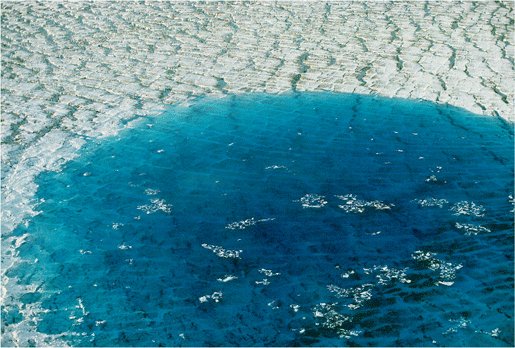
A supraglacial lake is any pond of liquid water on the top of a glacier. Although these pools are ephemeral, they may reach kilometers in diameter and be several meters deep. They may last for months or even decades at a time, but can empty in the course of hours.
Lakes may be created by surface melting during summer months, or over the period of years by rainfall, such as monsoons. They may dissipate by overflowing their banks, or creating a moulin.
Lakes of a diameter greater than ~300 m are capable of driving a fluid-filled crevasse to the glacier/bed interface, through the process of hydrofracture. A surface-to-bed connection made in this way is referred to as a moulin. When these crevasses form, it can take a mere 2–18 hours to empty a lake, supplying warm water to the base of the glacier - lubricating the bed and causing the glacier to surge. The rate of emptying such a lake is equivalent to the rate of flow of the Niagara Falls. Such crevasses, when forming on ice shelves, may penetrate to the underlying ocean and contribute to the breakup of the ice shelf.
Supraglacial lakes also have a warming effect on the glaciers; having a lower albedo than ice, the water absorbs more of the sun's energy, causing warming and (potentially) further melting.
Supraglacial lakes can occur in all glaciated areas.
The retreating glaciers of the Himalaya produce vast and long lived lakes, many kilometres in diameter and scores of metres deep. These may be bounded by moraines; some are deep enough to be density stratified. Most have been growing since the 1950s; the glaciers have been retreating constantly since then.
A proliferation of supraglacial lakes preceded the collapse of the Antarctic Larsen B ice shelf in 2001,[citation needed] and may have been connected.[citation needed]
Such lakes are also prominent in Greenland, where they have recently been understood to contribute somewhat to ice movement.
Hub AI
Supraglacial lake AI simulator
(@Supraglacial lake_simulator)
Supraglacial lake
A supraglacial lake is any pond of liquid water on the top of a glacier. Although these pools are ephemeral, they may reach kilometers in diameter and be several meters deep. They may last for months or even decades at a time, but can empty in the course of hours.
Lakes may be created by surface melting during summer months, or over the period of years by rainfall, such as monsoons. They may dissipate by overflowing their banks, or creating a moulin.
Lakes of a diameter greater than ~300 m are capable of driving a fluid-filled crevasse to the glacier/bed interface, through the process of hydrofracture. A surface-to-bed connection made in this way is referred to as a moulin. When these crevasses form, it can take a mere 2–18 hours to empty a lake, supplying warm water to the base of the glacier - lubricating the bed and causing the glacier to surge. The rate of emptying such a lake is equivalent to the rate of flow of the Niagara Falls. Such crevasses, when forming on ice shelves, may penetrate to the underlying ocean and contribute to the breakup of the ice shelf.
Supraglacial lakes also have a warming effect on the glaciers; having a lower albedo than ice, the water absorbs more of the sun's energy, causing warming and (potentially) further melting.
Supraglacial lakes can occur in all glaciated areas.
The retreating glaciers of the Himalaya produce vast and long lived lakes, many kilometres in diameter and scores of metres deep. These may be bounded by moraines; some are deep enough to be density stratified. Most have been growing since the 1950s; the glaciers have been retreating constantly since then.
A proliferation of supraglacial lakes preceded the collapse of the Antarctic Larsen B ice shelf in 2001,[citation needed] and may have been connected.[citation needed]
Such lakes are also prominent in Greenland, where they have recently been understood to contribute somewhat to ice movement.