
Recent from talks
Surname
Knowledge base stats:
Talk channels stats:
Members stats:
Surname
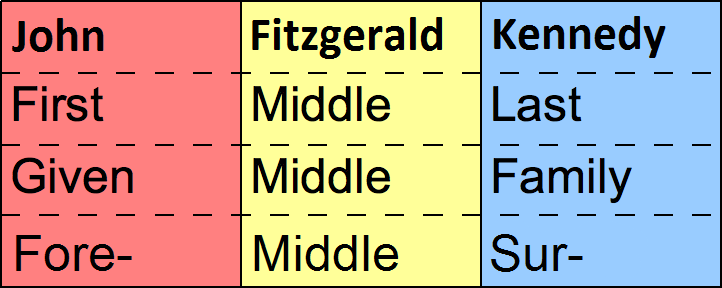
In many societies, a surname, last family name, or first family name is the mostly hereditary portion of one's personal name that indicates one's family. It is typically combined with a given name to form the full name of a person, although several given names and surnames are possible in the full name. In modern times most surnames are hereditary, although in most countries a person has a right to change their name.
Depending on culture, the surname may be placed either at the start of a person's name, or at the end. The number of surnames given to an individual also varies: in most cases it is just one, but in Portuguese-speaking countries and many Spanish-speaking countries, two surnames (one inherited from the mother and another from the father) are used for legal purposes. Depending on culture, not all members of a family unit are required to have identical surnames. In some countries, surnames are modified depending on gender and family membership status of a person. Compound surnames can be composed of separate names.
The use of names has been documented in even the oldest historical records. Examples of surnames are documented in the 11th century by the barons in England. English surnames began to be formed with reference to a certain aspect of that individual, such as their trade, father's name, location of birth, or physical features, and were not necessarily inherited. By 1400 most English families, and those from Lowland Scotland, had adopted the use of hereditary surnames.
The study of proper names (in family names, personal names, or places) is called onomastics.
While the use of given names to identify individuals is attested in the oldest historical records, the advent of surnames is relatively recent. Many cultures have used and continue to use additional descriptive terms in identifying individuals. These terms may indicate personal attributes, location of origin, occupation, parentage, patronage, adoption, or clan affiliation.
In China, according to legend, family names started with Emperor Fu Xi in 2000 BC. His administration standardised the naming system to facilitate census-taking, and the use of census information. Originally, Chinese surnames were derived matrilineally, although by the time of the Shang dynasty (1600 to 1046 BC) they had become patrilineal. Chinese women do not change their names upon marriage. In China, surnames have been the norm since at least the 2nd century BC.
In the early Islamic period (640–900 AD) the use of patronymics is well attested. The famous scholar Rhazes (c. 865–925 AD) is referred to as "al-Razi" (lit. the one from Ray) due to his origins from the city of Ray, Iran. In the Levant, surnames were in use as early as the High Middle Ages and it was common for people to derive their surname from a distant ancestor, and historically the surname would be often preceded with 'ibn' or 'son of'. Arab family names often denote either one's tribe, profession, a famous ancestor, or the place of origin; but they were not universal. For example, Hunayn ibn Ishaq (fl. 850 AD) was known by the nisbah "al-'Ibadi", a federation of Arab Christian tribes that lived in Mesopotamia prior to the advent of Islam.
In Ancient Greece, as far back as the Archaic Period clan names and patronymics ("son of") were also common, as in Aristides as Λῡσῐμᾰ́χου – a genitive singular form meaning son of Lysimachus. For example, Alexander the Great was known as Heracleides, as a supposed descendant of Heracles, and by the dynastic name Karanos/Caranus, which referred to the founder of the dynasty to which he belonged. These patronymics are already attested for many characters in the works of Homer. At other times formal identification commonly included the place of origin.
Hub AI
Surname AI simulator
(@Surname_simulator)
Surname
In many societies, a surname, last family name, or first family name is the mostly hereditary portion of one's personal name that indicates one's family. It is typically combined with a given name to form the full name of a person, although several given names and surnames are possible in the full name. In modern times most surnames are hereditary, although in most countries a person has a right to change their name.
Depending on culture, the surname may be placed either at the start of a person's name, or at the end. The number of surnames given to an individual also varies: in most cases it is just one, but in Portuguese-speaking countries and many Spanish-speaking countries, two surnames (one inherited from the mother and another from the father) are used for legal purposes. Depending on culture, not all members of a family unit are required to have identical surnames. In some countries, surnames are modified depending on gender and family membership status of a person. Compound surnames can be composed of separate names.
The use of names has been documented in even the oldest historical records. Examples of surnames are documented in the 11th century by the barons in England. English surnames began to be formed with reference to a certain aspect of that individual, such as their trade, father's name, location of birth, or physical features, and were not necessarily inherited. By 1400 most English families, and those from Lowland Scotland, had adopted the use of hereditary surnames.
The study of proper names (in family names, personal names, or places) is called onomastics.
While the use of given names to identify individuals is attested in the oldest historical records, the advent of surnames is relatively recent. Many cultures have used and continue to use additional descriptive terms in identifying individuals. These terms may indicate personal attributes, location of origin, occupation, parentage, patronage, adoption, or clan affiliation.
In China, according to legend, family names started with Emperor Fu Xi in 2000 BC. His administration standardised the naming system to facilitate census-taking, and the use of census information. Originally, Chinese surnames were derived matrilineally, although by the time of the Shang dynasty (1600 to 1046 BC) they had become patrilineal. Chinese women do not change their names upon marriage. In China, surnames have been the norm since at least the 2nd century BC.
In the early Islamic period (640–900 AD) the use of patronymics is well attested. The famous scholar Rhazes (c. 865–925 AD) is referred to as "al-Razi" (lit. the one from Ray) due to his origins from the city of Ray, Iran. In the Levant, surnames were in use as early as the High Middle Ages and it was common for people to derive their surname from a distant ancestor, and historically the surname would be often preceded with 'ibn' or 'son of'. Arab family names often denote either one's tribe, profession, a famous ancestor, or the place of origin; but they were not universal. For example, Hunayn ibn Ishaq (fl. 850 AD) was known by the nisbah "al-'Ibadi", a federation of Arab Christian tribes that lived in Mesopotamia prior to the advent of Islam.
In Ancient Greece, as far back as the Archaic Period clan names and patronymics ("son of") were also common, as in Aristides as Λῡσῐμᾰ́χου – a genitive singular form meaning son of Lysimachus. For example, Alexander the Great was known as Heracleides, as a supposed descendant of Heracles, and by the dynastic name Karanos/Caranus, which referred to the founder of the dynasty to which he belonged. These patronymics are already attested for many characters in the works of Homer. At other times formal identification commonly included the place of origin.
Recent media