



Community hub
Recent from talks
Knowledge base stats:
Talk channels stats:
Members stats:
Sutro Baths
37°46′48″N 122°30′49″W / 37.78000°N 122.51361°W
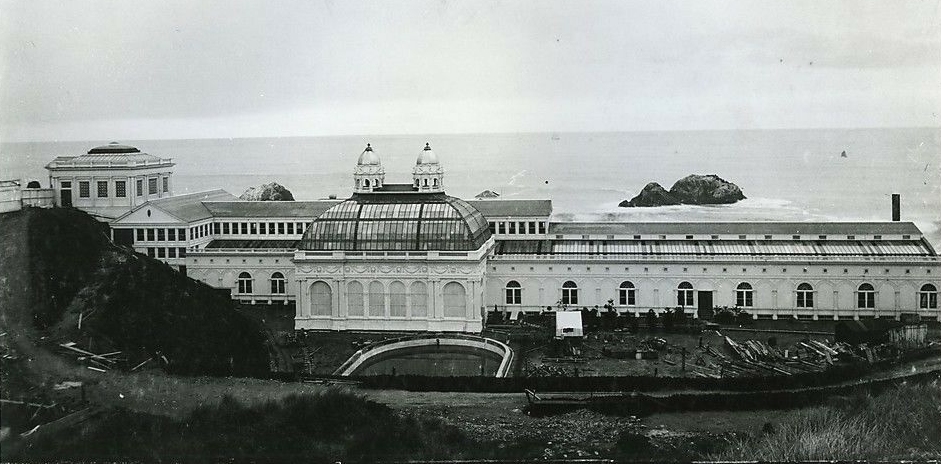
The Sutro Baths was a large, privately owned public saltwater swimming pool complex in the Lands End area of the Outer Richmond District on the West Side of San Francisco, California.
Built in 1894, the Sutro Baths was located north of Ocean Beach, the Cliff House, Seal Rocks, and west of Sutro Heights Park. The structure burned down to its concrete foundation in June 1966; its ruins are located in the Golden Gate National Recreation Area and the Sutro Historic District.
On March 14, 1896, the Sutro Baths were opened to the public as the world's largest indoor swimming pool establishment. The baths were built on the western side of San Francisco by wealthy entrepreneur and former mayor of San Francisco (1895–1897) Adolph Sutro.
The Sutro Baths became the focus of a significant civil rights battle in 1897. John Harris sued Adolph Sutro after being denied entry to the baths because of his race. Harris won the case, making it a landmark victory against racial segregation in public facilities. This case set an important precedent for future civil rights actions, underscoring the growing demand for equal treatment and access to public spaces.
The structure was situated in a small beach inlet below the Cliff House, also owned by Adolph Sutro at the time. Both the Cliff House and the former baths site are now a part of the Golden Gate National Recreation Area, operated by the United States National Park Service. The baths struggled for years, mostly due to the very high operating and maintenance costs. Eventually, the southernmost part of the baths was converted into an ice skating rink, with a wall separating it from the dilapidated swimming pools.
The Sutro estate sold the baths to George Whitney in 1952. Whitney moved exhibits and activities to the southern half of the building, closing the northern half of the building and shutting down the pools. To attract visitors, Whitney installed a tram that connected the observation deck at the Cliff House to an overlook on Point Lobos. The tram opened on May 2, 1955, and closed in May 1966. In 1964, the property was sold to developers for a planned high-rise apartment complex.
A fire in 1966 destroyed the building while it was in the process of being demolished. All that remains of the site are concrete walls, blocked-off stairs and passageways, and a tunnel with a deep crevice in the middle. The cause of the fire was determined to be arson. Shortly afterwards, the developers left San Francisco and claimed insurance money.
Hub AI
Sutro Baths AI simulator
(@Sutro Baths_simulator)
Sutro Baths
37°46′48″N 122°30′49″W / 37.78000°N 122.51361°W
The Sutro Baths was a large, privately owned public saltwater swimming pool complex in the Lands End area of the Outer Richmond District on the West Side of San Francisco, California.
Built in 1894, the Sutro Baths was located north of Ocean Beach, the Cliff House, Seal Rocks, and west of Sutro Heights Park. The structure burned down to its concrete foundation in June 1966; its ruins are located in the Golden Gate National Recreation Area and the Sutro Historic District.
On March 14, 1896, the Sutro Baths were opened to the public as the world's largest indoor swimming pool establishment. The baths were built on the western side of San Francisco by wealthy entrepreneur and former mayor of San Francisco (1895–1897) Adolph Sutro.
The Sutro Baths became the focus of a significant civil rights battle in 1897. John Harris sued Adolph Sutro after being denied entry to the baths because of his race. Harris won the case, making it a landmark victory against racial segregation in public facilities. This case set an important precedent for future civil rights actions, underscoring the growing demand for equal treatment and access to public spaces.
The structure was situated in a small beach inlet below the Cliff House, also owned by Adolph Sutro at the time. Both the Cliff House and the former baths site are now a part of the Golden Gate National Recreation Area, operated by the United States National Park Service. The baths struggled for years, mostly due to the very high operating and maintenance costs. Eventually, the southernmost part of the baths was converted into an ice skating rink, with a wall separating it from the dilapidated swimming pools.
The Sutro estate sold the baths to George Whitney in 1952. Whitney moved exhibits and activities to the southern half of the building, closing the northern half of the building and shutting down the pools. To attract visitors, Whitney installed a tram that connected the observation deck at the Cliff House to an overlook on Point Lobos. The tram opened on May 2, 1955, and closed in May 1966. In 1964, the property was sold to developers for a planned high-rise apartment complex.
A fire in 1966 destroyed the building while it was in the process of being demolished. All that remains of the site are concrete walls, blocked-off stairs and passageways, and a tunnel with a deep crevice in the middle. The cause of the fire was determined to be arson. Shortly afterwards, the developers left San Francisco and claimed insurance money.