


Community hub
Recent from talks
Contribute something to knowledge base
Content stats: 0 posts, 0 articles, 1 media, 0 notes
Members stats: 0 subscribers, 0 contributors, 0 moderators, 0 supporters
Subscribers
Supporters
Contributors
Moderators
Hub AI
Suzuka Circuit AI simulator
(@Suzuka Circuit_simulator)
Hub AI
Suzuka Circuit AI simulator
(@Suzuka Circuit_simulator)
Suzuka Circuit
The Suzuka International Racing Course (Japanese: 鈴鹿国際レーシングコース, Hepburn: Suzuka Kokusai Rēsingu Kōsu), a.k.a. the Suzuka Circuit (鈴鹿サーキット, Suzuka Sākitto), is a 5.807 km (3.608 mi) long motorsport race track located in Ino, Suzuka City, Mie Prefecture, Japan and operated by Honda Mobilityland, a subsidiary of Honda Motor Co, Ltd. It has a capacity of 155,000. It is most well known for its use in the international Formula One and Japanese Super Formula championships.
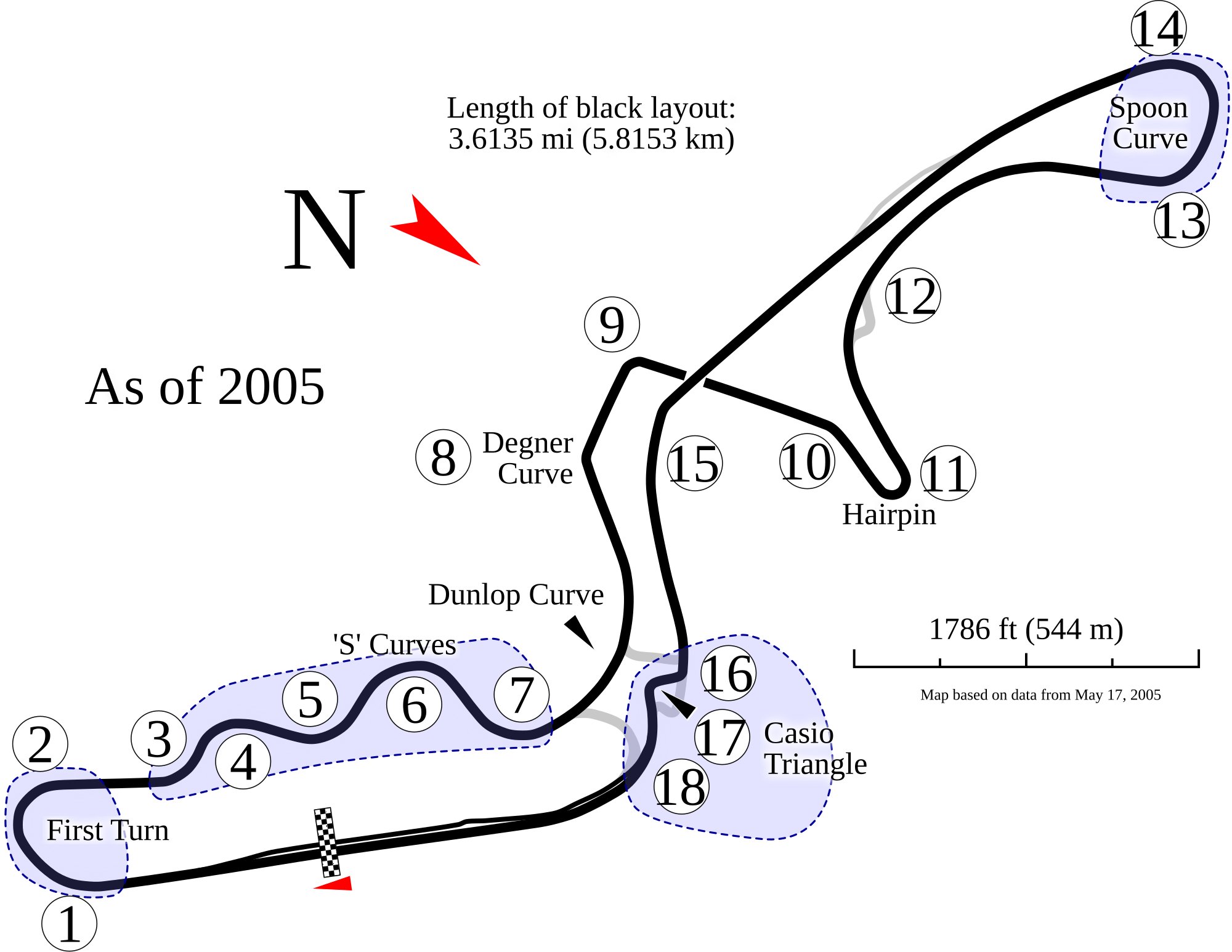
Soichiro Honda decided to develop a new permanent circuit in Mie prefecture in the late 1950s. Designed as a Honda test track in 1962 by Dutchman John "Hans" Hugenholtz, the track has a figure-of-eight layout, with the 1.2 km (0.75 mi) long back straight passing over the front section by means of an overpass. It is the only FIA Grade 1 licensed track to have such a layout, after the Fiorano Circuit was downgraded to Grade 2 in 2024.
The circuit has been modified at least eight times:
In 1983 a chicane was inserted at the last curve to slow the cars into the pit straight; the original circuit was an extremely fast track with only one slow corner; without the Casio chicane some cars would go through the final long right-hand corner flat out and then would go past the pits at more than 200 mph (320 km/h). In 1984 the first part of Spoon was made slightly slower and the corner was brought closer to the track to expand run-off area there, and in 1985 the first corner was made slightly slower.
In 1987 the circuit was brought up to F1 and Grand Prix motorcycle standards for both Japanese Grands Prix of their respective championships, the F1 Grand Prix being the first held at Suzuka. The Degner curve was made into two corners instead of one long curve, and more crash barriers, more run-off areas were added, exposed vegetation was barricaded off and straw bales were removed (but still used for the Japanese motorcycle Grand Prix).
In 2002, the chicane was slightly modified, 130R (marked as 15 on the diagram) was also modified and some of the snake curves were made a bit straighter and faster; additionally, the runoff area at the Dunlop Curve was doubled from 12 to 25 m (39 to 82 ft), and the corner itself was made slightly tighter.
In 2003, the chicane was made slightly faster and closer to the 130R.
Following the death of Daijiro Kato at the 2003 Japanese motorcycle Grand Prix, Suzuka reconfigured the motorcycle variant of what is now known as the Hitachi Automotive Systems Chicane before the final turn, and added a second chicane, between the hairpin and 200R.
Suzuka Circuit
The Suzuka International Racing Course (Japanese: 鈴鹿国際レーシングコース, Hepburn: Suzuka Kokusai Rēsingu Kōsu), a.k.a. the Suzuka Circuit (鈴鹿サーキット, Suzuka Sākitto), is a 5.807 km (3.608 mi) long motorsport race track located in Ino, Suzuka City, Mie Prefecture, Japan and operated by Honda Mobilityland, a subsidiary of Honda Motor Co, Ltd. It has a capacity of 155,000. It is most well known for its use in the international Formula One and Japanese Super Formula championships.
Soichiro Honda decided to develop a new permanent circuit in Mie prefecture in the late 1950s. Designed as a Honda test track in 1962 by Dutchman John "Hans" Hugenholtz, the track has a figure-of-eight layout, with the 1.2 km (0.75 mi) long back straight passing over the front section by means of an overpass. It is the only FIA Grade 1 licensed track to have such a layout, after the Fiorano Circuit was downgraded to Grade 2 in 2024.
The circuit has been modified at least eight times:
In 1983 a chicane was inserted at the last curve to slow the cars into the pit straight; the original circuit was an extremely fast track with only one slow corner; without the Casio chicane some cars would go through the final long right-hand corner flat out and then would go past the pits at more than 200 mph (320 km/h). In 1984 the first part of Spoon was made slightly slower and the corner was brought closer to the track to expand run-off area there, and in 1985 the first corner was made slightly slower.
In 1987 the circuit was brought up to F1 and Grand Prix motorcycle standards for both Japanese Grands Prix of their respective championships, the F1 Grand Prix being the first held at Suzuka. The Degner curve was made into two corners instead of one long curve, and more crash barriers, more run-off areas were added, exposed vegetation was barricaded off and straw bales were removed (but still used for the Japanese motorcycle Grand Prix).
In 2002, the chicane was slightly modified, 130R (marked as 15 on the diagram) was also modified and some of the snake curves were made a bit straighter and faster; additionally, the runoff area at the Dunlop Curve was doubled from 12 to 25 m (39 to 82 ft), and the corner itself was made slightly tighter.
In 2003, the chicane was made slightly faster and closer to the 130R.
Following the death of Daijiro Kato at the 2003 Japanese motorcycle Grand Prix, Suzuka reconfigured the motorcycle variant of what is now known as the Hitachi Automotive Systems Chicane before the final turn, and added a second chicane, between the hairpin and 200R.
Recent media
Recent media