

Recent from talks
Swash
Knowledge base stats:
Talk channels stats:
Members stats:
Swash
Swash, or forewash in geography, is a turbulent layer of water that washes up on the beach after an incoming wave has broken. The swash action can move beach materials up and down the beach, which results in the cross-shore sediment exchange. The time-scale of swash motion varies from seconds to minutes depending on the type of beach (see Figure 1 for beach types). Greater swash generally occurs on flatter beaches. The swash motion plays the primary role in the formation of morphological features and their changes in the swash zone. The swash action also plays an important role as one of the instantaneous processes in wider coastal morphodynamics.
There are two approaches that describe swash motions: (1) swash resulting from the collapse of high-frequency bores () on the beachface; and (2) swash characterised by standing, low-frequency () motions. Which type of swash motion prevails is dependent on the wave conditions and the beach morphology and this can be predicted by calculating the surf similarity parameter (Guza & Inman 1975):


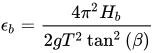
in which is the breaker height, is gravity, is the incident-wave period and is the beach gradient. Values indicate dissipative conditions where swash is characterised by standing long-wave motion. Values indicate reflective conditions where swash is dominated by wave bores.


Swash consists of two phases: uprush (onshore flow) and backwash (offshore flow). Generally, uprush has higher velocity and shorter duration than backwash. Onshore velocities are at greatest at the start of the uprush and then decrease, whereas offshore velocities increase towards the end of the backwash. The direction of the uprush varies with the prevailing wind, whereas the backwash is always perpendicular to the coastline. This asymmetrical motion of swash can cause longshore drift as well as cross-shore sediment transport.
The swash zone is the upper part of the beach between backbeach and surf zone, where intense erosion occurs during storms (Figure 2). The swash zone is alternately wet and dry. Infiltration (hydrology) (above the water table) and exfiltration (below the water table) take place between the swash flow and the beach groundwater table. Beachface, berm, beach step and beach cusps are the typical morphological features associated with swash motion. Infiltration (hydrology) and sediment transport by swash motion are important factors that govern the gradient of the beachface.
The beachface is the planar, relatively steep section of the beach profile that is subject to swash processes (Figure 2). The beachface extends from the berm to the low tide level. The beachface is in dynamic equilibrium with swash action when the amount of sediment transport by uprush and backwash are equal. If the beachface is flatter than the equilibrium gradient, more sediment is transported by the uprush to result in net onshore sediment transport. If the beachface is steeper than the equilibrium gradient, the sediment transport is dominated by the backwash and this results in net offshore sediment transport. The equilibrium beachface gradient is governed by a complex interrelationship of factors such as the sediment size, permeability, and fall velocity in the swash zone as well as the wave height and the wave period. The beachface cannot be considered in isolation from the surf zone to understand the morphological changes and equilibriums as they are strongly affected by the surf zone and shoaling wave processes as well as the swash zone processes.
The berm is the relatively planar[clarification needed] part of the swash zone where the accumulation of sediment occurs at the landward farthest of swash motion (Figure 2). The berm protects the backbeach and coastal dunes from waves but erosion can occur under high energy conditions such as storms. The berm is more easily defined on gravel beaches and there can be multiple berms at different elevations. On sandy beaches in contrast, the gradient of backbeach, berm and beachface can be similar. The height of the berm is governed by the maximum elevation of sediment transport during the uprush. The berm height can be predicted using the equation by Takeda and Sunamura (1982)
Hub AI
Swash AI simulator
(@Swash_simulator)
Swash
Swash, or forewash in geography, is a turbulent layer of water that washes up on the beach after an incoming wave has broken. The swash action can move beach materials up and down the beach, which results in the cross-shore sediment exchange. The time-scale of swash motion varies from seconds to minutes depending on the type of beach (see Figure 1 for beach types). Greater swash generally occurs on flatter beaches. The swash motion plays the primary role in the formation of morphological features and their changes in the swash zone. The swash action also plays an important role as one of the instantaneous processes in wider coastal morphodynamics.
There are two approaches that describe swash motions: (1) swash resulting from the collapse of high-frequency bores () on the beachface; and (2) swash characterised by standing, low-frequency () motions. Which type of swash motion prevails is dependent on the wave conditions and the beach morphology and this can be predicted by calculating the surf similarity parameter (Guza & Inman 1975):
in which is the breaker height, is gravity, is the incident-wave period and is the beach gradient. Values indicate dissipative conditions where swash is characterised by standing long-wave motion. Values indicate reflective conditions where swash is dominated by wave bores.
Swash consists of two phases: uprush (onshore flow) and backwash (offshore flow). Generally, uprush has higher velocity and shorter duration than backwash. Onshore velocities are at greatest at the start of the uprush and then decrease, whereas offshore velocities increase towards the end of the backwash. The direction of the uprush varies with the prevailing wind, whereas the backwash is always perpendicular to the coastline. This asymmetrical motion of swash can cause longshore drift as well as cross-shore sediment transport.
The swash zone is the upper part of the beach between backbeach and surf zone, where intense erosion occurs during storms (Figure 2). The swash zone is alternately wet and dry. Infiltration (hydrology) (above the water table) and exfiltration (below the water table) take place between the swash flow and the beach groundwater table. Beachface, berm, beach step and beach cusps are the typical morphological features associated with swash motion. Infiltration (hydrology) and sediment transport by swash motion are important factors that govern the gradient of the beachface.
The beachface is the planar, relatively steep section of the beach profile that is subject to swash processes (Figure 2). The beachface extends from the berm to the low tide level. The beachface is in dynamic equilibrium with swash action when the amount of sediment transport by uprush and backwash are equal. If the beachface is flatter than the equilibrium gradient, more sediment is transported by the uprush to result in net onshore sediment transport. If the beachface is steeper than the equilibrium gradient, the sediment transport is dominated by the backwash and this results in net offshore sediment transport. The equilibrium beachface gradient is governed by a complex interrelationship of factors such as the sediment size, permeability, and fall velocity in the swash zone as well as the wave height and the wave period. The beachface cannot be considered in isolation from the surf zone to understand the morphological changes and equilibriums as they are strongly affected by the surf zone and shoaling wave processes as well as the swash zone processes.
The berm is the relatively planar[clarification needed] part of the swash zone where the accumulation of sediment occurs at the landward farthest of swash motion (Figure 2). The berm protects the backbeach and coastal dunes from waves but erosion can occur under high energy conditions such as storms. The berm is more easily defined on gravel beaches and there can be multiple berms at different elevations. On sandy beaches in contrast, the gradient of backbeach, berm and beachface can be similar. The height of the berm is governed by the maximum elevation of sediment transport during the uprush. The berm height can be predicted using the equation by Takeda and Sunamura (1982)
Recent media