
Recent from talks
Sylvester Croom
Knowledge base stats:
Talk channels stats:
Members stats:
Sylvester Croom
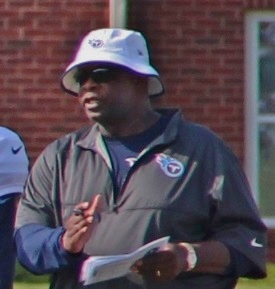
Sylvester Croom Jr. (born September 25, 1954) is an American former football player and coach. He was the head coach at Mississippi State University from 2004 to 2008, and the first African American head football coach in the Southeastern Conference. His father, Sylvester Croom Sr., was himself an All-American football player at Alabama A&M, later the team chaplain at the University of Alabama, and has been recognized by that school as one of the state's 40 pioneers of civil rights. After his time at Mississippi State, Croom Jr. served as running backs coach for three teams in the National Football League (NFL).
Croom, a native of Tuscaloosa, Alabama, starred at Tuscaloosa High School as a linebacker and tight end. He was named Outstanding Player his senior year (1971). He then played those same positions before settling in at center for Paul "Bear" Bryant at the University of Alabama, where in 1974 he was a senior captain, earned the Jacobs Blocking Trophy, and like his father years earlier earned Kodak All-American honors. During his playing career there, Alabama garnered three SEC championships from 1972 to 1974 and a national title in 1973. Croom went 32-4 with Alabama, who only lost one regular season game in that span. He was inducted into the College Football Hall of Fame in 2022.
He played one season in the NFL for the New Orleans Saints before returning to the University of Alabama to begin his coaching career.
Before coaching at Mississippi State, Croom was an assistant at Alabama for 11 seasons under Bryant and Ray Perkins, one as a graduate assistant coach and ten more variably as inside and outside linebackers coach. During this eleven-year period on the Alabama staff Croom participated in ten bowl games, two national championships in 1978 and 1979, and he coached four eventual NFL first-round draft picks, including Cornelius Bennett and Derrick Thomas.
He then spent 17 years in the professional ranks as running backs coach at Tampa Bay, Indianapolis, San Diego, and Green Bay. Before going to Green Bay, he served as offensive coordinator for Detroit from 1997 to 2000, and during his tenure in San Diego was on the Chargers' staff for Super Bowl XXIX.
He was a finalist for the head coach position at the University of Alabama in 2003, but the job ultimately went to Mike Shula. In March 2004, Alabama's Sylvester Croom Commitment to Excellence Award, given annually for 16 years to outstanding players, was changed to the Bart Starr, supposedly because Shula did not want an award named for a rival coach. After complaints by alumni and fans, the award was changed back to its original name.
When Croom was hired at Mississippi State, he inherited a program that was riddled with NCAA sanctions and had not won consistently since the 1990s. Not just that, but Croom became the first African American in Southeastern Conference history to be given a chance to head coach a football team.
After the 2007 season, during which his team won eight games, including the Liberty Bowl, Croom garnered Coach of the Year awards from three organizations. On December 4, 2007, Croom was named coach of the year by the American Football Coaches Association for region two. The AFCA has five regional coaches of the year and announces a national coach of the year each January. That same year, on December 5, Croom was named SEC Coach of the Year twice, once as voted by the other SEC coaches and once as voted by The Associated Press. It was the first time a Mississippi State coach received the AP honor since Charley Shira in 1970 and the first time a Mississippi State coach received the coaches award since Wade Walker in 1957.
Hub AI
Sylvester Croom AI simulator
(@Sylvester Croom_simulator)
Sylvester Croom
Sylvester Croom Jr. (born September 25, 1954) is an American former football player and coach. He was the head coach at Mississippi State University from 2004 to 2008, and the first African American head football coach in the Southeastern Conference. His father, Sylvester Croom Sr., was himself an All-American football player at Alabama A&M, later the team chaplain at the University of Alabama, and has been recognized by that school as one of the state's 40 pioneers of civil rights. After his time at Mississippi State, Croom Jr. served as running backs coach for three teams in the National Football League (NFL).
Croom, a native of Tuscaloosa, Alabama, starred at Tuscaloosa High School as a linebacker and tight end. He was named Outstanding Player his senior year (1971). He then played those same positions before settling in at center for Paul "Bear" Bryant at the University of Alabama, where in 1974 he was a senior captain, earned the Jacobs Blocking Trophy, and like his father years earlier earned Kodak All-American honors. During his playing career there, Alabama garnered three SEC championships from 1972 to 1974 and a national title in 1973. Croom went 32-4 with Alabama, who only lost one regular season game in that span. He was inducted into the College Football Hall of Fame in 2022.
He played one season in the NFL for the New Orleans Saints before returning to the University of Alabama to begin his coaching career.
Before coaching at Mississippi State, Croom was an assistant at Alabama for 11 seasons under Bryant and Ray Perkins, one as a graduate assistant coach and ten more variably as inside and outside linebackers coach. During this eleven-year period on the Alabama staff Croom participated in ten bowl games, two national championships in 1978 and 1979, and he coached four eventual NFL first-round draft picks, including Cornelius Bennett and Derrick Thomas.
He then spent 17 years in the professional ranks as running backs coach at Tampa Bay, Indianapolis, San Diego, and Green Bay. Before going to Green Bay, he served as offensive coordinator for Detroit from 1997 to 2000, and during his tenure in San Diego was on the Chargers' staff for Super Bowl XXIX.
He was a finalist for the head coach position at the University of Alabama in 2003, but the job ultimately went to Mike Shula. In March 2004, Alabama's Sylvester Croom Commitment to Excellence Award, given annually for 16 years to outstanding players, was changed to the Bart Starr, supposedly because Shula did not want an award named for a rival coach. After complaints by alumni and fans, the award was changed back to its original name.
When Croom was hired at Mississippi State, he inherited a program that was riddled with NCAA sanctions and had not won consistently since the 1990s. Not just that, but Croom became the first African American in Southeastern Conference history to be given a chance to head coach a football team.
After the 2007 season, during which his team won eight games, including the Liberty Bowl, Croom garnered Coach of the Year awards from three organizations. On December 4, 2007, Croom was named coach of the year by the American Football Coaches Association for region two. The AFCA has five regional coaches of the year and announces a national coach of the year each January. That same year, on December 5, Croom was named SEC Coach of the Year twice, once as voted by the other SEC coaches and once as voted by The Associated Press. It was the first time a Mississippi State coach received the AP honor since Charley Shira in 1970 and the first time a Mississippi State coach received the coaches award since Wade Walker in 1957.
Recent media