


Community hub
Recent from talks
Knowledge base stats:
Talk channels stats:
Members stats:
Phasor measurement unit
A phasor measurement unit (PMU) is a device used to estimate the magnitude and phase angle of an electrical phasor quantity (such as voltage or current) in the electricity grid using a common time source for synchronization. Time synchronization is usually provided by GPS or IEEE 1588 Precision Time Protocol, which allows synchronized real-time measurements of multiple remote points on the grid. PMUs are capable of capturing samples from a waveform in quick succession and reconstructing the phasor quantity, made up of an angle measurement and a magnitude measurement. The resulting measurement is known as a synchrophasor. These time synchronized measurements are important because if the grid’s supply and demand are not perfectly matched, frequency imbalances can cause stress on the grid, which is a potential cause for power outages.
PMUs can also be used to measure the frequency in the power grid. A typical commercial PMU can report measurements with very high temporal resolution, up to 120 measurements per second. This helps engineers in analyzing dynamic events in the grid which is not possible with traditional SCADA measurements that generate one measurement every 2 or 4 seconds. Therefore, PMUs equip utilities with enhanced monitoring and control capabilities and are considered to be one of the most important measuring devices in the future of power systems. A PMU can be a dedicated device, or the PMU function can be incorporated into a protective relay or other device.
In 1893, Charles Proteus Steinmetz presented a paper on simplified mathematical description of the waveforms of alternating current electricity. Steinmetz called his representation a phasor. With the invention of phasor measurement units (PMU) in 1988 by Dr. Arun G. Phadke and Dr. James S. Thorp at Virginia Tech, Steinmetz’s technique of phasor calculation evolved into the calculation of real time phasor measurements that are synchronized to an absolute time reference provided by the Global Positioning System. We therefore refer to synchronized phasor measurements as synchrophasors. Early prototypes of the PMU were built at Virginia Tech, and Macrodyne built the first PMU (model 1690) in 1992. Today they are available commercially.
With the increasing growth of distributed energy resources on the power grid, more observability and control systems will be needed to accurately monitor power flow. Historically, power has been delivered in a uni-directional fashion through passive components to customers, but now that customers can generate their own power with technologies such as solar PV, this is changing into a bidirectional system for distribution systems. With this change it is imperative that transmission and distribution networks are continuously being observed through advanced sensor technology, such as ––PMUs and uPMUs.
In simple terms, the public electric grid that a power company operates was originally designed to take power from a single source: the operating company's generators and power plants, and feed it into the grid, where the customers consume the power. Now, some customers are operating power generating devices (solar panels, wind turbines, etc.) and to save costs (or to generate income) are also feeding power back into the grid. Depending on the region, feeding power back into the grid may be done through net metering. Because of this process, voltage and current must be measured and regulated in order to ensure the power going into the grid is of the quality and standard that customer equipment expects (as seen through metrics such as frequency, phase synchronicity, and voltage). If this is not done, as Rob Landley puts it, "people's light bulbs start exploding." This measurement function is what these devices do.
A PMU can measure 50/60 Hz AC waveforms (voltages and currents) typically at a rate of 48 samples per cycle making them effective at detecting fluctuations in voltage or current at less than one cycle. However, when the frequency does not oscillate around or near 50/60 Hz, PMUs are not able to accurately reconstruct these waveforms. Phasor measurements from PMU’s are constructed from cosine waves, that follow the structure below.
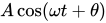
The A in this function is a scalar value, that is most often described as voltage or current magnitude (for PMU measurements). The θ is the phase angle offset from some defined starting position, and the ω is the angular frequency of the wave form (usually 2π50 radians/second or 2π60 radians/second). In most cases PMUs only measure the voltage magnitude and the phase angle, and assume that the angular frequency is a constant. Because this frequency is assumed constant, it is disregarded in the phasor measurement. PMU’s measurements are a mathematical fitting problem, where the measurements are being fit to a sinusoidal curve. Thus, when the waveform is non-sinusoidal, the PMU is unable to fit it exactly. The less sinusoidal the waveform is, such as grid behavior during a voltage sag or fault, the worse the phasor representation becomes.
Hub AI
Phasor measurement unit AI simulator
(@Phasor measurement unit_simulator)
Phasor measurement unit
A phasor measurement unit (PMU) is a device used to estimate the magnitude and phase angle of an electrical phasor quantity (such as voltage or current) in the electricity grid using a common time source for synchronization. Time synchronization is usually provided by GPS or IEEE 1588 Precision Time Protocol, which allows synchronized real-time measurements of multiple remote points on the grid. PMUs are capable of capturing samples from a waveform in quick succession and reconstructing the phasor quantity, made up of an angle measurement and a magnitude measurement. The resulting measurement is known as a synchrophasor. These time synchronized measurements are important because if the grid’s supply and demand are not perfectly matched, frequency imbalances can cause stress on the grid, which is a potential cause for power outages.
PMUs can also be used to measure the frequency in the power grid. A typical commercial PMU can report measurements with very high temporal resolution, up to 120 measurements per second. This helps engineers in analyzing dynamic events in the grid which is not possible with traditional SCADA measurements that generate one measurement every 2 or 4 seconds. Therefore, PMUs equip utilities with enhanced monitoring and control capabilities and are considered to be one of the most important measuring devices in the future of power systems. A PMU can be a dedicated device, or the PMU function can be incorporated into a protective relay or other device.
In 1893, Charles Proteus Steinmetz presented a paper on simplified mathematical description of the waveforms of alternating current electricity. Steinmetz called his representation a phasor. With the invention of phasor measurement units (PMU) in 1988 by Dr. Arun G. Phadke and Dr. James S. Thorp at Virginia Tech, Steinmetz’s technique of phasor calculation evolved into the calculation of real time phasor measurements that are synchronized to an absolute time reference provided by the Global Positioning System. We therefore refer to synchronized phasor measurements as synchrophasors. Early prototypes of the PMU were built at Virginia Tech, and Macrodyne built the first PMU (model 1690) in 1992. Today they are available commercially.
With the increasing growth of distributed energy resources on the power grid, more observability and control systems will be needed to accurately monitor power flow. Historically, power has been delivered in a uni-directional fashion through passive components to customers, but now that customers can generate their own power with technologies such as solar PV, this is changing into a bidirectional system for distribution systems. With this change it is imperative that transmission and distribution networks are continuously being observed through advanced sensor technology, such as ––PMUs and uPMUs.
In simple terms, the public electric grid that a power company operates was originally designed to take power from a single source: the operating company's generators and power plants, and feed it into the grid, where the customers consume the power. Now, some customers are operating power generating devices (solar panels, wind turbines, etc.) and to save costs (or to generate income) are also feeding power back into the grid. Depending on the region, feeding power back into the grid may be done through net metering. Because of this process, voltage and current must be measured and regulated in order to ensure the power going into the grid is of the quality and standard that customer equipment expects (as seen through metrics such as frequency, phase synchronicity, and voltage). If this is not done, as Rob Landley puts it, "people's light bulbs start exploding." This measurement function is what these devices do.
A PMU can measure 50/60 Hz AC waveforms (voltages and currents) typically at a rate of 48 samples per cycle making them effective at detecting fluctuations in voltage or current at less than one cycle. However, when the frequency does not oscillate around or near 50/60 Hz, PMUs are not able to accurately reconstruct these waveforms. Phasor measurements from PMU’s are constructed from cosine waves, that follow the structure below.
The A in this function is a scalar value, that is most often described as voltage or current magnitude (for PMU measurements). The θ is the phase angle offset from some defined starting position, and the ω is the angular frequency of the wave form (usually 2π50 radians/second or 2π60 radians/second). In most cases PMUs only measure the voltage magnitude and the phase angle, and assume that the angular frequency is a constant. Because this frequency is assumed constant, it is disregarded in the phasor measurement. PMU’s measurements are a mathematical fitting problem, where the measurements are being fit to a sinusoidal curve. Thus, when the waveform is non-sinusoidal, the PMU is unable to fit it exactly. The less sinusoidal the waveform is, such as grid behavior during a voltage sag or fault, the worse the phasor representation becomes.