Hubbry Logo
Protective relayProtective relayMain
Open search
Protective relay
Community hub
Protective relay
logo
8 pages, 0 posts
0 subscribers
Be the first to start a discussion here.
Protective relay
Protective relay
from Wikipedia
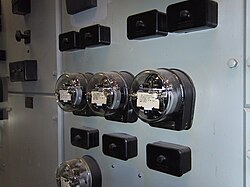
Electromechanical protective relays at a hydroelectric generating plant. The relays are in round glass cases. The rectangular devices are test connection blocks, used for testing and isolation of instrument transformer circuits.

In electrical engineering, a protective relay is a relay device designed to trip a circuit breaker when a fault is detected.[1]: 4  The first protective relays were electromagnetic devices, relying on coils operating on moving parts to provide detection of abnormal operating conditions such as over-current, overvoltage, reverse power flow, over-frequency, and under-frequency.[2]

Microprocessor-based solid-state digital protection relays now emulate the original devices, as well as providing types of protection and supervision impractical with electromechanical relays. Electromechanical relays provide only rudimentary indication of the location and origin of a fault.[3] In many cases a single microprocessor relay provides functions that would take two or more electromechanical devices. By combining several functions in one case, numerical relays also save capital cost and maintenance cost over electromechanical relays.[4] However, due to their very long life span, tens of thousands of these "silent sentinels"[5] are still protecting transmission lines and electrical apparatus all over the world. Important transmission lines and generators have cubicles dedicated to protection, with many individual electromechanical devices, or one or two microprocessor relays.

The theory and application of these protective devices is an important part of the education of a power engineer who specializes in power system protection. The need to act quickly to protect circuits and equipment often requires protective relays to respond and trip a breaker within a few thousandths of a second. In some instances these clearance times are prescribed in legislation or operating rules.[6] A maintenance or testing program is used to determine the performance and availability of protection systems.[7]

Based on the end application and applicable legislation, various standards such as ANSI C37.90, IEC255-4, IEC60255-3, and IAC govern the response time of the relay to the fault conditions that may occur.[8]

Operation principles

[edit]

Electromechanical protective relays operate by either magnetic attraction, or magnetic induction.[9]: 14  Unlike switching type electromechanical relays with fixed and usually ill-defined operating voltage thresholds and operating times, protective relays have well-established, selectable, and adjustable time and current (or other operating parameter) operating characteristics. Protection relays may use arrays of induction disks, shaded-pole,[9]: 25  magnets, operating and restraint coils, solenoid-type operators, telephone-relay contacts,[clarification needed] and phase-shifting networks.

Protective relays can also be classified by the type of measurement they make.[10]: 92  A protective relay may respond to the magnitude of a quantity such as voltage or current. Induction relays can respond to the product of two quantities in two field coils, which could for example represent the power in a circuit.

"It is not practical to make a relay that develops a torque equal to the quotient of two a.c. quantities. This, however is not important; the only significant condition for a relay is its setting and the setting can be made to correspond to a ratio regardless of the component values over a wide range."[10]: 92 

Several operating coils can be used to provide "bias" to the relay, allowing the sensitivity of response in one circuit to be controlled by another. Various combinations of "operate torque" and "restraint torque" can be produced in the relay.

By use of a permanent magnet in the magnetic circuit, a relay can be made to respond to current in one direction differently from in another. Such polarized relays are used on direct-current circuits to detect, for example, reverse current into a generator. These relays can be made bistable, maintaining a contact closed with no coil current and requiring reverse current to reset. For AC circuits, the principle is extended with a polarizing winding connected to a reference voltage source.

Lightweight contacts make for sensitive relays that operate quickly, but small contacts can't carry or break heavy currents. Often the measuring relay will trigger auxiliary telephone-type armature relays.

In a large installation of electromechanical relays, it would be difficult to determine which device originated the signal that tripped the circuit. This information is useful to operating personnel to determine the likely cause of the fault and to prevent its re-occurrence. Relays may be fitted with a "target" or "flag" unit, which is released when the relay operates, to display a distinctive colored signal when the relay has tripped.[11]

Types according to construction

[edit]

Electromechanical

[edit]

Electromechanical relays can be classified into several different types as follows:

  • attracted armature
  • moving coil
  • induction
  • motor operated
  • mechanical
  • thermal

"Armature"-type relays have a pivoted lever supported on a hinge[12] or knife-edge pivot, which carries a moving contact. These relays may work on either alternating or direct current, but for alternating current, a shading coil on the pole[9]: 14  is used to maintain contact force throughout the alternating current cycle. Because the air gap between the fixed coil and the moving armature becomes much smaller when the relay has operated, the current required to maintain the relay closed is much smaller than the current to first operate it. The "returning ratio"[13] or "differential" is the measure of how much the current must be reduced to reset the relay.

A variant application of the attraction principle is the plunger-type or solenoid operator. A reed relay is another example of the attraction principle.

"Moving coil" meters use a loop of wire turns in a stationary magnet, similar to a galvanometer but with a contact lever instead of a pointer. These can be made with very high sensitivity. Another type of moving coil suspends the coil from two conductive ligaments, allowing very long travel of the coil.

Induction disc overcurrent relay

[edit]
When the input current is above the current limit, the disk rotates, the contact moves left and reaches the fixed contact. The scale above the plate indicates the delay-time.

"Induction" disk meters work by inducing currents in a disk that is free to rotate; the rotary motion of the disk operates a contact. Induction relays require alternating current; if two or more coils are used, they must be at the same frequency otherwise no net operating force is produced.[11] These electromagnetic relays use the induction principle discovered by Galileo Ferraris in the late 19th century. The magnetic system in induction disc overcurrent relays is designed to detect overcurrents in a power system and operate with a pre-determined time delay when certain overcurrent limits have been reached. In order to operate, the magnetic system in the relays produces torque that acts on a metal disc to make contact, according to the following basic current/torque equation:[14]

Where and are the two fluxes and is the phase angle between the fluxes

The following important conclusions can be drawn from the above equation.[15]

  • Two alternating fluxes with a phase shift are needed for torque production.
  • Maximum torque is produced when the two alternating fluxes are 90 degrees apart.
  • The resultant torque is steady and not a function of time.

The relay's primary winding is supplied from the power systems current transformer via a plug bridge,[16] which is called the plug setting multiplier (psm). Usually seven equally spaced tappings or operating bands determine the relays sensitivity. The primary winding is located on the upper electromagnet. The secondary winding has connections on the upper electromagnet that are energised from the primary winding and connected to the lower electromagnet. Once the upper and lower electromagnets are energised they produce eddy currents that are induced onto the metal disc and flow through the flux paths. This relationship of eddy currents and fluxes creates torque proportional to the input current of the primary winding, due to the two flux paths being out of phase by 90°.

In an overcurrent condition, a value of current will be reached that overcomes the control spring pressure on the spindle and the braking magnet, causing the metal disc to rotate towards the fixed contact. This initial movement of the disc is also held off to a critical positive value of current by small slots that are often cut into the side of the disc. The time taken for rotation to make the contacts is not only dependent on current but also the spindle backstop position, known as the time multiplier (tm). The time multiplier is divided into 10 linear divisions of the full rotation time.

Providing the relay is free from dirt, the metal disc and the spindle with its contact will reach the fixed contact, thus sending a signal to trip and isolate the circuit, within its designed time and current specifications. Drop off current of the relay is much lower than its operating value, and once reached the relay will be reset in a reverse motion by the pressure of the control spring governed by the braking magnet.

Static

[edit]

Application of electronic amplifiers to protective relays was described as early as 1928, using vacuum tube amplifiers and continued up to 1956.[17] Devices using electron tubes were studied but never applied as commercial products, because of the limitations of vacuum tube amplifiers. A relatively large standby current is required to maintain the tube filament temperature; inconvenient high voltages are required for the circuits, and vacuum tube amplifiers had difficulty with incorrect operation due to noise disturbances.

Static relays have no or few moving parts, and became practical with the introduction of the transistor. Measuring elements of static relays have been successfully and economically built up from diodes, zener diodes, avalanche diodes, unijunction transistors, p-n-p and n-p-n bipolar transistors, field effect transistors or their combinations.[18]: 6  Static relays offer the advantage of higher sensitivity than purely electromechanical relays, because power to operate output contacts is derived from a separate supply, not from the signal circuits. Static relays eliminated or reduced contact bounce, and could provide fast operation, long life and low maintenance.[19]

Digital

[edit]

Digital protective relays were in their infancy during the late 1960s.[20][21] An experimental digital protection system was tested in the lab and in the field in the early 1970s.[22][23] Unlike the relays mentioned above, digital protective relays have two main parts: hardware and software[24]: 5 . The world's first commercially available digital protective relay was introduced to the power industry in 1984 by Schweitzer Engineering Laboratories (SEL) based in Pullman, Washington.[3] In spite of the developments of complex algorithms for implementing protection functions the microprocessor based-relays marketed in the 1980s did not incorporate them.[25] A microprocessor-based digital protection relay can replace the functions of many discrete electromechanical instruments. These relays convert voltage and currents to digital form and process the resulting measurements using a microprocessor. The digital relay can emulate functions of many discrete electromechanical relays in one device,[26] simplifying protection design and maintenance. Each digital relay can run self-test routines to confirm its readiness and alarm if a fault is detected. Digital relays can also provide functions such as communications (SCADA) interface, monitoring of contact inputs, metering, waveform analysis, and other useful features. Digital relays can, for example, store multiple sets of protection parameters,[27] which allows the behavior of the relay to be changed during maintenance of attached equipment. Digital relays also can provide protection strategies impossible to implement with electromechanical relays. This is particularly so in long-distance high voltage or multi-terminal circuits or in lines that are series or shunt compensated[24]: 3  They also offer benefits in self-testing and communication to supervisory control systems.

A digital (numeric) multifunction protective relay for distribution networks. A single such device can replace many single-function electromechanical relays, and provides self-testing and communication functions.

Numerical

[edit]

The distinction between digital and numerical protection relay rests on points of fine technical detail, and is rarely found in areas other than Protection[28]: Ch 7, pp 102 . Numerical relays are the product of the advances in technology from digital relays. Generally, there are several different types of numerical protection relays. Each type, however, shares a similar architecture, thus enabling designers to build an entire system solution that is based on a relatively small number of flexible components.[8] They use high speed processors executing appropriate algorithms[18]: 51 .[29][30] Most numerical relays are also multifunctional[31] and have multiple setting groups each often with tens or hundreds of settings.[32]

Relays by functions

[edit]

The various protective functions available on a given relay are denoted by standard ANSI device numbers. For example, a relay including function 51 would be a timed overcurrent protective relay.

Overcurrent relay

[edit]

An overcurrent relay is a type of protective relay which operates when the load current exceeds a pickup value. It is of two types: instantaneous over current (IOC) relay and definite time overcurrent (DTOC) relay.

The ANSI device number is 50 for an IOC relay or a DTOC relay. In a typical application, the over current relay is connected to a current transformer and calibrated to operate at or above a specific current level. When the relay operates, one or more contacts will operate and energize to trip a circuit breaker. The DTOC relay has been used extensively in the United Kingdom but its inherent issue of operating slower for faults closer to the source led to the development of the IDMT relay.[1]: pp 30-31 

A definite time over-current (DTOC) relay is a relay that operates after a definite period of time once the current exceeds the pickup value. Hence, this relay has current setting range as well as time setting range.

An instantaneous over-current relay is an overcurrent relay which has no intentional time delay for operation. The contacts of the relay are closed instantly when the current inside the relay rises beyond the operational value. The time interval between the instant pick-up value and the closing contacts of the relay is very low. It has low operating time and starts operating instantly when the value of current is more than the relay setting. This relay operates only when the impedance between the source and the relay is less than that provided in the section.[33]

An inverse-time over-current (ITOC) relay is an overcurrent relay which operates only when the magnitude of their operating current is inversely proportional to the magnitude of the energize quantities. The operating time of relay decreases with the increases in the current. The operation of the relay depends on the magnitude of the current.[33]

An inverse definite minimum time (IDMT) relay is a protective relay which is developed to overcome the shortcomings of the definite time overcurrent (DTOC) relays.[1]: pp 30-31 [34]: 134 

If the source impedance remains constant and the fault current changes appreciably as we move away from the relay then it is advantageous to use IDMT overcurrent protection[35]: 11  to achieve high speed protection over a large section of the protected circuit.[28]: 127  However, if the source impedance is significantly larger than the feeder impedance then the characteristic of the IDMT relay cannot be exploited and DTOC may be utilized.[36]: 42  Secondly if the source impedance varies and becomes weaker with less generation during light loads then this leads to slower clearance time hence negating the purpose of the IDMT relay.[37]: 143 

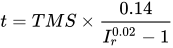
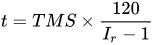
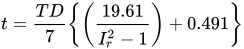
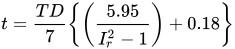
IEC standard 60255-151 specifies the IDMT relay curves as shown below. The four curves in Table 1 are derived from the now withdrawn British Standard BS 142.[38] The other five, in Table 2, are derived from the ANSI standard C37.112.[39]

While it is more common to use IDMT relays for current protection it is possible to utilize IDMT mode of operation for voltage protection[40]: 3 . It is possible to program customised curves in some protective relays[41]: pp Ch2-9  and other manufacturers[42]: 18  have special curves specific to their relays. Some numerical relays can be used to provide inverse time overvoltage protection[43]: 6  or negative sequence overcurrent protection.[44]: 915 

Table 1. Curves derived from BS 142
Relay Characteristic IEC Equation
Standard Inverse (SI)
Very Inverse
Extremely Inverse (EI)
Long time standard earth fault
Table 2. Curves derives from ANSI standard (North American IDMT relay characteristics)[28]: 126 
Relay Characteristic IEEE Equation
IEEE Moderately Inverse
IEE Very Inverse (VI)
Extremely Inverse (EI)
US CO8 inverse
US CO2 Short Time inverse

Ir = is the ratio of the fault current to the relay setting current or a Plug Setting Multiplier.[45]: pp 73  "Plug" is a reference from the electromechanical relay era and were available in discrete[1]: pp 37  steps. TD is the Time Dial setting.

The above equations result in a "family" of curves as a result of using different time multiplier setting (TMS) settings. It is evident from the relay characteristic equations that a larger TMS will result in a slower clearance time for a given PMS (Ir) value.

Distance relay

[edit]

Distance relays, also known as impedance relay, differ in principle from other forms of protection in that their performance is not governed by the magnitude of the current or voltage in the protected circuit but rather on the ratio of these two quantities. Distance relays are actually double actuating quantity relays with one coil energized by voltage and other coil by current. The current element produces a positive or pick up torque while the voltage element produces a negative or reset torque. The relay operates only when the V/I ratio falls below a predetermined value (or set value). During a fault on the transmission line the fault current increases and the voltage at the fault point decreases. The V/I [46] ratio is measured at the location of CTs and PTs. The voltage at the PT location depends on the distance between the PT and the fault. If the measured voltage is lesser, that means the fault is nearer and vice versa. Hence the protection called Distance relay. The load flowing through the line appears as an impedance to the relay and sufficiently large loads (as impedance is inversely proportional to the load) can lead to a trip of the relay even in the absence of a fault.[47]: 467 

Current differential protection scheme

[edit]

A differential scheme acts on the difference between current entering a protected zone (which may be a bus bar, generator, transformer or other apparatus) and the current leaving that zone. A fault outside the zone gives the same fault current at the entry and exit of the zone, but faults within the zone show up as a difference in current.

"The differential protection is 100% selective and therefore only responds to faults within its protected zone. The boundary of the protected zone is uniquely defined by the location of the current transformers. Time grading with other protection systems is therefore not required, allowing for tripping without additional delay. Differential protection is therefore suited as fast main protection for all important plant items."[48]: 15 

Differential protection can be used to provide protection for zones with multiple terminals[49][50] and can be used to protect lines,[51] generators, motors, transformers, and other electrical plant.

Directional relay

[edit]

A directional relay uses an additional polarizing source of voltage or current to determine the direction of a fault. Directional elements respond to the phase shift between a polarizing quantity and an operate quantity.[52] The fault can be located upstream or downstream of the relay's location, allowing appropriate protective devices to be operated inside or outside of the zone of protection.

Synchronism check

[edit]

A synchronism checking relay provides a contact closure when the frequency and phase of two sources are similar to within some tolerance margin. A "synch check" relay is often applied where two power systems are interconnected, such as at a switchyard connecting two power grids, or at a generator circuit breaker to ensure the generator is synchronized to the system before connecting it.[citation needed]

Power source

[edit]

Relays can also be classified by their type of power source.

A dual powered protection relay powered by the current obtained from the line by a CT. The striker is also shown
  • Self-powered relays operate on energy derived from the protected circuit, such as through the current transformers used to measure line current. Self-powered relays are advantageous in terms of cost and reliability as they do not require a separate power supply.
  • Auxiliary-powered relays rely on a battery or external AC supply. Some relays can use either AC or DC. The auxiliary supply must be highly reliable during a system fault to ensure the relay can operate.
  • Dual-powered relays are powered by the protected circuit and through an auxiliary power source which acts as a backup.

References

[edit]

Sources

[edit]
[edit]
Revisions and contributorsEdit on WikipediaRead on Wikipedia
from Grokipedia
A protective relay is an electrical device designed to detect abnormal or fault conditions in power systems, such as excessive currents, voltages, or imbalances, and to initiate rapid corrective actions, typically by tripping circuit breakers to isolate the affected section and prevent widespread damage or outages. According to IEEE Standard C37.100-1992, it functions as a relay that identifies defective lines, apparatus, or other abnormal power system states and triggers control circuit operations to maintain system integrity. These relays operate using inputs from instrument transformers, like current transformers (CTs) that scale currents to 0-5 A and potential transformers (PTs) that scale voltages to 0-120 V, providing electrical isolation between high-voltage systems and the relay. The evolution of protective relays spans over a century, beginning with electromechanical designs in the early 1900s that relied on mechanical components like induction discs or electromagnetic attractions to respond to faults. A pivotal advancement occurred in 1977 when Edmund O. Schweitzer III developed the first microprocessor-based digital relay as part of his doctoral research, enabling faster fault detection and data logging to enhance grid reliability following events like the 1965 Northeast blackout. By the , commercial digital relays, such as the SEL-21, introduced multifunction capabilities, including fault location within 1 km accuracy, and modern iterations like the SEL-T400L achieve detection in 1-2 milliseconds using time-domain algorithms. This shift from electromechanical to digital technology has improved cybersecurity, communication integration, and overall system efficiency across global power grids. Protective relays are categorized by technology—electromechanical, solid-state, and digital (microprocessor-based)—and by function, including (instantaneous or time-delayed), voltage (overvoltage and undervoltage monitoring), differential (comparing currents at two points), directional (assessing power flow direction), and (measuring impedance to faults). They protect specific zones of the power system, such as generators, transformers, buses, transmission lines, feeders, and , by adhering to core design principles: reliability (dependable operation without false trips), selectivity (isolating only the faulted area), speed (minimizing outage duration), (ease of ), and economics (cost-effective implementation). Standardized by IEEE C37.2 for device numbers (e.g., 50 for instantaneous ) and C37.90 for testing, these relays are indispensable for ensuring the , stability, and continuity of electrical power delivery in modern infrastructure.

Fundamentals

Definition and Purpose

A is an designed to detect specified abnormal conditions in a power system, such as faults, and automatically initiate corrective actions like tripping a to isolate the affected area. These devices monitor electrical parameters including current, voltage, and through sensors like current transformers (CTs) and voltage transformers (VTs), which provide scaled-down representations of system conditions to the relay's logic unit for analysis. The logic processes these inputs to determine if a fault exists, then activates output contacts to energize the trip coil of a , thereby disconnecting the faulty section. The primary purpose of protective relays is to safeguard power system equipment, such as transformers, generators, and transmission lines, from damage due to faults like short circuits or overloads, while also ensuring personnel and preserving overall system stability. By rapidly isolating faulty sections—often in milliseconds—they prevent the spread of disturbances, minimizing the risk of widespread outages or blackouts that could affect healthy parts of the grid. For instance, in scenarios where a fault occurs due to external factors like a contacting a , relays detect the resulting or changes and isolate the issue, thereby maintaining service continuity for unaffected areas and supporting grid reliability. Unlike other control devices used for normal operational tasks, such as automatic voltage regulators that maintain steady-state conditions, protective relays are specifically dedicated to responding to abnormal or fault conditions to prevent escalation. Their core components typically include sensing elements (e.g., CTs and VTs for input data), a decision-making logic section (mechanical, electronic, or digital for fault evaluation), and output interfaces (contacts for breaker control), forming a focused system for emergency isolation rather than routine regulation. This distinction ensures that protective relays prioritize speed and selectivity in fault scenarios without interfering with everyday power flow.

Historical Development

The origins of protective relays trace back to the late , when electromagnetic devices initially developed for applications were adapted for electrical power systems. The first dedicated protective relay emerged around 1902, designed to detect conditions in early distribution networks, with pioneers like M.O. Dolivo-Dobrovolsky contributing foundational concepts in the 1890s for selective protection in AC systems. Companies such as began producing early electromechanical relays in the early 1900s, focusing on basic fault detection before their widespread integration into power grids. During the and 1930s, protective relays saw broader adoption alongside the expansion of systems, enabling reliable fault isolation in interconnected networks. A significant milestone was the development of induction disc relays in the early , which introduced inverse time-current characteristics to improve selectivity and coordination, dominating electromechanical designs until the mid-20th century. Post-World War II advancements in the 1960s shifted toward static relays, leveraging transistor technology to replace mechanical components with for faster response and reduced maintenance. The modern era began in the late 1970s with the advent of digital relays, exemplified by the first microprocessor-based prototypes in 1979, which allowed precise fault location and event recording. In 1982, Edmund O. Schweitzer III commercialized the SEL-21, the first widely available digital relay, transforming practices. Numerical relays proliferated in the , incorporating advanced algorithms, while the 2000s saw integration with the standard—formalized in 2003—for enhanced substation communication and interoperability. Major events, such as the 1965 Northeast blackout affecting 30 million people, accelerated these innovations by highlighting vulnerabilities in relay coordination. Post-2020 developments have increasingly incorporated into protective relays for , using to analyze patterns and anticipate failures, thereby boosting grid resilience amid rising renewable integration.

Operating Principles

Fault Detection

Protective relays detect faults in power systems primarily through the use of current transformers (CTs) and voltage transformers (VTs), which provide scaled-down, isolated measurements of electrical quantities such as current, voltage, , and phase angle to ensure safe operation of the relay circuitry. CTs step down high primary currents to manageable secondary levels, typically following a turns , while VTs similarly reduce voltages, allowing relays to monitor system conditions without direct exposure to high-energy lines. These transducers enable the relay to sense deviations from normal operating parameters, forming the basis for fault identification across various power system components. The primary fault types detected by protective relays include , undervoltage, , ground faults, and imbalances, each corresponding to specific abnormal conditions that could damage equipment or disrupt service. faults arise from short circuits or overloads, where currents exceed normal levels; undervoltage indicates voltage sags that may lead to equipment stalling; protects against surges that stress insulation; ground faults involve unintended paths to ; and imbalances occur due to uneven phase loading or open conductors. To analyze these unsymmetrical faults, relays often employ theory, which decomposes three-phase quantities into positive-sequence (balanced, normal operation), negative-sequence (reversed rotation, indicating phase imbalances), and zero-sequence (in-phase, associated with ground involvement) components. For instance, a single-line-to-ground fault produces significant zero-sequence currents, calculated as I0=13(Ia+Ib+Ic)I_0 = \frac{1}{3} (I_a + I_b + I_c), where Ia,Ib,IcI_a, I_b, I_c are the phase currents, enabling precise fault localization. Once measured, the relay's logic processes these quantities by comparing them against predefined thresholds or settings to determine if a fault exists. This involves evaluating whether the magnitude of current II exceeds the pickup setting IsetI_\text{set}, expressed as I>IsetI > I_\text{set}, where IsetI_\text{set} is calibrated based on the protected equipment's ratings to avoid false operations during normal loads. Detection can be instantaneous, providing no intentional delay for high-magnitude faults to enable rapid isolation, or time-delayed, incorporating inverse time-current characteristics to allow temporary overloads while coordinating with downstream devices. The time dial setting adjusts the delay duration on these curves, scaling the operating time proportionally to ensure selective tripping without unnecessary outages. Upon confirmation, this detection generates output signals that initiate the tripping sequence.

Response and Tripping

Upon detecting a fault through sensed currents or voltages, a protective initiates its response by closing internal output contacts, which energize the trip coils of associated circuit breakers to interrupt the faulted circuit. These contacts typically handle the momentary current required by the trip coil, but in systems with high trip coil demands or multiple breakers, auxiliary may amplify the signal to ensure reliable operation without excessive wear on the primary contacts. The tripping sequence varies by fault severity: severe faults, such as close-in short circuits, trigger instantaneous tripping (often denoted as ANSI 50) for rapid isolation within cycles to minimize damage, while less severe faults employ inverse time-overcurrent characteristics (ANSI 51) where operating time decreases as fault current magnitude increases. Coordination principles ensure selectivity, with the nearest relay to the fault tripping first to isolate only the affected section, preventing unnecessary outages in healthy parts of the system; this is achieved by grading time settings so upstream relays have longer delays than downstream ones. Time-current curves define these behaviors, plotting operating time against multiples of pickup current; common types include standard inverse (moderately fast for moderate overcurrents), very inverse (steeper drop-off for higher currents), and extremely inverse curves, standardized to facilitate coordination across devices from manufacturers. Backup protection provides redundancy, where remote relays activate if primary ones fail due to issues like blown fuses or contact failures, typically with additional time delays (e.g., 0.3–0.5 seconds) to allow primary operation first. The inverse time characteristic for the moderately inverse curve (often referred to as standard inverse in IEEE contexts) is mathematically expressed per IEEE C37.112 as: t=TMS×(0.0515M0.021+0.114)t = \text{TMS} \times \left( \frac{0.0515}{M^{0.02} - 1} + 0.114 \right) where tt is the operating time in seconds, TMS is the time multiplier setting (a scaling factor for coordination, typically 0.1–1.0), MM is the multiple of pickup current (I/IpI / I_p, with II as fault current and IpI_p as pickup threshold), yielding longer times at low overcurrents (e.g., at M=2M = 2, t3.8×TMSt \approx 3.8 \times \text{TMS} seconds for TMS=1) but faster response at high multiples (e.g., at M=10M = 10, t1.2×TMSt \approx 1.2 \times \text{TMS} seconds). This equation includes the fixed time offset (B=0.114) characteristic of IEEE curves, enabling precise grading for overcurrent protection. Balancing dependability (ability to trip on actual faults) and (avoiding false trips on transients or load swings) is critical; settings are tuned for high sensitivity to genuine faults while incorporating intentional or directional elements to reject non-fault conditions, ensuring system stability.

Classification by Construction

Electromechanical Relays

Electromechanical relays represent the traditional form of protective relays, relying on mechanical components actuated by electromagnetic forces to detect and respond to faults in power systems. These devices typically feature moving parts such as discs, armatures, or balances that are driven by induced currents or , enabling them to close electrical contacts upon fault detection. Common types include attracted armature relays, which use electromagnetic attraction to pull a hinged or armature toward a coil to operate contacts; induction cup relays, which employ a rotating cup-shaped rotor for rapid response in directional applications; and polarized relays, which incorporate a permanent to enhance sensitivity to direct current or specific polarities. In operation, electromechanical relays generate from alternating magnetic fluxes produced by input currents, causing mechanical movement that closes or opens contacts to initiate tripping. The is proportional to the fault current, driving the moving element against restraining forces like springs, while damping mechanisms—such as permanent magnets inducing currents in the —prevent oscillations and ensure stable contact closure. These relays are often used for basic , where sustained high currents rotate the element to actuate the trip circuit after a time delay. Electromechanical relays offer advantages such as proven reliability in harsh environments, precise fault directionality in directional variants, and simplicity in application for short-line protection without requiring voltage transformers in certain schemes. However, they exhibit disadvantages including lower sensitivity compared to modern relays, coordination challenges due to inherent time delays, susceptibility to and position orientation affecting performance, and limited flexibility requiring manual adjustments for settings. A prominent example is the induction disc overcurrent relay, widely employed for time-delayed fault . In this design, a lightweight aluminum disc mounted on a shaft is positioned between electromagnets energized by the fault current through a primary coil and a secondary phase-shifting coil with a . When current exceeds the pickup threshold—adjusted via tap settings on the coil—the interaction of magnetic fields induces eddy currents in the disc, producing a that rotates it against a spiral spring restraint wound approximately 660 degrees. The rotation speed is proportional to the current magnitude, with travel limited to about 300 degrees before the moving contact on the shaft bridges stationary trip contacts; a permanent provides to control speed and prevent overshoot, while the time delay is set by a dial adjusting the air gap to the damping . Upon fault clearance, the spring resets the disc, typically within 12 to 60 seconds depending on the setting. Electromechanical relays dominated from the early through the , serving as the primary technology for over a century until gradually supplanted by solid-state and digital alternatives in the ; they remain in use within legacy systems for their robustness.

Static Relays

Static relays, also known as solid-state relays, represent a class of protective relays that utilize electronic components to detect and respond to electrical faults without mechanical moving parts, enabling faster and more precise operation in power systems. These devices emerged as an advancement over electromechanical relays, leveraging technology to process signals through analog circuitry. In terms of construction, static relays incorporate transistor-based amplifiers, rectifiers, comparators, and other solid-state elements such as diodes, resistors, capacitors, and inductors mounted on printed circuit boards. Later designs integrated operational amplifiers for and level detectors to establish fault thresholds, often housed in shielded enclosures to mitigate interference. The output stage typically employs static switches like thyristors or small electromechanical contacts for tripping circuit breakers. Operationally, static relays convert (AC) inputs from current or voltage transformers into (DC) via bridges, followed by amplification and logical processing using components like gates or comparators to evaluate fault conditions against set parameters. For instance, in a static relay, the rectified signal is filtered and fed into a timing circuit employing RC networks to introduce deliberate delays based on inverse time characteristics, triggering the output only when the fault persists beyond the threshold. This analog approach ensures rapid detection, often in milliseconds, without the associated with mechanical elements. Static relays offer several advantages over electromechanical types, including faster response times on the order of milliseconds, compact size due to , higher accuracy in fault discrimination, and reduced maintenance from the absence of . They also impose a low burden on , consuming minimal power in the milliwatt range, and provide long operational life with high reliability. However, disadvantages include vulnerability to , necessitating shielding, and the requirement for a stable independent DC power supply, which can complicate field applications. Initially, their higher costs and the need for specialized repair facilities limited widespread adoption, alongside sensitivity to temperature variations and component aging. The development of static relays began in the early , driven by advances in semiconductor technology that enabled reliable analog electronics for protection schemes, with commercial units appearing around 1962 as replacements for electromechanical designs. By the late , improved versions addressed early issues like interference, leading to their integration in utility and industrial systems, though they were largely phased out by the 1990s in favor of digital relays. Despite this, static relays remain in use for certain legacy and cost-sensitive industrial applications where simplicity is prioritized. They served as precursors to microprocessor-based designs by demonstrating the feasibility of electronic in relaying.

Digital and Numerical Relays

Digital and numerical relays represent an in protective relaying, leveraging microprocessor-based architectures to perform complex computations and integrate multiple functions within a single device. These relays typically incorporate microprocessors as the central processing units, analog-to-digital converters (ADCs) to digitize analog current and voltage inputs from current transformers and potential transformers, digital signal processors (DSPs) for real-time signal filtering and analysis, and modules to store configurable settings, fault event records, and historical data. This hardware configuration enables precise signal conditioning and programmable logic, distinguishing them from earlier electromechanical and static designs by allowing software-defined behaviors without physical reconfiguration. In operation, digital relays sample input signals at high rates, commonly 1-4 kHz to capture power system dynamics accurately, though advanced implementations may exceed this for specialized applications. The digitized samples undergo digital filtering, often employing discrete Fourier transforms (DFT) to extract the fundamental frequency component and suppress harmonics or noise, which is critical for reliable fault discrimination. The protection logic then applies algorithmic thresholds—such as impedance calculations or differential comparisons—to detect abnormalities and initiate tripping signals via output contacts to circuit breakers. For instance, the DFT processes a time-domain signal x(n)x(n) over NN samples to yield frequency-domain phasors X(k)X(k), enabling the isolation of the 50/60 Hz fundamental for fault detection by comparing measured phasors against pre-set zones. The DFT is derived from the continuous by discretizing the into a sum, where for the fundamental bin (k=1k=1): X(1)=n=0N1x(n)ej2πNnX(1) = \sum_{n=0}^{N-1} x(n) e^{-j \frac{2\pi}{N} n} This real and imaginary output forms the phasor magnitude and angle, applied in fault detection by assessing deviations in voltage/current phasors that indicate line faults, with the transform's orthogonality ensuring harmonic rejection for faster, more accurate relay response. Numerical relays, a sophisticated subset of digital relays, extend this by incorporating phasor measurement capabilities compliant with standards like IEEE C37.118, allowing synchronized wide-area monitoring, and adaptive settings that dynamically adjust thresholds based on system conditions such as load variations or topology changes. Post-2000 developments in numerical relays have integrated cybersecurity features, including encrypted communications, intrusion detection, and secure authentication protocols to mitigate hacking risks in networked substations. These relays offer significant advantages, including multifunctionality to consolidate multiple protection elements (e.g., overcurrent, distance, and differential) into one unit, built-in self-diagnostics for continuous health monitoring and fault prediction, and remote access via industrial protocols like Modbus for configuration and data retrieval over Ethernet or serial links. However, they incur higher initial costs due to sophisticated hardware and software, and require periodic firmware updates to address vulnerabilities or enhance performance, potentially increasing operational complexity in legacy systems. Building on the solid-state foundations of static relays, digital and numerical designs emphasize computational flexibility. As of 2025, modern trends focus on integration with Internet of Things (IoT) frameworks, enabling real-time monitoring through cloud-connected sensors and edge analytics for predictive maintenance and enhanced situational awareness in smart grids.

Classification by Function

Overcurrent Relays

Overcurrent relays are essential protective devices in power systems that detect and respond to excessive current flows, such as those caused by short circuits or overloads, by initiating tripping to isolate affected sections. These relays monitor phase, ground, or neutral currents and are classified under ANSI standards as instantaneous (ANSI 50) for rapid response without intentional delay and time-overcurrent (ANSI 51) for providing graded through inverse time characteristics. The ANSI 50 function operates when current exceeds a preset threshold, typically tripping within 0 to 60 milliseconds to clear high-magnitude faults quickly, while the ANSI 51 function incorporates a time delay that decreases as current magnitude increases, allowing coordination with other protective elements. Key settings for overcurrent relays include the pickup current, which defines the minimum current level (as a multiple of nominal current) that activates the relay, often set between 50% and 200% of rated current based on load and fault studies; the time dial setting, which scales the operating time curve to achieve desired delays; and curve selection, such as the IEEE moderately inverse characteristic, which balances sensitivity and speed for various fault scenarios. Coordination ensures selectivity by configuring downstream relays to trip faster than upstream ones, preventing widespread outages—for instance, a feeder relay might be set with a 0.5-second delay to allow a downstream device to clear closer faults first, using time-current curves to verify margins of 0.2 to 0.4 seconds between devices. These settings are determined through short-circuit analysis and load flow studies to maintain system reliability. In applications, relays are widely deployed for feeder in distribution networks, where they safeguard cables and transformers against overloads and faults by monitoring total line current; for motor , they prevent from starting inrush or stalled rotor conditions by incorporating definite-time elements. An example in radial distribution systems involves 51 relays on outgoing feeders set to IEEE very inverse curves to coordinate with utility transformers, ensuring faults are cleared locally without de-energizing the entire substation. Ground variants (ANSI 50N/51N) are used in solidly grounded systems to detect unbalanced faults. Despite their simplicity and cost-effectiveness, relays have limitations, including an inability to distinguish fault along a line or fault direction, which can lead to non-selective tripping in meshed networks; they are also insensitive to load variations, potentially causing nuisance operations during high-demand periods without additional supervision. These constraints make them unsuitable as standalone for long transmission lines, where more advanced relays are required. The operating characteristic for time-overcurrent relays follows the IEEE standard inverse-time equation: t=TD[AMp1+B]t = TD \left[ \frac{A}{M^p - 1} + B \right] where tt is the operating time in seconds, TDTD is the time dial setting (typically 0.5 to 11), M=I/IpickupM = I / I_{pickup} is the multiple of pickup current, and AA, BB, pp are curve-specific constants—for the moderately inverse curve, A=0.0515A = 0.0515, B=0.114B = 0.114, and p=0.02p = 0.02. This formula ensures faster tripping for higher fault currents, with curve selection based on system requirements like fault clearing times. Electromechanical overcurrent relays often employ induction disc mechanisms for the time-delayed element to achieve the inverse characteristic.

Distance Relays

Distance relays, designated as ANSI device number 21, operate by measuring the apparent impedance seen at the relay location to determine the distance to a fault on a transmission line. These relays utilize voltage inputs from potential transformers (VTs) and current inputs from current transformers (CTs) to compute the ratio Z = V/I, where a fault reduces the measured impedance proportional to its distance from the relay. This impedance-based approach allows the relay to divide the protected line into protection zones: Zone 1 typically covers 80-90% of the line length for instantaneous tripping without intentional delay, while Zones 2 and 3 provide time-delayed backup protection for adjacent line sections, ensuring coordination with downstream relays. The operating principle of distance relays is visualized in the R-X impedance plane, where fault conditions trace loci that the relay characteristics enclose or exclude. Common characteristics include the mho , which forms a circular boundary passing through the origin for inherent directionality, and shapes for better coverage of resistive faults. Phase distance elements protect against phase-to-phase faults, while ground distance elements, compensated for zero-sequence effects, address phase-to-ground faults. Reach settings for distance relays are calculated based on the positive-sequence line impedance, adjusted for the and the minimum source impedance behind the relay to prevent underreach during weak infeed conditions. For , mutual coupling between circuits can distort the zero-sequence impedance seen by ground elements, necessitating compensation factors (typically k = (Z_0 - Z_1)/3Z_1, where Z_0 and Z_1 are zero- and positive-sequence impedances) to maintain accurate reach. Distance relays offer significant advantages in transmission systems, including high-speed clearing of close-in faults (often within one cycle) due to Zone 1 operation, and selective discrimination that isolates only the faulted section without affecting the rest of the network. The fundamental impedance calculation is given by Z=VphIphZ = \frac{V_\text{ph}}{I_\text{ph}} where VphV_\text{ph} is the phase voltage and IphI_\text{ph} is the phase current at the location. For the offset mho characteristic, the operating boundary is geometrically derived as a circle offset from the origin, defined by the condition ZZr/2=Zr/2|Z - Z_\text{r}/2| = |Z_\text{r}/2|, where ZrZ_\text{r} is the reach impedance; this ensures the circle passes through the origin (providing forward directionality) and encloses impedances up to ZrZ_\text{r} along the line . In zone coordination, for a 100 km line with Z_L = 0.4 Ω/km, Zone 1 might be set to 85% reach (34 km, Z_1 = 13.6 Ω) to account for measurement errors, Zone 2 to 120% (48 km, Z_2 = 19.2 Ω) with 0.3-0.5 s delay, and Zone 3 to 180% (72 km, Z_3 = 28.8 Ω) with 1-2 s delay, ensuring backup without overlap issues. In modern implementations, adaptive relaying dynamically adjusts zone reaches and characteristics based on real-time system conditions such as varying load, source strength, or topology changes, enhancing reliability in evolving power grids.

Differential Relays

Differential relays are protective devices designed to detect internal faults within a specific zone of a power system by comparing the currents entering and leaving that zone. They operate based on the principle that, under normal conditions or external faults, the net current through the protected zone is zero due to Kirchhoff's current law, but an internal fault causes a significant difference between input and output currents. This differential current (I_in - I_out) is monitored, and the relay trips if it exceeds a bias threshold, providing high-speed and selective protection for critical equipment. The ANSI device number for differential relays is 87, commonly applied in percentage differential schemes for transformers and current differential for transmission lines. There are two primary schemes for differential relays: high-impedance and low-impedance types. High-impedance relays use a high-ohm stabilizing across the secondary of current transformers (CTs) connected in parallel, detecting faults through voltage developed across the resistor proportional to the differential current; this scheme is robust against CT saturation during external faults but requires matched CTs. Low-impedance relays, in contrast, employ numerical algorithms within digital relays to compute the differential and restraint currents directly from CT outputs, offering greater flexibility and adaptability to varying system conditions without relying on high stabilizing impedances. For protection, both schemes incorporate restraint to prevent false tripping during magnetizing inrush currents, which contain high second- content; the relay blocks operation if the second- component exceeds a set percentage (typically 15-20%) of the fundamental current. Key settings for differential relays include the minimum pickup current, which establishes the sensitivity threshold (often 10-20% of rated current) to avoid nuisance tripping from measurement errors, and the restraint (bias), which provides security against CT saturation and mismatches by increasing the operating threshold with higher through-currents. Dual- characteristics are commonly used, featuring a lower (e.g., 0.25-0.5) for low currents to enhance sensitivity and a higher (e.g., 0.7-0.85) for high currents to ensure stability during through-faults. These settings are calibrated based on CT ratios and system parameters to maintain balance under normal operation. The operating condition for a basic percentage differential relay is given by: I1I2>kI1+I22|I_1 - I_2| > k \cdot \frac{|I_1| + |I_2|}{2} where I1I_1 and I2I_2 are the currents from the two ends of the protected zone (adjusted for CT ratio matching to ensure equality under normal conditions), and kk is the restraint slope factor. CT ratio matching involves scaling the measured currents by their respective CT ratios (e.g., if CT1 has a 1000:5 ratio and CT2 a 1200:5, multiply I2 by 1000/1200) to align magnitudes and phases, often visualized in vector diagrams where balanced currents form a closed loop, but an internal fault introduces a differential vector. For line , phase compensation accounts for line charging currents, while applications include zero-sequence filtering to handle delta-wye connections. This equation ensures tripping only for internal faults while restraining for external ones, with vector analysis confirming that through-fault currents remain nearly equal in magnitude and phase. Differential relays are widely applied in generator, , and schemes, where fast fault clearing (typically 10-20 ms) minimizes damage to high-value assets. In generators, they safeguard windings against phase-to-phase or ground faults; in , they detect turn-to-turn faults; and in , they isolate sections during internal short circuits, often integrated with breaker-failure schemes. As a primary , they may use relays as backup for undetected faults. Challenges in differential relay operation include CT mismatch due to varying burdens or ratios, which can cause spurious differential currents, and through-fault stability, where heavy external faults might saturate CTs asymmetrically, leading to unintended tripping if bias settings are inadequate. Modern digital relays mitigate these through advanced algorithms like alpha-plane analysis or dynamic bias adjustments, but proper CT selection and testing remain essential for reliability.

Directional and Synchronism Relays

Directional relays, designated as ANSI device 67, are designed to detect the direction of power flow in a circuit by comparing the phase angle between and current signals. These relays operate based on the principle that faults in the forward direction produce a specific phase relationship, typically with current leading or lagging voltage by approximately 90 degrees in inductive systems, enabling between forward and reverse faults. The in an electromechanical directional is proportional to the sine of the angle between the polarizing quantity (voltage) and the operating quantity (current), expressed as TVIsinθT \propto V I \sin \theta, where maximum occurs at θ=90\theta = 90^\circ due to the interaction of polarizing and operating fluxes. This 90-degree offset aligns with the angle of transmission lines, ensuring reliable operation for forward faults while restraining for reverse conditions. In practice, the directional element is often combined with an element to provide directional overcurrent protection, tripping only when both excessive current and the correct fault direction are detected. This combination enhances selectivity in interconnected systems, preventing unnecessary tripping for faults outside the protected zone. For reverse power detection, related ANSI device 32 relays monitor power flow direction to identify motoring conditions in generators, where reverse power indicates has failed, potentially causing overheating. Synchronism-check relays, classified as ANSI device 25, ensure safe paralleling of circuits by verifying that voltage magnitudes, frequencies, and phase angles on both sides of an open breaker are within acceptable limits before permitting closure. These relays typically include under/ thresholds (e.g., 5-10% deviation), slip limits (e.g., 0.1-0.5 Hz), and phase angle differences (e.g., up to 20 degrees) to prevent out-of-phase connections that could cause severe mechanical stress or system instability. The sync-check function blocks breaker closing if any parameter exceeds the set thresholds, thereby protecting equipment during processes. Applications of directional relays include ring main units and parallel feeders, where they provide selectivity by tripping only for faults in the protected direction, maintaining supply continuity in looped distribution networks. Synchronism-check relays are essential for generator paralleling, ensuring safe connection to without transient disturbances. In modern systems, both directional and synchronism functions are frequently integrated into multifunction digital relays, allowing coordinated schemes with shared inputs for voltage and current. Distance relays may incorporate directional features for enhanced zone selectivity, but this is supplementary to dedicated directional elements.

Voltage Relays

Voltage relays, also known as overvoltage (ANSI 59) and undervoltage (ANSI 27) relays or voltage monitoring relays (relé de tensão in Portuguese), are protective devices that continuously monitor voltage levels in a circuit or power system. They activate by tripping circuit breakers or opening contacts when the voltage exceeds preset overvoltage thresholds or drops below undervoltage thresholds, thereby disconnecting equipment to prevent damage from abnormal voltage conditions such as sags, surges, or sustained deviations. These relays protect sensitive equipment like motors, generators, and transformers from adverse voltage conditions. Undervoltage protection (ANSI 27) guards against low voltage that could cause motor stalling, overheating, or failure to start, while overvoltage protection (ANSI 59) prevents insulation breakdown, overheating, or equipment stress from high voltage. They often feature adjustable pickup settings, time delays, and instantaneous or inverse-time characteristics for coordination within protection schemes. In modern digital relays, these functions are commonly integrated into multifunction devices.

Power Supply and Integration

Power Sources for Relays

Protective relays require reliable power sources to ensure continuous operation and fault response in power systems. The primary for relays is typically a station battery system providing (DC), with common nominal voltages of 125 VDC or 250 VDC, which supports both control logic and actuation functions across substations. These batteries, often lead-acid or nickel-cadmium types, deliver uninterruptible power during AC supply interruptions, essential for maintaining relay functionality amid grid disturbances. Alternative power sources include supplies derived from current transformers (CTs) or voltage transformers (VTs), which generate auxiliary DC power from the primary AC signals for low-burden applications, reducing dependency on separate batteries in remote or compact installations. For minimal power needs, capacitor discharge units provide short-duration energy bursts, suitable for instantaneous relay operations where sustained supply is unnecessary. Relay power requirements encompass continuous low-current DC for internal logic circuits, typically in the milliampere range, alongside high momentary currents—often several amperes—for energizing trip coils to open circuit breakers during faults. is achieved through dual battery configurations or modular power supplies, such as those using isolation to switch seamlessly between sources, minimizing single-point failures and ensuring availability per reliability standards. Challenges in relay power sourcing include routine battery maintenance, such as electrolyte checks and equalization charging, to prevent capacity degradation over time. Voltage drops during high-load fault conditions can impair trip coil performance, necessitating robust wiring and monitoring to maintain minimum thresholds, around 70-80% of nominal for effective operation. For digital relays, integrating uninterruptible power supplies (UPS) addresses processor demands during outages, providing seconds to minutes of backup via capacitive or battery-assisted modules. Relevant standards include IEEE C37.90.1, which specifies surge withstand capability tests to verify relay resilience against electromagnetic transients in power environments, ensuring operational integrity under stressful conditions. Battery sizing for s involves calculating capacity based on the aggregate burden—continuous loads from relay electronics plus peak demands from multiple trip coils—and required autonomy, often 8 hours of standby plus 1 minute of fault duty. For instance, a typical 125 VDC system might require 100-200 ampere-hours to handle 5-10 A continuous draw and 20-50 A momentary surges across several , adjusted for end-of-life voltage (e.g., 105 VDC minimum) and temperature effects.

Integration with Protection Schemes

Protective relays integrate with broader protection schemes through various interfaces that enable communication and control signals between relays, circuit breakers, and other substation equipment. Traditional hardwired contacts provide direct, reliable signaling for tripping and , using physical connections to transmit binary status or control signals without reliance on . protocols, such as with RTU, facilitate point-to-point or multi-drop data exchange for relay settings, metering, and event recording over distances up to 1,200 meters. In modern systems, Ethernet-based interfaces employing the standard utilize Generic Object Oriented Substation Events () for high-speed, messaging, achieving latencies under 4 milliseconds to replace hardwiring and enable relay interactions. Protection schemes incorporating relays are categorized as unit or non-unit based on the scope of coverage. Unit protection confines detection to a specific zone, such as a or line section, using differential principles to isolate faults rapidly without affecting adjacent areas, ensuring selectivity and minimal disruption. Non-unit protection, like or schemes, extends beyond defined zones and relies on time or directional discrimination to coordinate responses across the system. Relays often interlock with lockout relays (ANSI 86), which latch upon fault detection to prevent re-energization until manual reset, enhancing safety in critical applications. Integration with allows automatic reclosing after transient faults, where the relay signals the recloser to attempt restoration while blocking reclose for permanent faults via auxiliary contacts. Coordination ensures sequential operation among relays to clear faults with minimal outage scope, incorporating grading margins—typically 0.2 to 0.4 seconds—to allow upstream devices to act before downstream ones. Software tools like ETAP simulate fault scenarios, model relay characteristics, and optimize settings to verify coordination, reducing misoperation risks in . In contemporary substations, protective relays integrate with automation systems via for centralized monitoring, control, and , enabling real-time fault analysis and remote configuration through protocols like or IEC 61850. Cybersecurity measures, aligned with post-2020 NERC CIP standards such as CIP-005-8, mandate role-based access controls to limit user privileges, , and to protect against unauthorized access to relay functions. These require stable power supplies for uninterrupted communication during disturbances. A representative example is the pilot wire scheme in differential protection, where low-resistance pilot wires connect current transformers at both ends of a line—up to several kilometers—to compare currents instantaneously; any imbalance triggers tripping, providing high-speed, zone-specific for medium-voltage feeders.

Applications and Advancements

Deployment in Power Systems

In transmission networks, protective relays play a in safeguarding high-voltage lines from faults and instabilities. relays are widely deployed to measure line impedance and provide multi-zone protection, enabling rapid fault detection and location along overhead lines and cables, typically operating within 1-2 cycles for primary zones. Differential relays complement this by comparing currents at line ends to isolate internal faults selectively, ensuring minimal disruption to . Out-of-step protection schemes, often integrated with relays, detect power swings and system instabilities by monitoring impedance trajectories, blocking tripping during stable swings while activating for unstable conditions to prevent widespread separation. These deployments enhance reliability in long-distance power transfer, where fault currents can exceed 10-20 times rated values. Distribution systems rely on relays for feeder protection, which detect phase and ground faults by monitoring current magnitudes and time delays to coordinate with downstream devices. coordination is essential, allowing automatic reclosing after temporary faults—such as those from or —while fuses or sectionalizers handle persistent issues, restoring service for many temporary faults quickly. For arc-flash mitigation, modern digital relays incorporate fast curves and zone-selective to clear faults in under 2 cycles, reducing incident energy levels by up to 50% and complying with safety standards like . This setup minimizes outages in radial feeders serving urban and rural loads, where fault currents range from 200-2000 A. At generation sites, synchronous machines are protected using reverse power relays (ANSI 32) to detect motoring conditions, where power flows back into the prime mover, initiating tripping to avoid mechanical damage. Loss-of-field relays (ANSI 40), typically offset mho or quadrature types, monitor reactive power absorption due to excitation failure, initiating generator disconnection to prevent rotor overheating and stator end-turn damage from sustained operation as an induction machine. These functions are vital for units up to 1000 MW, coordinating with overall generator differential and backup schemes to maintain grid stability during transients. Special applications like microgrids require adaptive protective relays that dynamically adjust settings based on topology changes, such as or reconnection, using communication protocols like for decentralized coordination. In renewable integration, inverter-based resources (IBRs) such as solar PV introduce challenges like intermittent faults and reduced fault currents (often 1.2-2 times rated), necessitating advanced schemes like data-driven algorithms for detection accuracy exceeding 98% in bidirectional flows. For instance, support vector machine-based relays in microgrids achieve fault localization in approximately 50 ms while handling high-impedance faults up to 10 Ω. Case studies illustrate these deployments' impacts. In the 2003 Northeast blackout, Zone 3 distance relays on 345-kV lines tripped 13 key circuits between 16:06 and 16:10 EDT due to overload-induced low impedance, misinterpreting stable power swings as faults and accelerating the cascade that affected 50 million people, despite their design to isolate issues and prevent escalation. In 2020s solar farms, protective relays have evolved for IBR-heavy setups, with adaptive and differential schemes ensuring coordination in PV arrays exceeding 100 MW, mitigating intermittent faults through incremental quantity analysis and achieving 99% selectivity in high-penetration scenarios.

Testing, Maintenance, and Standards

Testing of protective s ensures their reliability in detecting faults and initiating protective actions within power systems. Primary injection testing involves injecting high currents directly into the primary circuit, including current transformers (CTs), wiring, and the itself, to verify the entire protection chain under realistic conditions. This method is preferred for commissioning new installations as it includes all components, though it requires specialized high-current equipment and can be time-consuming due to safety precautions. In contrast, secondary injection testing injects lower currents into the terminals after the CTs, isolating the 's logic and settings without energizing the primary circuit, making it suitable for routine and faster verification of functionality. For digital relays, simulation using files—standardized formats for transient data exchange—allows replaying recorded fault events to test responses without physical injection, enabling comprehensive evaluation of complex algorithms and coordination. Pickup and timing tests are fundamental procedures to confirm relay sensitivity and speed. For a pickup test, gradually increase the input current or voltage from zero until the relay operates, recording the exact threshold (typically within 2-5% of the setpoint) to ensure it detects faults above the pickup value without nuisance tripping below it; then decrease the input to verify dropout. Timing tests follow by applying a step input at or above pickup and measuring the operate time using a or automated , comparing it against manufacturer curves or settings— for example, ensuring an inverse-time relay trips within milliseconds for high faults. These steps are repeated across phases and elements, with results documented for compliance. Maintenance practices for protective relays focus on preserving accuracy and availability, typically following scheduled intervals. Periodic calibration verifies settings and metering accuracy using secondary injection, adjusting as needed to maintain tolerances like ±5% for current pickups. Event log analysis involves reviewing stored waveforms and sequences from numerical relays post-disturbance to confirm correct operation, identify miscoordination, or detect degrading components. Battery checks ensure DC power supplies for relay memory and outputs remain reliable, with replacements every 2-5 years based on . In numerical relays, leverage built-in diagnostics to monitor self-tests, contact wear, and environmental factors, forecasting failures to enable proactive interventions. Industry standards govern relay testing, maintenance, and nomenclature to promote interoperability and reliability. IEEE C37.2 defines standard device numbers and functions for protective relays, such as 50 for instantaneous and 87 for differential, facilitating consistent representation across systems. IEC 60255 series outlines performance requirements for measuring relays and equipment, including environmental testing, accuracy classes, and functional specifications to ensure robustness under fault conditions. NERC PRC-005 requires documented programs for systems affecting the Bulk Electric System, with intervals based on performance criteria and historical data (such as limiting countable events to no more than 4% of components) to ensure reliability. Recent advancements emphasize automation and security in relay testing. Post-2020 automated tools, such as software-driven test sets like RelaySimTest, simulate grid-wide faults and automate sequence execution, reducing manual effort and improving repeatability for digital relays. Cybersecurity testing incorporates NIST frameworks, assessing relay communications for vulnerabilities like unauthorized access via protocols (e.g., DNP3), with penetration testing and encryption verification to mitigate threats in interconnected systems. By 2025, AI diagnostics in numerical relays enable real-time anomaly detection and self-healing, analyzing event data with machine learning to predict faults hours in advance, enhancing predictive maintenance.

References

Add your contribution
Related Hubs
User Avatar
No comments yet.