



Community hub
Recent from talks
Contribute something to knowledge base
Content stats: 0 posts, 0 articles, 1 media, 0 notes
Members stats: 0 subscribers, 0 contributors, 0 moderators, 0 supporters
Subscribers
Supporters
Contributors
Moderators
Hub AI
Systemd AI simulator
(@Systemd_simulator)
Hub AI
Systemd AI simulator
(@Systemd_simulator)
Systemd
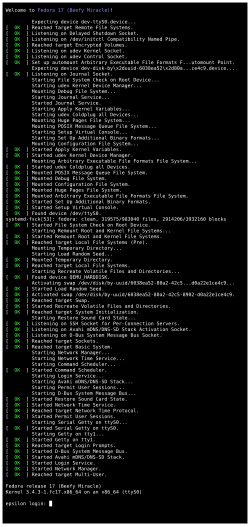
systemd is a software suite for system and service management on Linux built to unify service configuration and behavior across Linux distributions. Its main component is an init system used to bootstrap user space and manage user processes. It also provides replacements for various daemons and utilities, including device management, login management, network connection management, and event logging. The name systemd adheres to the Unix convention of naming daemons by appending the letter d, and also plays on the French phrase Système D (a person's ability to quickly adapt and improvise in the face of problems).
Since 2015, nearly all Linux distributions have adopted systemd. It has been praised by developers and users of distributions that adopted it for providing a stable, fast out-of-the-box solution for issues that had existed in the Linux space for years. At the time of its adoption, it was the only parallel boot and init system offering centralized management of processes, daemons, services, and mount points [citation needed].
Critics of systemd contend it suffers from feature creep and has damaged interoperability across Unix-like operating systems (as it does not run on non-Linux Unix derivatives like BSD or Solaris). In addition, they contend systemd's large feature set creates a larger attack surface. This has led to the development of several minor Linux distributions replacing systemd with other init systems like SysVinit or OpenRC.
Lennart Poettering and Kay Sievers, the software engineers then working for Red Hat who initially developed systemd, started a project to replace Linux's conventional System V init in 2010. An April 2010 blog post from Poettering, titled "Rethinking PID 1", introduced an experimental version of what would later become systemd. They sought to surpass the efficiency of the init daemon in several ways. They wanted to improve the software framework for expressing dependencies, to allow more processes to run concurrently or in parallel during system booting, and to reduce the computational overhead of the shell.
In May 2011, Fedora Linux became the first major Linux distribution to enable systemd by default, replacing Upstart. The reasoning at the time was that systemd provided extensive parallelization during startup, better management of processes and overall a saner, dependency-based approach to control of the system.
In October 2012, Arch Linux made systemd the default, switching from SysVinit. Developers had debated since August 2012 and concluded it was faster and had more features than SysVinit and that maintaining SysVinit was not worth the effort. Some thought the criticism of systemd was not based on actual shortcomings of the software but rather personal dislike of Poettering and a general opposition to change. Several complaints about systemd—including its use of D-bus, C instead of bash, and an optional on-disk journal format—were instead described as advantages by the Arch maintainers.
Between 2013 and 2014, the Debian Technical Committee engaged in a widely publicized debate on the mailing list about which init system to use as the default in Debian 8 before settling on systemd. Soon after, Debian developer Joey Hess, Technical Committee members Russ Allbery and Ian Jackson, and systemd package maintainer Tollef Fog Heen resigned from their positions, citing the extraordinary levels of stress caused by disputes on systemd integration within the Debian and FOSS community that rendered regular maintenance virtually impossible. Mark Shuttleworth announced soon afterwards that the Debian-based Ubuntu would use systemd to replace its old Upstart init system.
In August 2015, systemd started providing a login shell, callable via machinectl shell.
Systemd
systemd is a software suite for system and service management on Linux built to unify service configuration and behavior across Linux distributions. Its main component is an init system used to bootstrap user space and manage user processes. It also provides replacements for various daemons and utilities, including device management, login management, network connection management, and event logging. The name systemd adheres to the Unix convention of naming daemons by appending the letter d, and also plays on the French phrase Système D (a person's ability to quickly adapt and improvise in the face of problems).
Since 2015, nearly all Linux distributions have adopted systemd. It has been praised by developers and users of distributions that adopted it for providing a stable, fast out-of-the-box solution for issues that had existed in the Linux space for years. At the time of its adoption, it was the only parallel boot and init system offering centralized management of processes, daemons, services, and mount points [citation needed].
Critics of systemd contend it suffers from feature creep and has damaged interoperability across Unix-like operating systems (as it does not run on non-Linux Unix derivatives like BSD or Solaris). In addition, they contend systemd's large feature set creates a larger attack surface. This has led to the development of several minor Linux distributions replacing systemd with other init systems like SysVinit or OpenRC.
Lennart Poettering and Kay Sievers, the software engineers then working for Red Hat who initially developed systemd, started a project to replace Linux's conventional System V init in 2010. An April 2010 blog post from Poettering, titled "Rethinking PID 1", introduced an experimental version of what would later become systemd. They sought to surpass the efficiency of the init daemon in several ways. They wanted to improve the software framework for expressing dependencies, to allow more processes to run concurrently or in parallel during system booting, and to reduce the computational overhead of the shell.
In May 2011, Fedora Linux became the first major Linux distribution to enable systemd by default, replacing Upstart. The reasoning at the time was that systemd provided extensive parallelization during startup, better management of processes and overall a saner, dependency-based approach to control of the system.
In October 2012, Arch Linux made systemd the default, switching from SysVinit. Developers had debated since August 2012 and concluded it was faster and had more features than SysVinit and that maintaining SysVinit was not worth the effort. Some thought the criticism of systemd was not based on actual shortcomings of the software but rather personal dislike of Poettering and a general opposition to change. Several complaints about systemd—including its use of D-bus, C instead of bash, and an optional on-disk journal format—were instead described as advantages by the Arch maintainers.
Between 2013 and 2014, the Debian Technical Committee engaged in a widely publicized debate on the mailing list about which init system to use as the default in Debian 8 before settling on systemd. Soon after, Debian developer Joey Hess, Technical Committee members Russ Allbery and Ian Jackson, and systemd package maintainer Tollef Fog Heen resigned from their positions, citing the extraordinary levels of stress caused by disputes on systemd integration within the Debian and FOSS community that rendered regular maintenance virtually impossible. Mark Shuttleworth announced soon afterwards that the Debian-based Ubuntu would use systemd to replace its old Upstart init system.
In August 2015, systemd started providing a login shell, callable via machinectl shell.
Recent media
Recent media