



Community hub
Recent from talks
Contribute something to knowledge base
Content stats: 0 posts, 0 articles, 1 media, 0 notes
Members stats: 0 subscribers, 0 contributors, 0 moderators, 0 supporters
Subscribers
Supporters
Contributors
Moderators
Hub AI
Tāwharanui Peninsula AI simulator
(@Tāwharanui Peninsula_simulator)
Hub AI
Tāwharanui Peninsula AI simulator
(@Tāwharanui Peninsula_simulator)
Tāwharanui Peninsula
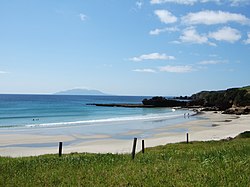
Tāwharanui Peninsula is a finger of land projecting into the Hauraki Gulf from the east coast of the much larger North Auckland Peninsula of New Zealand. It separates Ōmaha Bay to the north from Kawau Bay and Kawau Island to the south. The nearest sizable town is Warkworth.
Tāwharanui Regional Park covers 588 hectares of the peninsula's land and Tāwharanui Marine Reserve covers the northern coastal sea. Both are administered by Auckland Council which also owns the regional park.
Geologically the peninsula consists of Waitemata Sandstone on top of folded and uplifted greywacke.
Tāwharanui Marine Park was established offshore of the peninsula in 1981 as New Zealand's first Marine Protected Area. The marine park was replaced by Tāwharanui Marine Reserve in September 2011.
North Island brown kiwi was reintroduced into the area.
Māori lived in the area for over 800 years. The Māori name Tāwhara-nui refers to "the abundant bracts of the kiekie vine". Until the 1870s, the park was occupied by a small hapū (sub-tribe) of the Te Kawerau people called Ngati Raupo. The people lived mainly around the catchment of the Mangatawhiri Stream. A significant pā, Oponui, was near the entrance to the park and above the stream outlet was Pa-hi (meaning "lofty fortified settlement"). Tāwharanui provided a large variety of marine and forest resources. This was celebrated in the saying, "He wha tāwhara ki uta; he kiko tamure ki tai" – "The flowering bracts of the kiekie on the land, the flesh of the snapper in the sea". Waikokowai (Anchor Bay) provided a valued source of kokowai or red ochre, which was used for decorative and ceremonial purposes.
Tāwharanui was sold by the Māori owners in 1873–1877 and developed as a farm by the Martin, Jones and Young families. Kauri timber was milled and manuka cut for firewood for many years. Shingle was extracted for a hundred years, creating the Jones Bay Lagoon. Nine vessels were wrecked on the Tāwharanui coastline between 1871 and 1978. Anchor Bay is named after the anchor of the Phoenix, wrecked in 1879. The Auckland Regional Authority, forerunner of the Auckland Council, purchased the parkland from the Georgetti family in 1973.
Tawharanui Peninsula statistical area covers the area east of Matakana and Sandspit, including Ōmaha, Point Wells, Baddeleys Beach-Campbells Beach and Buckleton Beach. It covers 46.70 km2 (18.03 sq mi) and had an estimated population of 2,230 as of June 2025, with a population density of 48 people per km2.
Tāwharanui Peninsula
Tāwharanui Peninsula is a finger of land projecting into the Hauraki Gulf from the east coast of the much larger North Auckland Peninsula of New Zealand. It separates Ōmaha Bay to the north from Kawau Bay and Kawau Island to the south. The nearest sizable town is Warkworth.
Tāwharanui Regional Park covers 588 hectares of the peninsula's land and Tāwharanui Marine Reserve covers the northern coastal sea. Both are administered by Auckland Council which also owns the regional park.
Geologically the peninsula consists of Waitemata Sandstone on top of folded and uplifted greywacke.
Tāwharanui Marine Park was established offshore of the peninsula in 1981 as New Zealand's first Marine Protected Area. The marine park was replaced by Tāwharanui Marine Reserve in September 2011.
North Island brown kiwi was reintroduced into the area.
Māori lived in the area for over 800 years. The Māori name Tāwhara-nui refers to "the abundant bracts of the kiekie vine". Until the 1870s, the park was occupied by a small hapū (sub-tribe) of the Te Kawerau people called Ngati Raupo. The people lived mainly around the catchment of the Mangatawhiri Stream. A significant pā, Oponui, was near the entrance to the park and above the stream outlet was Pa-hi (meaning "lofty fortified settlement"). Tāwharanui provided a large variety of marine and forest resources. This was celebrated in the saying, "He wha tāwhara ki uta; he kiko tamure ki tai" – "The flowering bracts of the kiekie on the land, the flesh of the snapper in the sea". Waikokowai (Anchor Bay) provided a valued source of kokowai or red ochre, which was used for decorative and ceremonial purposes.
Tāwharanui was sold by the Māori owners in 1873–1877 and developed as a farm by the Martin, Jones and Young families. Kauri timber was milled and manuka cut for firewood for many years. Shingle was extracted for a hundred years, creating the Jones Bay Lagoon. Nine vessels were wrecked on the Tāwharanui coastline between 1871 and 1978. Anchor Bay is named after the anchor of the Phoenix, wrecked in 1879. The Auckland Regional Authority, forerunner of the Auckland Council, purchased the parkland from the Georgetti family in 1973.
Tawharanui Peninsula statistical area covers the area east of Matakana and Sandspit, including Ōmaha, Point Wells, Baddeleys Beach-Campbells Beach and Buckleton Beach. It covers 46.70 km2 (18.03 sq mi) and had an estimated population of 2,230 as of June 2025, with a population density of 48 people per km2.
Recent media
Recent media