


Community hub
Recent from talks
Contribute something to knowledge base
Content stats: 0 posts, 0 articles, 1 media, 0 notes
Members stats: 0 subscribers, 0 contributors, 0 moderators, 0 supporters
Subscribers
Supporters
Contributors
Moderators
Hub AI
T-35 AI simulator
(@T-35_simulator)
Hub AI
T-35 AI simulator
(@T-35_simulator)
T-35
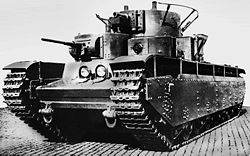
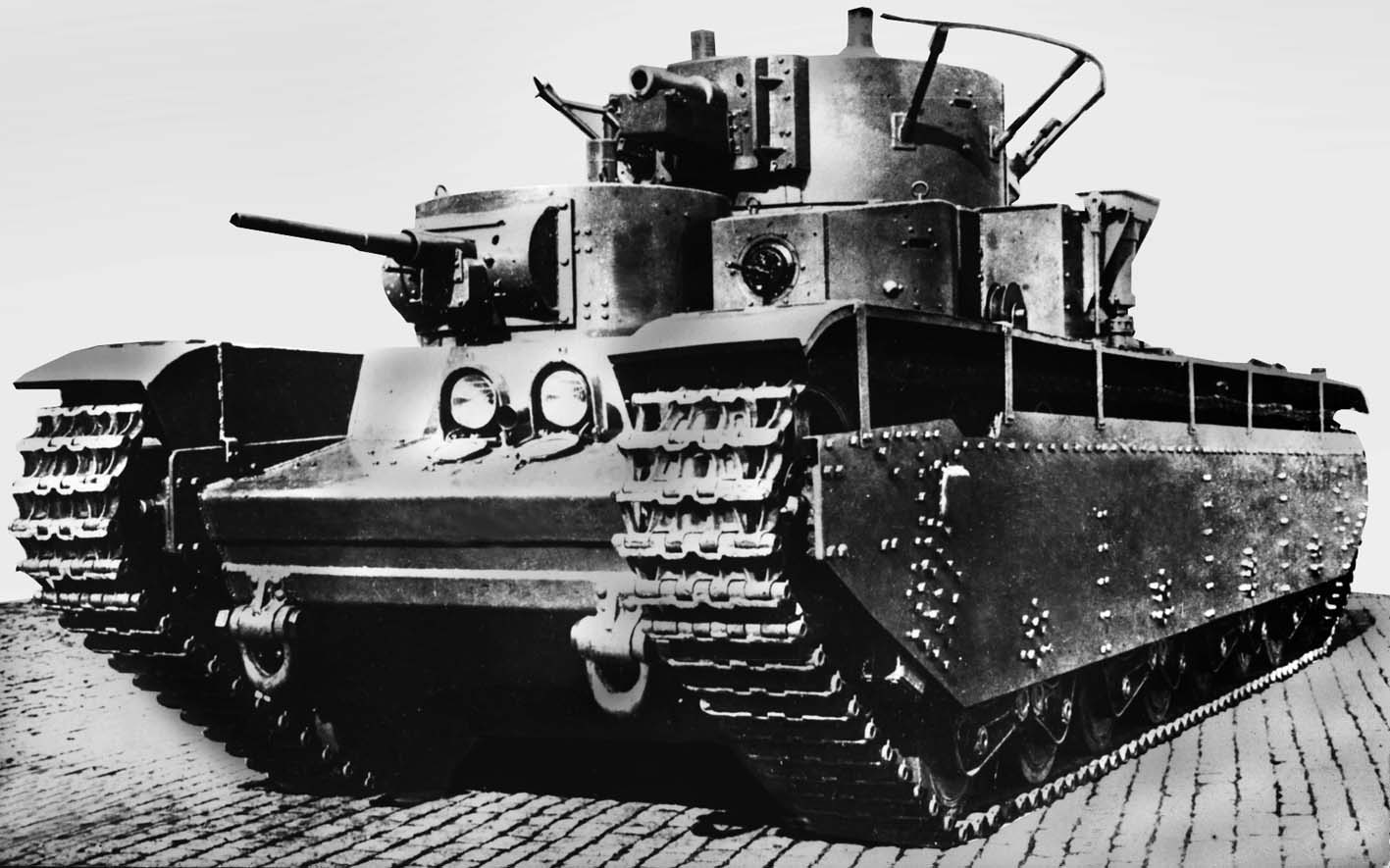
The T-35 was a Soviet multi-turreted heavy tank of the interwar period and early Second World War that saw limited service with the Red Army. Often called a "land battleship", it was the only five-turreted heavy tank in the world to reach production, but proved to be slow and mechanically unreliable. Most of the T-35 tanks still operational at the time of Operation Barbarossa were lost due to mechanical failure rather than enemy action. It was designed to complement the contemporary T-28 medium tank; however, very few were built.
Outwardly it was large, but internally the spaces were cramped with the fighting compartments separated from each other. Some of the turrets obscured the entrance hatches.
The T-35 was developed by the OKMO design bureau of the Bolshevik Factory, which began work on a heavy tank in 1930. Two teams developed separate designs. The team headed by German engineer Grotte worked on the 100-ton four-turreted TG-5 tank, armed with a 107 mm naval gun, using pneumatic servo-controls and pneumatic suspension. This project was later cancelled.
The concept of large, multi-turreted breakthrough tanks was favoured by several European armies in the 1920s and 1930s. Designs existed in Britain, France, and Germany for such vehicles. The second OKMO team, headed by N. Tsiets, worked on a tank similar to the British Vickers A1E1 Independent.
By July 1932, a prototype of a 35-ton tank with a 76.2 mm tank gun was completed. The first prototype was further enhanced with four smaller turrets, two with 37 mm guns and two with machine guns. This first prototype had severe defects in its transmission and was considered too complex and expensive for mass production. Work on it was therefore stopped and a new simpler prototype was built.
This new prototype received a new engine, new gearbox and improved transmission. The decision was also made to standardise the turrets used on the T-35 with those employed on the T-28, a triple-turreted medium tank. The small machine-gun turrets were identical on the two tanks. The large main turret housing the 76.2 mm gun was nearly identical, but those used on the T-28 had an additional, rear-firing machine gun.
On 11 August 1933, the T-35 was accepted for production. Engineering was shifted to the Kharkov Locomotive Factory, and two batches of ten vehicles were completed.
The experiences gained with the two prototypes were used for the main production T-35, which was again improved from the second prototype, with eight-wheel suspension, improved hull and 45-mm guns in place of the 37s. It started production in 1934, and 59 (including ones with conical turrets) were built by 1939. In general, throughout its production run small improvements were made to the individual tanks. Production tanks had medium turrets similar to the ones on the BT-5, but without the rear overhang. The final batch was a run of ten T-35 that had new turrets with sloped armour all around, as well as modified side skirts with suspension service hatches and new driver's hatch. Four of them had original fully vertical pedestal for the main turret, while the latter six had sloped pedestal.
T-35
The T-35 was a Soviet multi-turreted heavy tank of the interwar period and early Second World War that saw limited service with the Red Army. Often called a "land battleship", it was the only five-turreted heavy tank in the world to reach production, but proved to be slow and mechanically unreliable. Most of the T-35 tanks still operational at the time of Operation Barbarossa were lost due to mechanical failure rather than enemy action. It was designed to complement the contemporary T-28 medium tank; however, very few were built.
Outwardly it was large, but internally the spaces were cramped with the fighting compartments separated from each other. Some of the turrets obscured the entrance hatches.
The T-35 was developed by the OKMO design bureau of the Bolshevik Factory, which began work on a heavy tank in 1930. Two teams developed separate designs. The team headed by German engineer Grotte worked on the 100-ton four-turreted TG-5 tank, armed with a 107 mm naval gun, using pneumatic servo-controls and pneumatic suspension. This project was later cancelled.
The concept of large, multi-turreted breakthrough tanks was favoured by several European armies in the 1920s and 1930s. Designs existed in Britain, France, and Germany for such vehicles. The second OKMO team, headed by N. Tsiets, worked on a tank similar to the British Vickers A1E1 Independent.
By July 1932, a prototype of a 35-ton tank with a 76.2 mm tank gun was completed. The first prototype was further enhanced with four smaller turrets, two with 37 mm guns and two with machine guns. This first prototype had severe defects in its transmission and was considered too complex and expensive for mass production. Work on it was therefore stopped and a new simpler prototype was built.
This new prototype received a new engine, new gearbox and improved transmission. The decision was also made to standardise the turrets used on the T-35 with those employed on the T-28, a triple-turreted medium tank. The small machine-gun turrets were identical on the two tanks. The large main turret housing the 76.2 mm gun was nearly identical, but those used on the T-28 had an additional, rear-firing machine gun.
On 11 August 1933, the T-35 was accepted for production. Engineering was shifted to the Kharkov Locomotive Factory, and two batches of ten vehicles were completed.
The experiences gained with the two prototypes were used for the main production T-35, which was again improved from the second prototype, with eight-wheel suspension, improved hull and 45-mm guns in place of the 37s. It started production in 1934, and 59 (including ones with conical turrets) were built by 1939. In general, throughout its production run small improvements were made to the individual tanks. Production tanks had medium turrets similar to the ones on the BT-5, but without the rear overhang. The final batch was a run of ten T-35 that had new turrets with sloped armour all around, as well as modified side skirts with suspension service hatches and new driver's hatch. Four of them had original fully vertical pedestal for the main turret, while the latter six had sloped pedestal.
Recent media
Recent media