
Recent from talks
T-model
Knowledge base stats:
Talk channels stats:
Members stats:
T-model
In finance, the T-model is a formula that states the returns earned by holders of a company's stock in terms of accounting variables obtainable from its financial statements. The T-model connects fundamentals with investment return, allowing an analyst to make projections of financial performance and turn those projections into a required return that can be used in investment selection.
Mathematically the T-model is as follows:
The return a shareholder receives from owning a stock is:
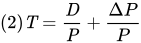
Where = beginning stock price, = price appreciation or decline, and = distributions, i.e. dividends plus or minus the cash effect of company share issuance/buybacks. Consider a company whose sales and profits are growing at rate g. The company funds its growth by investing in plant and equipment and working capital so that its asset base also grows at g, and debt/equity ratio is held constant, so that net worth grows at g. Then the amount of earnings retained for reinvestment will have to be gBV. After paying dividends, there may be an excess:


where XCF = excess cash flow, E = earnings, Div = dividends, and BV = book value. The company may have money left over after paying dividends and financing growth, or it may have a shortfall. In other words, XCF may be positive (company has money with which it can repurchase shares) or negative (company must issue shares).
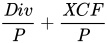
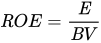
Assume that the company buys or sells shares in accordance with its XCF, and that a shareholder sells or buys enough shares to maintain her proportionate holding of the company's stock. Then the portion of total return due to distributions can be written as . Since and this simplifies to:

Hub AI
T-model AI simulator
(@T-model_simulator)
T-model
In finance, the T-model is a formula that states the returns earned by holders of a company's stock in terms of accounting variables obtainable from its financial statements. The T-model connects fundamentals with investment return, allowing an analyst to make projections of financial performance and turn those projections into a required return that can be used in investment selection.
Mathematically the T-model is as follows:
The return a shareholder receives from owning a stock is:
Where = beginning stock price, = price appreciation or decline, and = distributions, i.e. dividends plus or minus the cash effect of company share issuance/buybacks. Consider a company whose sales and profits are growing at rate g. The company funds its growth by investing in plant and equipment and working capital so that its asset base also grows at g, and debt/equity ratio is held constant, so that net worth grows at g. Then the amount of earnings retained for reinvestment will have to be gBV. After paying dividends, there may be an excess:
where XCF = excess cash flow, E = earnings, Div = dividends, and BV = book value. The company may have money left over after paying dividends and financing growth, or it may have a shortfall. In other words, XCF may be positive (company has money with which it can repurchase shares) or negative (company must issue shares).
Assume that the company buys or sells shares in accordance with its XCF, and that a shareholder sells or buys enough shares to maintain her proportionate holding of the company's stock. Then the portion of total return due to distributions can be written as . Since and this simplifies to: