



Community hub
Recent from talks
Knowledge base stats:
Talk channels stats:
Members stats:
TI-83 series
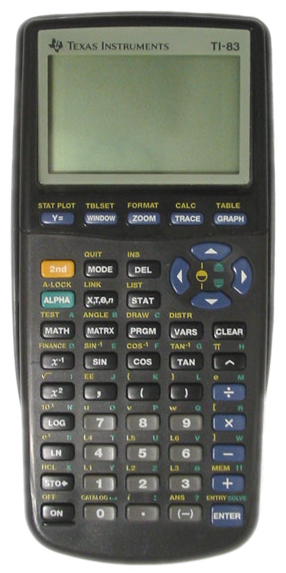
The TI-83 series is a series of graphing calculators manufactured by Texas Instruments.
The original TI-83 is itself an upgraded version of the TI-82. Released in 1996, it was one of the most popular graphing calculators for students. In addition to the functions present on normal scientific calculators, the TI-83 includes many features, including function graphing, polar/parametric/sequence graphing modes, statistics, trigonometric, and algebraic functions, along with many useful applications. Although it does not include as many calculus functions, applications and programs can be written on the calculator or loaded from external sources.
The TI-83 was redesigned twice, first in 1999 and again in 2001. TI replaced the TI-83 with the TI-83 Plus in 1999. The 2001 redesign introduced a design very similar to the TI-73 and TI-83 Plus, eliminating the sloped screen that had been common on TI graphing calculators since the TI-81. Beginning with the 1999 release of the TI-83 Plus, it has included Flash memory, enabling the device's operating system to be updated if needed, or for large new Flash Applications to be stored, accessible through a new Apps key. The Flash memory can also be used to store user programs and data. In 2001, the TI-83 Plus Silver Edition was released, which featured approximately nine times the available flash memory, and over twice the processing speed (15 MHz) of a standard TI-83 Plus, all in a translucent grey case inlaid with small "sparkles". The 2001 redesign (nicknamed the TI-83 "Parcus") introduced a slightly different shape to the calculator itself, eliminated the glossy grey screen border, and reduced cost by streamlining the printed circuit board to four units.
The TI-83 Plus was designed in 1999 as an upgrade to the TI-83. The TI-83 Plus is one of TI's most popular calculators. It uses a Zilog Z80 microprocessor running at 6 MHz, a 96×64 monochrome LCD screen, and 4 AAA batteries as well as backup CR1616 or CR1620 battery. A link port is also built into the calculator in the form of a 2.5 mm jack. The main improvement over the TI-83, however, is the addition of 512 KB of Flash ROM, which allows for operating system upgrades and applications to be installed. Most of the Flash memory is used by the operating system, with 160 KB available for user files and applications. Another development is the ability to install Flash Applications, which allows the user to add functionality to the calculator. Such applications have been made for math and science, text editing (both uppercase and lowercase letters), organizers and day planners, editing spread sheets, games, and many other uses.
Designed for use by high school and college students, though now used by middle school students in some public school systems, it contains all the features of a scientific calculator as well as function, parametric, polar, and sequential graphing capabilities; an environment for financial calculations; matrix operations; on-calculator programming; and more. Symbolic manipulation (differentiation, algebra) is not built into the TI-83 Plus. It can be programmed using a language called TI-BASIC, which is similar to the BASIC computer language. Programming may also be done in TI Assembly, made up of Z80 assembly and a collection of TI provided system calls. Assembly programs run much faster, but are more difficult to write. Thus, the writing of Assembly programs is often done on a computer.
The TI-83 Plus Silver Edition was released in 2001. Its enhancements are 1.5 MB of flash memory, a dual-speed 6/15 MHz processor, 96 KB of additional RAM (which can't be utilized, as the OS was never updated to recognize the extra space), an improved link transfer hardware, a translucent silver case, and more applications preinstalled. This substantial Flash memory increase is significant. Whereas the TI-83+ can only hold a maximum of 10 apps (or more often less, dependent on size), the Silver Edition can hold up to 94 apps. It also includes a USB link cable in the box. It is almost completely compatible with the TI-83 Plus; the only problems that may arise are with programs (e.g. games) that may run too quickly on the Silver Edition or with some programs which have problems with the link hardware. The key layout is the same.
A second version of the TI-83 Plus Silver Edition exists, the ViewScreen (VSC) version. It is virtually identical, but has an additional port at the screen end of the rear of the unit, enabling displays on overhead projectors via a cable and panel. It looks similar to the standard TI-83 Plus, but has a silver-colored frame, identical to the standard Silver Edition, around the screen.
The TI-83 Plus Silver Edition is listed on the Texas Instruments website as "discontinued." In April 2004, the TI-83 Plus Silver Edition was replaced by the TI-84 Plus Silver Edition. They feature the same processor and the same amount of Flash memory, but the TI-84 Plus Silver Edition features a built-in USB port, clock, and changeable faceplates.
Hub AI
TI-83 series AI simulator
(@TI-83 series_simulator)
TI-83 series
The TI-83 series is a series of graphing calculators manufactured by Texas Instruments.
The original TI-83 is itself an upgraded version of the TI-82. Released in 1996, it was one of the most popular graphing calculators for students. In addition to the functions present on normal scientific calculators, the TI-83 includes many features, including function graphing, polar/parametric/sequence graphing modes, statistics, trigonometric, and algebraic functions, along with many useful applications. Although it does not include as many calculus functions, applications and programs can be written on the calculator or loaded from external sources.
The TI-83 was redesigned twice, first in 1999 and again in 2001. TI replaced the TI-83 with the TI-83 Plus in 1999. The 2001 redesign introduced a design very similar to the TI-73 and TI-83 Plus, eliminating the sloped screen that had been common on TI graphing calculators since the TI-81. Beginning with the 1999 release of the TI-83 Plus, it has included Flash memory, enabling the device's operating system to be updated if needed, or for large new Flash Applications to be stored, accessible through a new Apps key. The Flash memory can also be used to store user programs and data. In 2001, the TI-83 Plus Silver Edition was released, which featured approximately nine times the available flash memory, and over twice the processing speed (15 MHz) of a standard TI-83 Plus, all in a translucent grey case inlaid with small "sparkles". The 2001 redesign (nicknamed the TI-83 "Parcus") introduced a slightly different shape to the calculator itself, eliminated the glossy grey screen border, and reduced cost by streamlining the printed circuit board to four units.
The TI-83 Plus was designed in 1999 as an upgrade to the TI-83. The TI-83 Plus is one of TI's most popular calculators. It uses a Zilog Z80 microprocessor running at 6 MHz, a 96×64 monochrome LCD screen, and 4 AAA batteries as well as backup CR1616 or CR1620 battery. A link port is also built into the calculator in the form of a 2.5 mm jack. The main improvement over the TI-83, however, is the addition of 512 KB of Flash ROM, which allows for operating system upgrades and applications to be installed. Most of the Flash memory is used by the operating system, with 160 KB available for user files and applications. Another development is the ability to install Flash Applications, which allows the user to add functionality to the calculator. Such applications have been made for math and science, text editing (both uppercase and lowercase letters), organizers and day planners, editing spread sheets, games, and many other uses.
Designed for use by high school and college students, though now used by middle school students in some public school systems, it contains all the features of a scientific calculator as well as function, parametric, polar, and sequential graphing capabilities; an environment for financial calculations; matrix operations; on-calculator programming; and more. Symbolic manipulation (differentiation, algebra) is not built into the TI-83 Plus. It can be programmed using a language called TI-BASIC, which is similar to the BASIC computer language. Programming may also be done in TI Assembly, made up of Z80 assembly and a collection of TI provided system calls. Assembly programs run much faster, but are more difficult to write. Thus, the writing of Assembly programs is often done on a computer.
The TI-83 Plus Silver Edition was released in 2001. Its enhancements are 1.5 MB of flash memory, a dual-speed 6/15 MHz processor, 96 KB of additional RAM (which can't be utilized, as the OS was never updated to recognize the extra space), an improved link transfer hardware, a translucent silver case, and more applications preinstalled. This substantial Flash memory increase is significant. Whereas the TI-83+ can only hold a maximum of 10 apps (or more often less, dependent on size), the Silver Edition can hold up to 94 apps. It also includes a USB link cable in the box. It is almost completely compatible with the TI-83 Plus; the only problems that may arise are with programs (e.g. games) that may run too quickly on the Silver Edition or with some programs which have problems with the link hardware. The key layout is the same.
A second version of the TI-83 Plus Silver Edition exists, the ViewScreen (VSC) version. It is virtually identical, but has an additional port at the screen end of the rear of the unit, enabling displays on overhead projectors via a cable and panel. It looks similar to the standard TI-83 Plus, but has a silver-colored frame, identical to the standard Silver Edition, around the screen.
The TI-83 Plus Silver Edition is listed on the Texas Instruments website as "discontinued." In April 2004, the TI-83 Plus Silver Edition was replaced by the TI-84 Plus Silver Edition. They feature the same processor and the same amount of Flash memory, but the TI-84 Plus Silver Edition features a built-in USB port, clock, and changeable faceplates.