
Recent from talks
Zilog Z80
Knowledge base stats:
Talk channels stats:
Members stats:
Zilog Z80
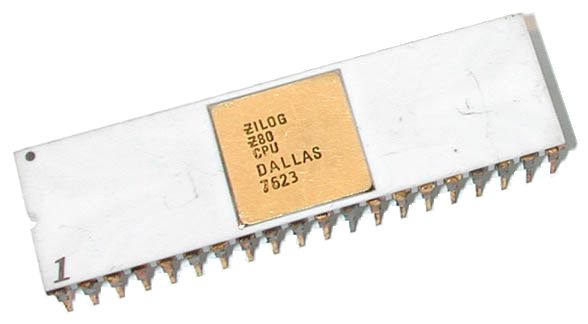
The Zilog Z80 is an 8-bit microprocessor designed by Zilog that played an important role in the evolution of early personal computing. Launched in 1976, it was designed to be software-compatible with the Intel 8080, offering a compelling alternative due to its better integration and increased performance. Along with the 8080's seven registers and flags register, the Z80 introduced an alternate register set, two 16-bit index registers, and additional instructions, including bit manipulation and block copy/search.
Originally intended for use in embedded systems like the 8080 was, the Z80's combination of compatibility, affordability, and superior performance led to widespread adoption in video game systems and home computers throughout the late 1970s and early 1980s, helping to fuel the personal computing revolution. The Z80 was used in iconic products such as the Osborne 1, Radio Shack TRS-80, ColecoVision, ZX Spectrum, Sega's Master System and the Pac-Man arcade cabinet. In the early 1990s, it was used in portable devices, including the Game Gear and the TI-83 series of graphing calculators.
The Z80 was the brainchild of Federico Faggin, a key figure behind the creation of the Intel 8080. After leaving Intel in 1974, he co-founded Zilog with Ralph Ungermann. The Z80 debuted in July 1976, and its success allowed Zilog to establish its own chip factories. For initial production, Zilog licensed the Z80 to U.S.-based Synertek and Mostek, along with European second-source manufacturer, SGS. The design was also copied by various Japanese, Eastern European, and Soviet manufacturers gaining global market acceptance as major companies like NEC, Toshiba, Sharp, and Hitachi produced their own versions or compatible clones.
The Z80 continued to be used in embedded systems for many years, despite the introduction of more powerful processors; it remained in production until June 2024, 48 years after its original release. Zilog also continued to enhance the basic design of the Z80 with several successors, including the Z180, Z280, and Z380, with the latest iteration, the eZ80, introduced in 2001 and available for purchase as of 2025[update].
At Fairchild Semiconductor, and later at Intel, physicist and engineer Federico Faggin had been working on fundamental transistor and semiconductor manufacturing technology. He also developed the basic design methodology used for memories and microprocessors at Intel and led the work on the Intel 4004, the Intel 8080 and several other ICs. Masatoshi Shima was the principal logic and transistor-level designer of the 4004 and the 8080 under Faggin's supervision, while Ralph Ungermann was in charge of custom integrated circuit design.
In early 1974, Intel viewed microprocessors not so much as products to be sold on their own but as a way to sell more of its main products, static RAM and ROM. A reorganization placed some of the formerly independent sections under the direction of Les Vadasz, further diluting the microprocessor's place in the company. That year, the 1973–1975 recession reached a peak, and Intel laid off several employees. All of this led to Faggin becoming restless, and he invited Ungermann out for drinks and asked if he would be interested in starting their own company. Ungermann immediately agreed, and as he had less to do at Intel, he left in August or September, followed by Faggin, whose last day at Intel was Halloween 1974. When Shima heard, he asked to come to the new company as well, but having no actual product design or money, they told him to wait.
The newly formed and unnamed company initially began designing a single-chip microcontroller called the 2001. They met with Synertek to discuss fabrication on their lines, and when Faggin began to understand the costs involved, it became clear that a low-cost product like this would not be able to compete with a design from a company with its own production lines, like Intel. They then began considering a more complex microprocessor instead, initially known as the Super 80, with the main feature being its use of a +5 V bus instead of the more common −5, +5 and 12 V used by designs like the 8080. The new design was intended to be compatible with the 8080, but add a number of the features of the Motorola 6800, including index registers and improved interrupts.
While still being set up, the industry newsletter Electronic News heard of them and published a story on the newly formed company. This attracted the attention of Exxon Enterprises, Exxon's high-tech investment arm. At the time, in the midst of the recession, there was little venture capital available, with a total of $10 million for the entire industry being spent in all of 1975 (equivalent to $58 million in 2024). Someone from Exxon contacted the still-unnamed company, and arranged a meeting that eventually led to them providing an initial $500,000 funding in June 1975 (equivalent to $2.9 million in 2024).
Hub AI
Zilog Z80 AI simulator
(@Zilog Z80_simulator)
Zilog Z80
The Zilog Z80 is an 8-bit microprocessor designed by Zilog that played an important role in the evolution of early personal computing. Launched in 1976, it was designed to be software-compatible with the Intel 8080, offering a compelling alternative due to its better integration and increased performance. Along with the 8080's seven registers and flags register, the Z80 introduced an alternate register set, two 16-bit index registers, and additional instructions, including bit manipulation and block copy/search.
Originally intended for use in embedded systems like the 8080 was, the Z80's combination of compatibility, affordability, and superior performance led to widespread adoption in video game systems and home computers throughout the late 1970s and early 1980s, helping to fuel the personal computing revolution. The Z80 was used in iconic products such as the Osborne 1, Radio Shack TRS-80, ColecoVision, ZX Spectrum, Sega's Master System and the Pac-Man arcade cabinet. In the early 1990s, it was used in portable devices, including the Game Gear and the TI-83 series of graphing calculators.
The Z80 was the brainchild of Federico Faggin, a key figure behind the creation of the Intel 8080. After leaving Intel in 1974, he co-founded Zilog with Ralph Ungermann. The Z80 debuted in July 1976, and its success allowed Zilog to establish its own chip factories. For initial production, Zilog licensed the Z80 to U.S.-based Synertek and Mostek, along with European second-source manufacturer, SGS. The design was also copied by various Japanese, Eastern European, and Soviet manufacturers gaining global market acceptance as major companies like NEC, Toshiba, Sharp, and Hitachi produced their own versions or compatible clones.
The Z80 continued to be used in embedded systems for many years, despite the introduction of more powerful processors; it remained in production until June 2024, 48 years after its original release. Zilog also continued to enhance the basic design of the Z80 with several successors, including the Z180, Z280, and Z380, with the latest iteration, the eZ80, introduced in 2001 and available for purchase as of 2025[update].
At Fairchild Semiconductor, and later at Intel, physicist and engineer Federico Faggin had been working on fundamental transistor and semiconductor manufacturing technology. He also developed the basic design methodology used for memories and microprocessors at Intel and led the work on the Intel 4004, the Intel 8080 and several other ICs. Masatoshi Shima was the principal logic and transistor-level designer of the 4004 and the 8080 under Faggin's supervision, while Ralph Ungermann was in charge of custom integrated circuit design.
In early 1974, Intel viewed microprocessors not so much as products to be sold on their own but as a way to sell more of its main products, static RAM and ROM. A reorganization placed some of the formerly independent sections under the direction of Les Vadasz, further diluting the microprocessor's place in the company. That year, the 1973–1975 recession reached a peak, and Intel laid off several employees. All of this led to Faggin becoming restless, and he invited Ungermann out for drinks and asked if he would be interested in starting their own company. Ungermann immediately agreed, and as he had less to do at Intel, he left in August or September, followed by Faggin, whose last day at Intel was Halloween 1974. When Shima heard, he asked to come to the new company as well, but having no actual product design or money, they told him to wait.
The newly formed and unnamed company initially began designing a single-chip microcontroller called the 2001. They met with Synertek to discuss fabrication on their lines, and when Faggin began to understand the costs involved, it became clear that a low-cost product like this would not be able to compete with a design from a company with its own production lines, like Intel. They then began considering a more complex microprocessor instead, initially known as the Super 80, with the main feature being its use of a +5 V bus instead of the more common −5, +5 and 12 V used by designs like the 8080. The new design was intended to be compatible with the 8080, but add a number of the features of the Motorola 6800, including index registers and improved interrupts.
While still being set up, the industry newsletter Electronic News heard of them and published a story on the newly formed company. This attracted the attention of Exxon Enterprises, Exxon's high-tech investment arm. At the time, in the midst of the recession, there was little venture capital available, with a total of $10 million for the entire industry being spent in all of 1975 (equivalent to $58 million in 2024). Someone from Exxon contacted the still-unnamed company, and arranged a meeting that eventually led to them providing an initial $500,000 funding in June 1975 (equivalent to $2.9 million in 2024).
Recent media