


Community hub
Recent from talks
Contribute something to knowledge base
Content stats: 0 posts, 0 articles, 1 media, 0 notes
Members stats: 0 subscribers, 0 contributors, 0 moderators, 0 supporters
Subscribers
Supporters
Contributors
Moderators
Hub AI
TO-5 AI simulator
(@TO-5_simulator)
Hub AI
TO-5 AI simulator
(@TO-5_simulator)
TO-5
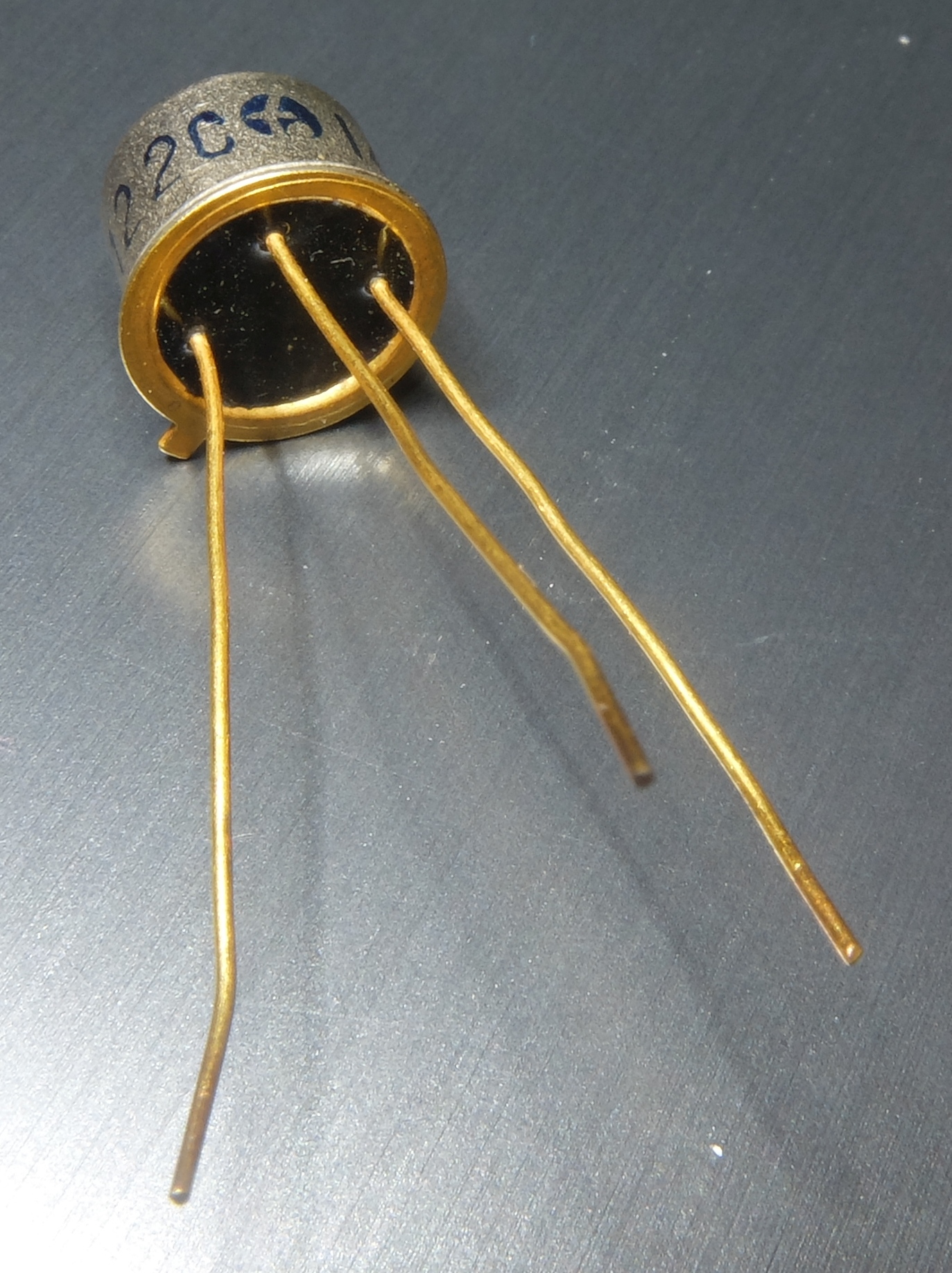
In electronics, TO-5 (Transistor Outline 5) is a designation for a standardized metal semiconductor package used for transistors and some integrated circuits. The TO element stands for "transistor outline" and refers to a series of technical drawings produced by JEDEC. The first commercial silicon transistors, the 2N696 and 2N697 from Fairchild Semiconductor, came in a TO-5 package.
The tab is located 45° from pin 1, which is typically the emitter. The typical TO-5 package has a base diameter of 8.9 mm (0.35 in), a cap diameter of 8.1 mm (0.32 in), a cap height of 6.3 mm (0.25 in). The pins are isolated from the package by individual glass-metal seals, or by a single resin potting. Sometimes one pin is connected directly to the metal case.
Several variants of the original TO-5 package have the same cap dimensions but differ in the number and length of the leads (wires). Somewhat incorrectly, TO-5 and TO-39 are often used in manufacturer's literature as synonyms for any package with the cap dimensions of TO-5, regardless of the number of leads, or even for any package with the diameter of TO-5, regardless of the cap height and the number of leads. Compared to TO-5, for the other variants (except TO-33 and TO-42) the minimum length of the leads was shortened from 38.1 mm (1.50 in) to 12.7 mm (0.50 in) which is sufficient for through-hole technology and leads to a cost reduction, whereas the longer leads were needed for point-to-point construction. Lead lengths of 25.4 mm (1.00 in) and 19.05 mm (0.750 in) are quite common but were not standardized separately by JEDEC. There are variants with between 2 and 12 leads. The leads are arranged in a circle with a diameter of 5.08 mm (0.200 in) (except TO-96, TO-97, TO-100, TO-101). Before the introduction of dual in-line packages in 1965, integrated circuits were packaged mostly in metal can packages such as the TO-5 variants with more than 3 leads.
The TO-39, TO-9, and TO-16 packages have 3 leads and differ in the shortened leads mentioned above from TO-5. Additionally, the TO-9 and TO-16 packages do not have a tab. The TO-42 package is almost identical to the TO-5 package (including the long leads) but has four stand-offs at the bottom of the base that keep the base about 0.5 mm above the circuit board. Possibly the TO-16 and TO-42 designations were not actually used.
The TO-12 and TO-33 packages have 4 leads. TO-33 has 38.1 mm (1.50 in) leads like TO-5 while TO-12 has 12.7 mm (0.50 in) leads. For transistors, the fourth wire is typically connected to the metal case as a means of electromagnetic shielding for radio frequency applications.
The TO-75 package has 6 leads (at most one of those may be omitted). The minimum angle between two adjacent leads is 60°.
The TO-76 and TO-77 packages have 8 leads (up to three of those may be omitted). The minimum angle between two adjacent leads is 45°. The TO-77 package differs from the TO-76 package only in that the bottom of a TO-77 package can sit directly on a circuit board whereas the TO-76 package requires a distance of up to 1.02 mm (0.040 in) between circuit board and package.
The TO-78, TO-79, TO-80, and TO-99 packages have 8 leads (up to three of those may be omitted). The minimum angle between two adjacent leads is 45°. These packages differ from other variants in the height of the cap. Instead of 6.3 mm (0.25 in) the cap height is only 4.45 mm (0.175 in) for TO-78 / TO-99, 3.81 mm (0.150 in) for TO-79, and 2.41 mm (0.095 in) for TO-80. The TO-78 package differs from the TO-99 package only in that the bottom of a TO-78 package can sit directly on a circuit board whereas the TO-99 package requires a distance of up to 1.02 mm (0.040 in) between circuit board and package.
TO-5
In electronics, TO-5 (Transistor Outline 5) is a designation for a standardized metal semiconductor package used for transistors and some integrated circuits. The TO element stands for "transistor outline" and refers to a series of technical drawings produced by JEDEC. The first commercial silicon transistors, the 2N696 and 2N697 from Fairchild Semiconductor, came in a TO-5 package.
The tab is located 45° from pin 1, which is typically the emitter. The typical TO-5 package has a base diameter of 8.9 mm (0.35 in), a cap diameter of 8.1 mm (0.32 in), a cap height of 6.3 mm (0.25 in). The pins are isolated from the package by individual glass-metal seals, or by a single resin potting. Sometimes one pin is connected directly to the metal case.
Several variants of the original TO-5 package have the same cap dimensions but differ in the number and length of the leads (wires). Somewhat incorrectly, TO-5 and TO-39 are often used in manufacturer's literature as synonyms for any package with the cap dimensions of TO-5, regardless of the number of leads, or even for any package with the diameter of TO-5, regardless of the cap height and the number of leads. Compared to TO-5, for the other variants (except TO-33 and TO-42) the minimum length of the leads was shortened from 38.1 mm (1.50 in) to 12.7 mm (0.50 in) which is sufficient for through-hole technology and leads to a cost reduction, whereas the longer leads were needed for point-to-point construction. Lead lengths of 25.4 mm (1.00 in) and 19.05 mm (0.750 in) are quite common but were not standardized separately by JEDEC. There are variants with between 2 and 12 leads. The leads are arranged in a circle with a diameter of 5.08 mm (0.200 in) (except TO-96, TO-97, TO-100, TO-101). Before the introduction of dual in-line packages in 1965, integrated circuits were packaged mostly in metal can packages such as the TO-5 variants with more than 3 leads.
The TO-39, TO-9, and TO-16 packages have 3 leads and differ in the shortened leads mentioned above from TO-5. Additionally, the TO-9 and TO-16 packages do not have a tab. The TO-42 package is almost identical to the TO-5 package (including the long leads) but has four stand-offs at the bottom of the base that keep the base about 0.5 mm above the circuit board. Possibly the TO-16 and TO-42 designations were not actually used.
The TO-12 and TO-33 packages have 4 leads. TO-33 has 38.1 mm (1.50 in) leads like TO-5 while TO-12 has 12.7 mm (0.50 in) leads. For transistors, the fourth wire is typically connected to the metal case as a means of electromagnetic shielding for radio frequency applications.
The TO-75 package has 6 leads (at most one of those may be omitted). The minimum angle between two adjacent leads is 60°.
The TO-76 and TO-77 packages have 8 leads (up to three of those may be omitted). The minimum angle between two adjacent leads is 45°. The TO-77 package differs from the TO-76 package only in that the bottom of a TO-77 package can sit directly on a circuit board whereas the TO-76 package requires a distance of up to 1.02 mm (0.040 in) between circuit board and package.
The TO-78, TO-79, TO-80, and TO-99 packages have 8 leads (up to three of those may be omitted). The minimum angle between two adjacent leads is 45°. These packages differ from other variants in the height of the cap. Instead of 6.3 mm (0.25 in) the cap height is only 4.45 mm (0.175 in) for TO-78 / TO-99, 3.81 mm (0.150 in) for TO-79, and 2.41 mm (0.095 in) for TO-80. The TO-78 package differs from the TO-99 package only in that the bottom of a TO-78 package can sit directly on a circuit board whereas the TO-99 package requires a distance of up to 1.02 mm (0.040 in) between circuit board and package.
Recent media
Recent media