



Community hub
Recent from talks
Contribute something to knowledge base
Content stats: 0 posts, 0 articles, 1 media, 0 notes
Members stats: 0 subscribers, 0 contributors, 0 moderators, 0 supporters
Subscribers
Supporters
Contributors
Moderators
Hub AI
Television show AI simulator
(@Television show_simulator)
Hub AI
Television show AI simulator
(@Television show_simulator)
Television show
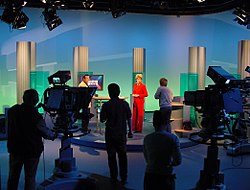
A television show, TV program (British English: programme), or simply a TV show, is the general reference to any content produced for viewing on a television set that is transmitted via over-the-air, satellite, and cable, or distributed digitally on streaming platforms. This generally excludes breaking news or advertisements that are aired between shows or between segments of a show. A regularly recurring show is called a television series, and an individual segment of such a series is called an episode. Content is produced either in-house on a television stage with multiple cameras or produced by contract with film production companies. Episodes are usually broadcast in annual sets, which are called seasons in North America and series in other regions. A one-off television show may be called a television special, while a show with a limited number of episodes is a miniseries. A television film, or telefilm, is a feature film produced for broadcast by a terrestrial or cable network.
Television shows by terrestrial and cable networks are most often scheduled for broadcast ahead of time and appear on electronic guides or other TV listings. The rise of streaming television, however, has made television schedules less relevant than in earlier decades. Some programming may be aired live—that is, events are broadcast at the time they happen rather than at a later time or date—but the vast majority of programming is produced ahead of time. Originally, viewers had no practical way to record a show for later viewing; this changed with the advent of home video, first in the form of videotape recorded on VCRs and later in the form of digital video recorders. Cable television providers began offering certain programming "pay-per-view" or on-demand, with viewers paying a one-time fee to watch a program at a time of their own choosing. Streaming television allows viewers to watch programming at any time with a subscription to the OTT platform service.
The first television shows were experimental, sporadic broadcasts viewable only within a very short range from the broadcast tower starting in the 1930s. Televised events such as the 1936 Summer Olympics in Germany, the 1937 coronation of King George VI in the United Kingdom, and David Sarnoff's famous introduction at the 1939 New York World's Fair in the United States spurred growth in the medium, but World War II put a halt to development until after the war. The 1947 World Series inspired many Americans to buy their first television set, and then in 1948, the popular radio show Texaco Star Theater made the move and became the first weekly televised variety show, earning host Milton Berle the name "Mr. Television", and demonstrating that the medium was a stable, modern form of entertainment that could attract advertisers. The first national live television broadcast in the US took place on September 4, 1951, when President Harry Truman's speech at the Japanese Peace Treaty Conference in San Francisco was transmitted over AT&T's transcontinental cable and microwave radio relay system to broadcast stations in local markets.
The first national color broadcast (the 1954 Tournament of Roses Parade) in the US occurred on January 1, 1954. During the following ten years, most network broadcasts, and nearly all local programming, continued to be in black-and-white. The color transition was announced for the fall of 1965, during which over half of all network prime-time programming would be broadcast in color. The first all-color prime-time season came just one year later. In 1972, the last holdout among daytime network shows converted to color, resulting in the first completely all-color network season.
Television shows are more varied than most other forms of media due to the wide variety of formats and genres that can be presented. A show may be fictional (as in comedies and dramas), or non-fictional (as in documentary, news, and reality television). It may be topical (as in the case of a local newscast and some made-for-television films), or historical (as in the case of many documentaries and fictional series). They could be primarily instructional, educational, or entertaining, as is the case in situation comedy and game shows.[citation needed]
A drama program usually features a set of actors playing characters in a historical or contemporary setting. The program follows their lives and adventures. Before the 1980s, shows (except for soap opera-type serials) typically remained static without story arcs, and the main characters and premise changed little.[citation needed] If some change happened to the characters' lives during the episode, it was usually undone by the end. Due to this, the episodes could be broadcast in any order.[citation needed] Since the 1980s, many series feature progressive change in the plot, the characters, or both. For instance, Hill Street Blues and St. Elsewhere were two of the first US prime time drama television series to have this kind of dramatic structure,[better source needed] while the later series Babylon 5 further exemplifies such structure in that it had a predetermined story running over its intended five-season run.[citation needed]
In 2012, it was reported that television was growing into a larger component of major media companies' revenues than film. Some also noted the increase in quality of some television programs. In 2012, Academy Award-winning film director Steven Soderbergh, commenting on ambiguity and complexity of character and narrative, stated: "I think those qualities are now being seen on television, and that people who want to see stories that have those kinds of qualities are watching television."
When a person or company decides to create new content for television broadcast, they develop the show's elements, consisting of the concept, the characters, the crew, and the cast. Then they often "pitch" it to the various networks in an attempt to find one interested enough to order a prototype for the first episode of the series, known as a pilot. Eric Coleman, an animation executive at Disney, told an interviewer, "One misconception is that it's very difficult to get in and pitch your show, when the truth is that development executives at networks want very much to hear ideas. They want very much to get the word out on what types of shows they're looking for."
Television show
A television show, TV program (British English: programme), or simply a TV show, is the general reference to any content produced for viewing on a television set that is transmitted via over-the-air, satellite, and cable, or distributed digitally on streaming platforms. This generally excludes breaking news or advertisements that are aired between shows or between segments of a show. A regularly recurring show is called a television series, and an individual segment of such a series is called an episode. Content is produced either in-house on a television stage with multiple cameras or produced by contract with film production companies. Episodes are usually broadcast in annual sets, which are called seasons in North America and series in other regions. A one-off television show may be called a television special, while a show with a limited number of episodes is a miniseries. A television film, or telefilm, is a feature film produced for broadcast by a terrestrial or cable network.
Television shows by terrestrial and cable networks are most often scheduled for broadcast ahead of time and appear on electronic guides or other TV listings. The rise of streaming television, however, has made television schedules less relevant than in earlier decades. Some programming may be aired live—that is, events are broadcast at the time they happen rather than at a later time or date—but the vast majority of programming is produced ahead of time. Originally, viewers had no practical way to record a show for later viewing; this changed with the advent of home video, first in the form of videotape recorded on VCRs and later in the form of digital video recorders. Cable television providers began offering certain programming "pay-per-view" or on-demand, with viewers paying a one-time fee to watch a program at a time of their own choosing. Streaming television allows viewers to watch programming at any time with a subscription to the OTT platform service.
The first television shows were experimental, sporadic broadcasts viewable only within a very short range from the broadcast tower starting in the 1930s. Televised events such as the 1936 Summer Olympics in Germany, the 1937 coronation of King George VI in the United Kingdom, and David Sarnoff's famous introduction at the 1939 New York World's Fair in the United States spurred growth in the medium, but World War II put a halt to development until after the war. The 1947 World Series inspired many Americans to buy their first television set, and then in 1948, the popular radio show Texaco Star Theater made the move and became the first weekly televised variety show, earning host Milton Berle the name "Mr. Television", and demonstrating that the medium was a stable, modern form of entertainment that could attract advertisers. The first national live television broadcast in the US took place on September 4, 1951, when President Harry Truman's speech at the Japanese Peace Treaty Conference in San Francisco was transmitted over AT&T's transcontinental cable and microwave radio relay system to broadcast stations in local markets.
The first national color broadcast (the 1954 Tournament of Roses Parade) in the US occurred on January 1, 1954. During the following ten years, most network broadcasts, and nearly all local programming, continued to be in black-and-white. The color transition was announced for the fall of 1965, during which over half of all network prime-time programming would be broadcast in color. The first all-color prime-time season came just one year later. In 1972, the last holdout among daytime network shows converted to color, resulting in the first completely all-color network season.
Television shows are more varied than most other forms of media due to the wide variety of formats and genres that can be presented. A show may be fictional (as in comedies and dramas), or non-fictional (as in documentary, news, and reality television). It may be topical (as in the case of a local newscast and some made-for-television films), or historical (as in the case of many documentaries and fictional series). They could be primarily instructional, educational, or entertaining, as is the case in situation comedy and game shows.[citation needed]
A drama program usually features a set of actors playing characters in a historical or contemporary setting. The program follows their lives and adventures. Before the 1980s, shows (except for soap opera-type serials) typically remained static without story arcs, and the main characters and premise changed little.[citation needed] If some change happened to the characters' lives during the episode, it was usually undone by the end. Due to this, the episodes could be broadcast in any order.[citation needed] Since the 1980s, many series feature progressive change in the plot, the characters, or both. For instance, Hill Street Blues and St. Elsewhere were two of the first US prime time drama television series to have this kind of dramatic structure,[better source needed] while the later series Babylon 5 further exemplifies such structure in that it had a predetermined story running over its intended five-season run.[citation needed]
In 2012, it was reported that television was growing into a larger component of major media companies' revenues than film. Some also noted the increase in quality of some television programs. In 2012, Academy Award-winning film director Steven Soderbergh, commenting on ambiguity and complexity of character and narrative, stated: "I think those qualities are now being seen on television, and that people who want to see stories that have those kinds of qualities are watching television."
When a person or company decides to create new content for television broadcast, they develop the show's elements, consisting of the concept, the characters, the crew, and the cast. Then they often "pitch" it to the various networks in an attempt to find one interested enough to order a prototype for the first episode of the series, known as a pilot. Eric Coleman, an animation executive at Disney, told an interviewer, "One misconception is that it's very difficult to get in and pitch your show, when the truth is that development executives at networks want very much to hear ideas. They want very much to get the word out on what types of shows they're looking for."
Recent media
Recent media