



Community hub
Recent from talks
Contribute something to knowledge base
Content stats: 0 posts, 0 articles, 1 media, 0 notes
Members stats: 0 subscribers, 0 contributors, 0 moderators, 0 supporters
Subscribers
Supporters
Contributors
Moderators
Hub AI
Table football AI simulator
(@Table football_simulator)
Hub AI
Table football AI simulator
(@Table football_simulator)
Table football
Table football, known as foosball (fußball) or table soccer in North America, is a tabletop game loosely based on association football. Its objective is to move the ball into the opponent's goal by manipulating rods which have figures attached resembling football players of two opposing teams. Although its rules often vary by country and region when the game is played casually, competitive-level table football is played according to a unified code.
Patents for similar table games date back as early as the 1890s in Germany and France. In 1921, Harold Searles Thornton patented the game in the United Kingdom as "Apparatus for playing a game of table football", seen as the first patent for a game with the same core playing features as the modern game. His design inspiration came from a box of matches.
Belgian magazine Le Soir illustré claimed in 1979 the French inventor Lucien Rosengart (1881–1976) came up with the game of table football in the 1930s when he was looking for things to keep his grandchildren entertained during the cold winter months. He called the game babyfoot.
Galician inventor Alejandro Finisterre patented his invention of table football, futbolín, in Madrid in 1937. His version is the one used in modern-day table football.
The game was eventually brought to the United States in the 1950s by Lawrence Patterson, reaching its peak of popularity there in the 1970s, when it could be found in bars and pool halls throughout the country. The name foosball became common in the United States via German imports that called it "tischfußball" (lit. "table football").
In 2002, the International Table Soccer Federation (ITSF) was established in France with the mission of promoting the game. It acts as an organising sports body, regulating international competitions and establishing the game with the International Olympic Committee and General Association of International Sport Federation.
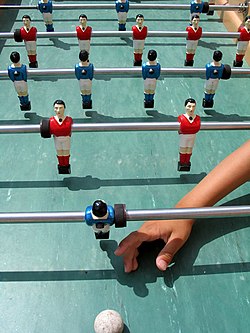
The game involves using figures mounted on rotating bars to kick a ball into the opposing goal. Table football tables can vary in size, but a table for adult play is typically 150 cm long and 90 cm wide, while smaller tables are typically built for children usage. The table usually contains eight rows of foos men, which are plastic, metal, wooden, or sometimes carbon-fibre figures mounted on horizontal metal bars. Each team of one or two human players controls four rows of foos men, one row each for the goalkeeper, defenders, midfield and strikers. Players manipulate the rods to control the figures, using them to hold up, pass or 'kick' the ball. Games begin when the ball is served through a hole at the side of the table, or simply placed by hand at the feet of a figure in the centre of the table. A coin toss is usually used to determine which player or team serves first. If it is not the first match or if the ball gets out of play or if the ball suddenly stops out, then the team scored last would get the serve after he scores one. The term for when the ball leaves the table or gets stopped somewhere out of the men-like figures’ reach is dead ball. Expert players have been known to move balls at speeds up to 56 km/h (35 mph) in competition.
The rules prohibit "over 360-degree shots", or "spinning": using the palm of the hand to swiftly spin the bar all around, instead of using wrist strokes to kick the ball with a bar-mounted figure. Since the establishment of the International Table Soccer Federation (ITSF), the rules have become standardised in most international competitions. The rules say that a full 360-degree rotation before or after hitting the ball is considered spinning, and thus forbidden (although, if a spinning rod hits the ball backwards into their own goal, it will count as a goal for the opposing team). If an ungrasped rod is spun by the force of a ball hitting a player figure on the rod, the spin will be considered legitimate.
Table football
Table football, known as foosball (fußball) or table soccer in North America, is a tabletop game loosely based on association football. Its objective is to move the ball into the opponent's goal by manipulating rods which have figures attached resembling football players of two opposing teams. Although its rules often vary by country and region when the game is played casually, competitive-level table football is played according to a unified code.
Patents for similar table games date back as early as the 1890s in Germany and France. In 1921, Harold Searles Thornton patented the game in the United Kingdom as "Apparatus for playing a game of table football", seen as the first patent for a game with the same core playing features as the modern game. His design inspiration came from a box of matches.
Belgian magazine Le Soir illustré claimed in 1979 the French inventor Lucien Rosengart (1881–1976) came up with the game of table football in the 1930s when he was looking for things to keep his grandchildren entertained during the cold winter months. He called the game babyfoot.
Galician inventor Alejandro Finisterre patented his invention of table football, futbolín, in Madrid in 1937. His version is the one used in modern-day table football.
The game was eventually brought to the United States in the 1950s by Lawrence Patterson, reaching its peak of popularity there in the 1970s, when it could be found in bars and pool halls throughout the country. The name foosball became common in the United States via German imports that called it "tischfußball" (lit. "table football").
In 2002, the International Table Soccer Federation (ITSF) was established in France with the mission of promoting the game. It acts as an organising sports body, regulating international competitions and establishing the game with the International Olympic Committee and General Association of International Sport Federation.
The game involves using figures mounted on rotating bars to kick a ball into the opposing goal. Table football tables can vary in size, but a table for adult play is typically 150 cm long and 90 cm wide, while smaller tables are typically built for children usage. The table usually contains eight rows of foos men, which are plastic, metal, wooden, or sometimes carbon-fibre figures mounted on horizontal metal bars. Each team of one or two human players controls four rows of foos men, one row each for the goalkeeper, defenders, midfield and strikers. Players manipulate the rods to control the figures, using them to hold up, pass or 'kick' the ball. Games begin when the ball is served through a hole at the side of the table, or simply placed by hand at the feet of a figure in the centre of the table. A coin toss is usually used to determine which player or team serves first. If it is not the first match or if the ball gets out of play or if the ball suddenly stops out, then the team scored last would get the serve after he scores one. The term for when the ball leaves the table or gets stopped somewhere out of the men-like figures’ reach is dead ball. Expert players have been known to move balls at speeds up to 56 km/h (35 mph) in competition.
The rules prohibit "over 360-degree shots", or "spinning": using the palm of the hand to swiftly spin the bar all around, instead of using wrist strokes to kick the ball with a bar-mounted figure. Since the establishment of the International Table Soccer Federation (ITSF), the rules have become standardised in most international competitions. The rules say that a full 360-degree rotation before or after hitting the ball is considered spinning, and thus forbidden (although, if a spinning rod hits the ball backwards into their own goal, it will count as a goal for the opposing team). If an ungrasped rod is spun by the force of a ball hitting a player figure on the rod, the spin will be considered legitimate.
Recent media
Recent media