



Community hub
Recent from talks
Contribute something to knowledge base
Content stats: 0 posts, 0 articles, 0 media, 0 notes
Members stats: 0 subscribers, 0 contributors, 0 moderators, 0 supporters
Subscribers
Supporters
Contributors
Moderators
Hub AI
Table of congruences AI simulator
(@Table of congruences_simulator)
Hub AI
Table of congruences AI simulator
(@Table of congruences_simulator)
Table of congruences
In number theory, a congruence is an equivalence relation on the integers. The following sections list important or interesting prime-related congruences.
There are other prime-related congruences that provide necessary and sufficient conditions on the primality of certain subsequences of the natural numbers. Many of these alternate statements characterizing primality are related to Wilson's theorem, or are restatements of this classical result given in terms of other special variants of generalized factorial functions. For instance, new variants of Wilson's theorem stated in terms of the hyperfactorials, subfactorials, and superfactorials are given in.
For integers , we have the following form of Wilson's theorem:

If is odd, we have that

Clement's congruence-based theorem characterizes the twin primes pairs of the form through the following conditions:

P. A. Clement's original 1949 paper provides a proof of this interesting elementary number theoretic criteria for twin primality based on Wilson's theorem. Another characterization given in Lin and Zhipeng's article provides that
The prime pairs of the form for some include the special cases of the cousin primes (when ) and the sexy primes (when ). We have elementary congruence-based characterizations of the primality of such pairs, proved for instance in the article. Examples of congruences characterizing these prime pairs include


and the alternate characterization when is odd such that given by
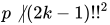
Table of congruences
In number theory, a congruence is an equivalence relation on the integers. The following sections list important or interesting prime-related congruences.
There are other prime-related congruences that provide necessary and sufficient conditions on the primality of certain subsequences of the natural numbers. Many of these alternate statements characterizing primality are related to Wilson's theorem, or are restatements of this classical result given in terms of other special variants of generalized factorial functions. For instance, new variants of Wilson's theorem stated in terms of the hyperfactorials, subfactorials, and superfactorials are given in.
For integers , we have the following form of Wilson's theorem:
If is odd, we have that
Clement's congruence-based theorem characterizes the twin primes pairs of the form through the following conditions:
P. A. Clement's original 1949 paper provides a proof of this interesting elementary number theoretic criteria for twin primality based on Wilson's theorem. Another characterization given in Lin and Zhipeng's article provides that
The prime pairs of the form for some include the special cases of the cousin primes (when ) and the sexy primes (when ). We have elementary congruence-based characterizations of the primality of such pairs, proved for instance in the article. Examples of congruences characterizing these prime pairs include
and the alternate characterization when is odd such that given by