
Recent from talks
Tafseer-e-Majidi
Knowledge base stats:
Talk channels stats:
Members stats:
Tafseer-e-Majidi
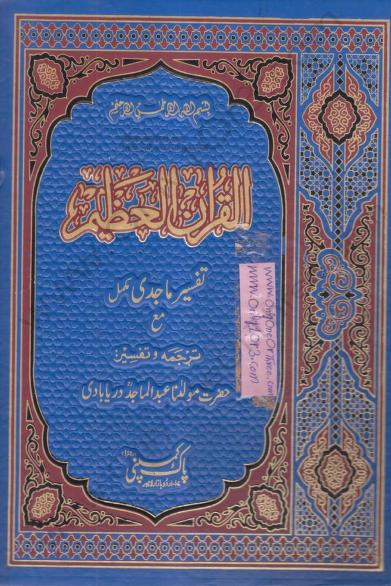
Tafseer-e-Majidi or Tafsirul Quran: Translation and Commentary of the Holy Quran (Urdu: القرآن الحکیم) a complete Tafsir written by Abdul Majid Daryabadi. He was influenced by Ashraf Ali Thanwi to write a Tafsir and then he wrote this Tafsir in English first then in Urdu. The Urdu style and methodology adopted in writing this Tafsir were the same as his English Tafsir. The only difference was that this Tafsir was supposed to be comparatively more lengthy. The author himself wrote the Preface on December in 1941. The author observed that to translate the Quran is very difficult. So, he advised to the translators to follow the six main points and various subpoints to translate the Quran into English. Because he observed some problems to translate into English and he told that, there is no language in the world as well as Arabic. The Introduction was written by Abul Hasan Ali Hasani Nadwi on 16 August in 1981.
Daryabadi worked to study all researches, done in the West or East in past or in modern time, which confirm the verses of the Quran and he referred to them in his exegesis. He gathered materials about the Quranic stories, geographic places, individuals, nations, religions etc. as lots of materials have been gathered in one place. One of the other exclusivities of this Tafsir is that its author has studied comparatively the Quran and previous books, especially the Torah and The gospel. In the comparison, he unveiled distortions and additions in the Torah and The gospel. He responded rationally to doubts of sceptic minds of philosophers and some Muslim intellectuals who were influenced by Western secularism about some Quranic verses as the mind of reader accepts the Quran as a clear and fault free book with sound mind. It is the feature of this exegesis that it has utilized the modern science and new researches in service of the Quran without being influenced by absurd claims, baseless and so-called scientific slogans of Westerners. The most important feature of this exegesis is that it has presented a comparative study of the Quran and old divine books, particularly the Torah and The gospel; a work which had not carried out until that time by any exegete but by Daryabadi. The tafsīr is said to be generally: responding doubts of the time, using science in exegesis of the Quran, avoiding from eisegesis, comparative study of the Quran and previous divine books, adductive response to the misgivings of Jews and Christians, enjoying smooth and clear prose, proving the social system of Islam to the rest of systems etc. are among the most important features of Tafseer-e-Majedi.
Abdul Majid Daryabadi was a scholar in Islamic learning and sciences. He had contributed successfully in various subject of the Islamic literature and especially in exegesis of the Quran. It is his highest contribution to the study of tafsir literature in English and in Urdu. He had written tafsir in English (1933–1939) first. Then he had written tafsir in his mother tongue Urdu. It has highly been recommended to all of the Urdu speaking Muslims in India and Pakistan as well as his English. It was published in one set from Taj Company Limited, Lahore and Karachi, Pakistan. It was named Al-Quran al-Hakim, which is known as Tafsir-i Majidi and it was completed in total 1215 pages in one complete volume. The author, Abdul Majid Daryabadi himself has written a Preface of this tafsir. He has cited a number of books, from which he has been associated, like Arabic and Urdu exegesis, dictionaries in Arabic and in Urdu. He has been associated more to translate his Urdu tafsir from Bayan al-Quran of Ashraf Ali Thanwi.
The tafsir in English was written with the influence of Sirajul Haq MachliShahri. He knew very much about Daryabadis knowledge, personalities and good commanding in English language. Therefore, once he requested him to write a tafsir, which will be a modern and comparison of religions, because there is no English translation of the Quran for the Ahl al-Sunnah and whole Muslims. Then he had started to write this tafsir in English and taken six/seven years to write this tafsir from July 1933 to 1939. He has written this tafsir during the Second World War (1939-1945AC). He had written this tafsir by the suggestions of his several esteemed friends and scholars. It was completed with four volumes and was published first in 1941 by Darul Ishaat, Urdu Bazar, Karachi, Pakistan. On December, in 1941, the Introduction had been written by Abul Hasan Ali Hasani Nadwi and it had been published on 16 August, in 1981. Then it was published in 1991. The Author himself has written the Preface. In the preface, the Author has advised to the translators to follow the six main points and various sub-points about how to translate the Quran into English, because he has observed some problems to translate the Quran from Arabic into English. So, he has thought, there is no language in the world as well as Arabic. The first volume is started from Al-Fatiha to 82 verses of Al-Ma'idah. As if it is brief exegesis of the Quran but it is highly appreciated, admired, accepted and recommended. In the volume number 1, the pages are 454 and the index is 10 pages in addition. He had started to write this tafsir from 1933 and finished it in 1939 and published in 1941. It is titled Tafsir-ul-Quran: Translation and Commentary of the Holy Qurān and in Urdu, title is Al-Quran al-Hakim, completed in one volume. It was printed and published first in 1944 by Taj Company, Lahore, Pakistan. There is an appendix on Trade and interest after the end of Al-Baqara. It was written by Abul A'la Maududi, it is 2 pages in total, who was an editor of Tarjuman al-Quran, Lahore, Pakistan. It is related to the verse no. 275 of Al-Baqara. He has interpreted the verse under the footnote no. 141–152, end of the footnote no. 145, in addition, the readers have been requested to see appendix at the end of the Surah to learn details from this verse no. 275. In as much as, he has included an appendix on Trade and Interest, written by Abul Ala Mawdudi in the interpretation of the verse no. 275 of Al-Baqara, but he was a man of different school of thought. However, in his Urdu tafsir, there is no appendix on Trade and Interest by Abul Ala Mawdudi in the interpretation of the verse no. 275 of Al-Baqara, there is his own interpretation in the footnote no. 1066–73. In his Urdu tafsir, he included six articles, against the interpretation of verse no. 183 of Al-Baqara, those are published in his weekly magazine Sach, from Lucknow, edited by Abdul Majid Daryabadi, in several dates; first is on 3 April in 1925, second is on 3 April in 1926, third is on 26 March in 1926, fourth is on 3 March in 1928, fifth is on 14 March in 1927 and sixth is on 21 March in 1927. But in his English tafsir, there are no articles included against the verse no. 183 of Al-Baqarah. The verse no. 3 of the An-Nisa, in the footnote no. 498, he has requested the readers to see appendix on polygamy at the end of the An-Nisa. It is 4 pages in total, but well written and logical and natural and physical also. He has made three questions about polygamy. They are: (i) Is polygamy unnatural? (ii) Is it immoral? (iii) Is it irrational? Then he has positively answered and proved logically that the adoption of polygamy as a necessity and after the war the population was greatly reduced and there was considerable surplus of females, so, it was real phenomena that for dignity and security of females and save the society from wild like sexual activities. In addition, it is limited in four against the activities of Jews and Christian. However, in his Urdu tafsir, there is no appendix on polygamy against the verse no. 3 of Al-Nisa; he has interpreted the verse in the footnote no. 10 of the Surah.
The volume number II has been started from the verse no. 83 of Al-Maidah up to the end of the An-Nahl. There are 497 pages in total and the index is within 10 pages. There is no appendix in this volume. The volume III has been started from the Al-Isra' up to the end of the Fatir and the pages are 503 along with the references and the four appendices had been included. First of the four appendices is Seven Sleepers written by Abul Hasan Ali Hasani Nadwi and second is Identification of Dhu al-Qarnayn by Ali Nadwi. The third is Historicity of Haman as mentioned in the Quran by Sher Mohammad Syed and the fourth is Was Muhammad Literate? by S.G. Muhiuddin. He has introduced himself a broad-minded personality for including others articles, related to the interpretation of the verses of the Quran in his tafsir.
The volume number IV is the last one; it has been started from Ya-Sin up to the Al-Nas, the end of the Quran. The pages are 543, a bibliography of 4 pages had been included, and an index is in 10 pages. The number of footnotes in all the earlier volumes began and ended with a part (Para) of the Quran. As, however, the third volume was terminated with the Al-Fatir, a portion of Yasin, which has been included in part XXII, had to be brought out into this volume. Consequently, the footnotes begin with the Yasin and continue into part XXIII. In subsequent parts, the usual practice of giving the footnotes by Quranic Paras has been followed. Then the number of footnotes was begun with part XXIV and continued at the end of the part XXIV. There is no appendix in this volume.
The unique preface was written by the author himself on December in 1941. The introduction was written by Abul Hasan Ali Hasani Nadwi on 16 August in 1981. Here is a long distance between preface and introduction, 40 years after Abul Hasan Ali Hasani Nadwi has written an Introduction on Daryabadis tafsir in English. It was published in 1991 as First Edition. Although it is a brief exegesis of the Quran, but it is a highly appreciated, admired, accepted and recommended tafsir to all. In addition, the author has interpreted many verses of the Quran in the light of comparative religion. In his Urdu tafsir, he has also written a preface, but it is different from the preface of his English tafsir. In it, he has discussed elaborately. He had revised the first part of his tafsir in December 1944 and in October 1946, he has finished revision of the five parts of the Quran.
When an interpreter of the Quran starts to interpret then it is considered to interpret by the other verses of the Quran first as the foremost source for interpreting the Quran. Daryabadi has applied it mainly in linguistic and legislative explanations of the Quran.
Hub AI
Tafseer-e-Majidi AI simulator
(@Tafseer-e-Majidi_simulator)
Tafseer-e-Majidi
Tafseer-e-Majidi or Tafsirul Quran: Translation and Commentary of the Holy Quran (Urdu: القرآن الحکیم) a complete Tafsir written by Abdul Majid Daryabadi. He was influenced by Ashraf Ali Thanwi to write a Tafsir and then he wrote this Tafsir in English first then in Urdu. The Urdu style and methodology adopted in writing this Tafsir were the same as his English Tafsir. The only difference was that this Tafsir was supposed to be comparatively more lengthy. The author himself wrote the Preface on December in 1941. The author observed that to translate the Quran is very difficult. So, he advised to the translators to follow the six main points and various subpoints to translate the Quran into English. Because he observed some problems to translate into English and he told that, there is no language in the world as well as Arabic. The Introduction was written by Abul Hasan Ali Hasani Nadwi on 16 August in 1981.
Daryabadi worked to study all researches, done in the West or East in past or in modern time, which confirm the verses of the Quran and he referred to them in his exegesis. He gathered materials about the Quranic stories, geographic places, individuals, nations, religions etc. as lots of materials have been gathered in one place. One of the other exclusivities of this Tafsir is that its author has studied comparatively the Quran and previous books, especially the Torah and The gospel. In the comparison, he unveiled distortions and additions in the Torah and The gospel. He responded rationally to doubts of sceptic minds of philosophers and some Muslim intellectuals who were influenced by Western secularism about some Quranic verses as the mind of reader accepts the Quran as a clear and fault free book with sound mind. It is the feature of this exegesis that it has utilized the modern science and new researches in service of the Quran without being influenced by absurd claims, baseless and so-called scientific slogans of Westerners. The most important feature of this exegesis is that it has presented a comparative study of the Quran and old divine books, particularly the Torah and The gospel; a work which had not carried out until that time by any exegete but by Daryabadi. The tafsīr is said to be generally: responding doubts of the time, using science in exegesis of the Quran, avoiding from eisegesis, comparative study of the Quran and previous divine books, adductive response to the misgivings of Jews and Christians, enjoying smooth and clear prose, proving the social system of Islam to the rest of systems etc. are among the most important features of Tafseer-e-Majedi.
Abdul Majid Daryabadi was a scholar in Islamic learning and sciences. He had contributed successfully in various subject of the Islamic literature and especially in exegesis of the Quran. It is his highest contribution to the study of tafsir literature in English and in Urdu. He had written tafsir in English (1933–1939) first. Then he had written tafsir in his mother tongue Urdu. It has highly been recommended to all of the Urdu speaking Muslims in India and Pakistan as well as his English. It was published in one set from Taj Company Limited, Lahore and Karachi, Pakistan. It was named Al-Quran al-Hakim, which is known as Tafsir-i Majidi and it was completed in total 1215 pages in one complete volume. The author, Abdul Majid Daryabadi himself has written a Preface of this tafsir. He has cited a number of books, from which he has been associated, like Arabic and Urdu exegesis, dictionaries in Arabic and in Urdu. He has been associated more to translate his Urdu tafsir from Bayan al-Quran of Ashraf Ali Thanwi.
The tafsir in English was written with the influence of Sirajul Haq MachliShahri. He knew very much about Daryabadis knowledge, personalities and good commanding in English language. Therefore, once he requested him to write a tafsir, which will be a modern and comparison of religions, because there is no English translation of the Quran for the Ahl al-Sunnah and whole Muslims. Then he had started to write this tafsir in English and taken six/seven years to write this tafsir from July 1933 to 1939. He has written this tafsir during the Second World War (1939-1945AC). He had written this tafsir by the suggestions of his several esteemed friends and scholars. It was completed with four volumes and was published first in 1941 by Darul Ishaat, Urdu Bazar, Karachi, Pakistan. On December, in 1941, the Introduction had been written by Abul Hasan Ali Hasani Nadwi and it had been published on 16 August, in 1981. Then it was published in 1991. The Author himself has written the Preface. In the preface, the Author has advised to the translators to follow the six main points and various sub-points about how to translate the Quran into English, because he has observed some problems to translate the Quran from Arabic into English. So, he has thought, there is no language in the world as well as Arabic. The first volume is started from Al-Fatiha to 82 verses of Al-Ma'idah. As if it is brief exegesis of the Quran but it is highly appreciated, admired, accepted and recommended. In the volume number 1, the pages are 454 and the index is 10 pages in addition. He had started to write this tafsir from 1933 and finished it in 1939 and published in 1941. It is titled Tafsir-ul-Quran: Translation and Commentary of the Holy Qurān and in Urdu, title is Al-Quran al-Hakim, completed in one volume. It was printed and published first in 1944 by Taj Company, Lahore, Pakistan. There is an appendix on Trade and interest after the end of Al-Baqara. It was written by Abul A'la Maududi, it is 2 pages in total, who was an editor of Tarjuman al-Quran, Lahore, Pakistan. It is related to the verse no. 275 of Al-Baqara. He has interpreted the verse under the footnote no. 141–152, end of the footnote no. 145, in addition, the readers have been requested to see appendix at the end of the Surah to learn details from this verse no. 275. In as much as, he has included an appendix on Trade and Interest, written by Abul Ala Mawdudi in the interpretation of the verse no. 275 of Al-Baqara, but he was a man of different school of thought. However, in his Urdu tafsir, there is no appendix on Trade and Interest by Abul Ala Mawdudi in the interpretation of the verse no. 275 of Al-Baqara, there is his own interpretation in the footnote no. 1066–73. In his Urdu tafsir, he included six articles, against the interpretation of verse no. 183 of Al-Baqara, those are published in his weekly magazine Sach, from Lucknow, edited by Abdul Majid Daryabadi, in several dates; first is on 3 April in 1925, second is on 3 April in 1926, third is on 26 March in 1926, fourth is on 3 March in 1928, fifth is on 14 March in 1927 and sixth is on 21 March in 1927. But in his English tafsir, there are no articles included against the verse no. 183 of Al-Baqarah. The verse no. 3 of the An-Nisa, in the footnote no. 498, he has requested the readers to see appendix on polygamy at the end of the An-Nisa. It is 4 pages in total, but well written and logical and natural and physical also. He has made three questions about polygamy. They are: (i) Is polygamy unnatural? (ii) Is it immoral? (iii) Is it irrational? Then he has positively answered and proved logically that the adoption of polygamy as a necessity and after the war the population was greatly reduced and there was considerable surplus of females, so, it was real phenomena that for dignity and security of females and save the society from wild like sexual activities. In addition, it is limited in four against the activities of Jews and Christian. However, in his Urdu tafsir, there is no appendix on polygamy against the verse no. 3 of Al-Nisa; he has interpreted the verse in the footnote no. 10 of the Surah.
The volume number II has been started from the verse no. 83 of Al-Maidah up to the end of the An-Nahl. There are 497 pages in total and the index is within 10 pages. There is no appendix in this volume. The volume III has been started from the Al-Isra' up to the end of the Fatir and the pages are 503 along with the references and the four appendices had been included. First of the four appendices is Seven Sleepers written by Abul Hasan Ali Hasani Nadwi and second is Identification of Dhu al-Qarnayn by Ali Nadwi. The third is Historicity of Haman as mentioned in the Quran by Sher Mohammad Syed and the fourth is Was Muhammad Literate? by S.G. Muhiuddin. He has introduced himself a broad-minded personality for including others articles, related to the interpretation of the verses of the Quran in his tafsir.
The volume number IV is the last one; it has been started from Ya-Sin up to the Al-Nas, the end of the Quran. The pages are 543, a bibliography of 4 pages had been included, and an index is in 10 pages. The number of footnotes in all the earlier volumes began and ended with a part (Para) of the Quran. As, however, the third volume was terminated with the Al-Fatir, a portion of Yasin, which has been included in part XXII, had to be brought out into this volume. Consequently, the footnotes begin with the Yasin and continue into part XXIII. In subsequent parts, the usual practice of giving the footnotes by Quranic Paras has been followed. Then the number of footnotes was begun with part XXIV and continued at the end of the part XXIV. There is no appendix in this volume.
The unique preface was written by the author himself on December in 1941. The introduction was written by Abul Hasan Ali Hasani Nadwi on 16 August in 1981. Here is a long distance between preface and introduction, 40 years after Abul Hasan Ali Hasani Nadwi has written an Introduction on Daryabadis tafsir in English. It was published in 1991 as First Edition. Although it is a brief exegesis of the Quran, but it is a highly appreciated, admired, accepted and recommended tafsir to all. In addition, the author has interpreted many verses of the Quran in the light of comparative religion. In his Urdu tafsir, he has also written a preface, but it is different from the preface of his English tafsir. In it, he has discussed elaborately. He had revised the first part of his tafsir in December 1944 and in October 1946, he has finished revision of the five parts of the Quran.
When an interpreter of the Quran starts to interpret then it is considered to interpret by the other verses of the Quran first as the foremost source for interpreting the Quran. Daryabadi has applied it mainly in linguistic and legislative explanations of the Quran.
Recent media