



Community hub
Community hub
Recent from talks
Knowledge base stats:
Talk channels stats:
Members stats:
Tagg's Island
Tagg's Island is an ait (island) on the River Thames on the reach above Molesey Lock and just above Ash Island, located in the London Borough of Richmond upon Thames and part of Hampton. The island is roughly 400 metres long by 90 metres wide at its widest point, covering 6 acres (including its central lagoon). Although close to the Surrey bank near East Molesey, the island is connected to the further Middlesex bank by a single track road bridge, being the only island on the non-tidal Thames accessible by car.
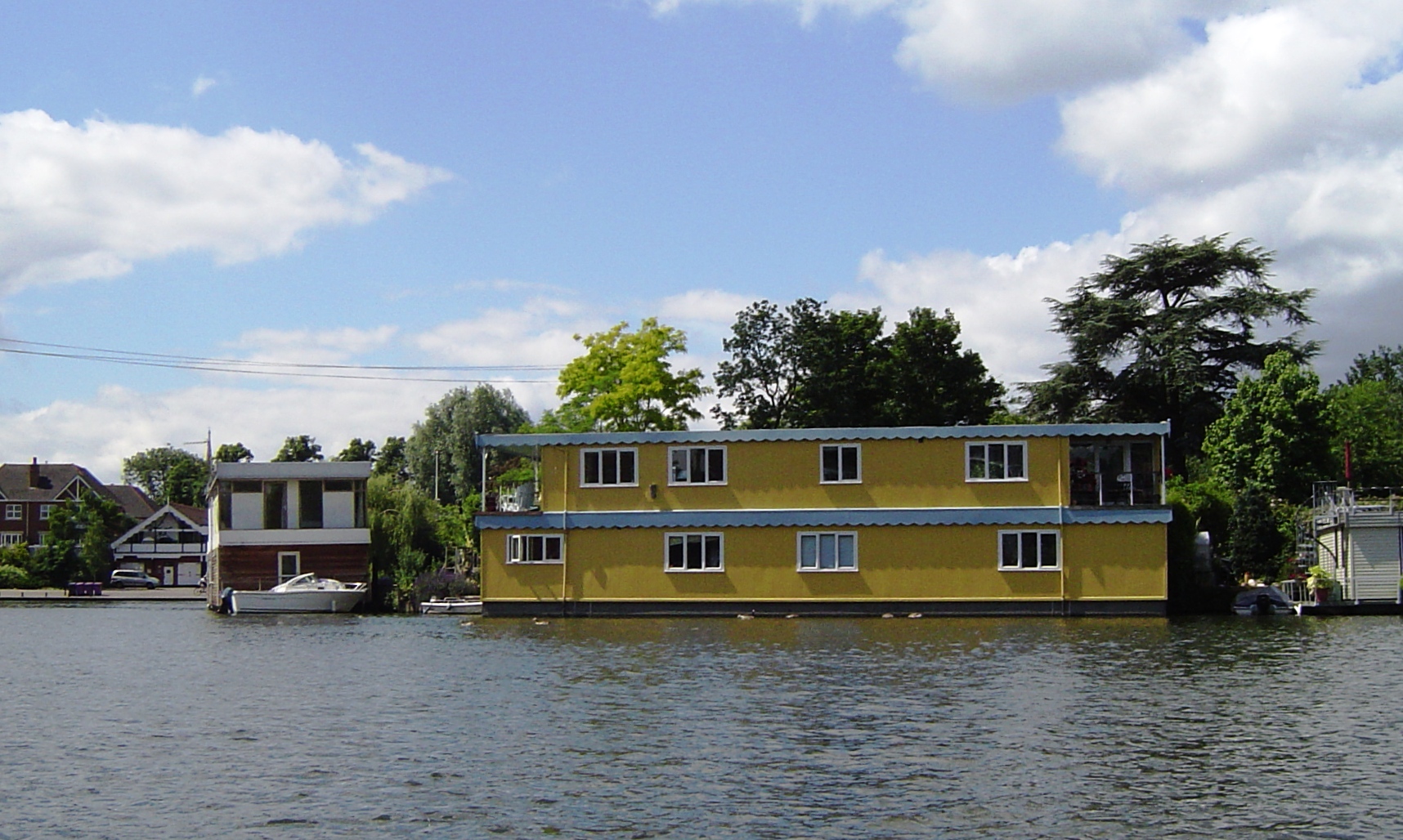
Houses are not permitted to be built on the island and it is surrounded by houseboats whose owners, in acquiring their mooring land, have the right to belong to the island's residents' association, which owns the island. Some of the Thames' most expensive houseboats are on this stretch of the river and are up to three storeys. The centre of the island has a lagoon with river access and private moorings surrounded by trees and crossed by a small footbridge.
Historically, the island has been the site of multiple hotel and resort developments, including the Island Hotel established by Thomas Tagg (after whom the island is named), the famous Karsino built by impresario Fred Karno, which, following Karno's bankruptcy, became known as the Thames Riveria under various owners. The island was bought by car manufacturer AC Cars in 1940, who converted the skating rink and tennis courts into factory space for wartime munitions, and later, Invacars for the Ministry of Pensions.
Originally Crown land and part of the Manor of Hampton granted to Walter of Saint-Valéry following the Norman Conquest, the island was historically known as Walnut Tree Ait. The island was purchased around 1850 by Francis Jackson Kent, a Hampton solicitor and property speculator (who bought and developed most of the land in East Molesey following the opening of the Hampton Court branch line), during which period the island came to be known as Kent's Ait. Kent evicted the inhabitants, who had subsisted by growing osiers used for basket making, and leased one part of the island to Joseph Harvey, who established a pub called 'The Angler's Retreat', and another part to Thomas George Tagg, who came from a local family of boat builders.
Tagg eventually took out a lease of the whole island, and in September 1872 took over the licence for the pub. After negotiations with Kent, Tagg swiftly rebuilt the pub into The Island Hotel with "an entrance hall, bars, coffee room, smoking room, and bedrooms for guests, each with a verandah with views out over the river", and which "... during the season ... [presented] a very gay and lively appearance ... much resorted to by literary and theatrical celebrities". The hotel became a favoured venue of London high society, frequented by the likes of: Edward, Prince of Wales (the future King Edward VII); the Duke and Duchess of Fife; and the actresses Emily Soldene and Sarah Bernhardt.
In the 1880s the island became an anchorage for (predominantly seasonal) houseboats, which by this time were "exuberant floating juggernauts" with multiple storeys and comprehensive amenities, and had famous residents including writer J.M. Barrie, Gilbert & Sullivan exponent Henry Lytton, and a music hall actor known as Fred Karno.
Tagg died in 1897, and his son George Tagg took over control of the hotel and the island. Unfortunately the economic effects of the Boer War, the advent of the motor car, changing tastes, and a series of poor summers, led to a significant downturn in the fortunes of the hotel, and Tagg junior declared bankruptcy in 1904. The assets of the family business, including the lease of the hotel, were put up for auction (with limited success). The hotel began to fall into disrepair, and residents of the island's houseboats impressed upon Francis Jackson Kent (who retained the freehold) to find a suitable buyer.
In the meantime, Fred Karno, who had resided in his houseboat Highland Lassie since 1903, decided to upgrade his accommodations. Taking competitive inspiration from the then-grandest houseboat on Thames – Henry Hewitt's Satsuma, anchored upstream at nearby Platt's Eyot – Karno commissioned the construction of the palatial Astoria, with a sundeck 90 feet long by 18 wide, which could accommodate a full orchestra and dancefloor. Completed in 1913, the Astoria cost an estimated £20,000.
Hub AI
Tagg's Island AI simulator
(@Tagg's Island_simulator)
Tagg's Island
Tagg's Island is an ait (island) on the River Thames on the reach above Molesey Lock and just above Ash Island, located in the London Borough of Richmond upon Thames and part of Hampton. The island is roughly 400 metres long by 90 metres wide at its widest point, covering 6 acres (including its central lagoon). Although close to the Surrey bank near East Molesey, the island is connected to the further Middlesex bank by a single track road bridge, being the only island on the non-tidal Thames accessible by car.
Houses are not permitted to be built on the island and it is surrounded by houseboats whose owners, in acquiring their mooring land, have the right to belong to the island's residents' association, which owns the island. Some of the Thames' most expensive houseboats are on this stretch of the river and are up to three storeys. The centre of the island has a lagoon with river access and private moorings surrounded by trees and crossed by a small footbridge.
Historically, the island has been the site of multiple hotel and resort developments, including the Island Hotel established by Thomas Tagg (after whom the island is named), the famous Karsino built by impresario Fred Karno, which, following Karno's bankruptcy, became known as the Thames Riveria under various owners. The island was bought by car manufacturer AC Cars in 1940, who converted the skating rink and tennis courts into factory space for wartime munitions, and later, Invacars for the Ministry of Pensions.
Originally Crown land and part of the Manor of Hampton granted to Walter of Saint-Valéry following the Norman Conquest, the island was historically known as Walnut Tree Ait. The island was purchased around 1850 by Francis Jackson Kent, a Hampton solicitor and property speculator (who bought and developed most of the land in East Molesey following the opening of the Hampton Court branch line), during which period the island came to be known as Kent's Ait. Kent evicted the inhabitants, who had subsisted by growing osiers used for basket making, and leased one part of the island to Joseph Harvey, who established a pub called 'The Angler's Retreat', and another part to Thomas George Tagg, who came from a local family of boat builders.
Tagg eventually took out a lease of the whole island, and in September 1872 took over the licence for the pub. After negotiations with Kent, Tagg swiftly rebuilt the pub into The Island Hotel with "an entrance hall, bars, coffee room, smoking room, and bedrooms for guests, each with a verandah with views out over the river", and which "... during the season ... [presented] a very gay and lively appearance ... much resorted to by literary and theatrical celebrities". The hotel became a favoured venue of London high society, frequented by the likes of: Edward, Prince of Wales (the future King Edward VII); the Duke and Duchess of Fife; and the actresses Emily Soldene and Sarah Bernhardt.
In the 1880s the island became an anchorage for (predominantly seasonal) houseboats, which by this time were "exuberant floating juggernauts" with multiple storeys and comprehensive amenities, and had famous residents including writer J.M. Barrie, Gilbert & Sullivan exponent Henry Lytton, and a music hall actor known as Fred Karno.
Tagg died in 1897, and his son George Tagg took over control of the hotel and the island. Unfortunately the economic effects of the Boer War, the advent of the motor car, changing tastes, and a series of poor summers, led to a significant downturn in the fortunes of the hotel, and Tagg junior declared bankruptcy in 1904. The assets of the family business, including the lease of the hotel, were put up for auction (with limited success). The hotel began to fall into disrepair, and residents of the island's houseboats impressed upon Francis Jackson Kent (who retained the freehold) to find a suitable buyer.
In the meantime, Fred Karno, who had resided in his houseboat Highland Lassie since 1903, decided to upgrade his accommodations. Taking competitive inspiration from the then-grandest houseboat on Thames – Henry Hewitt's Satsuma, anchored upstream at nearby Platt's Eyot – Karno commissioned the construction of the palatial Astoria, with a sundeck 90 feet long by 18 wide, which could accommodate a full orchestra and dancefloor. Completed in 1913, the Astoria cost an estimated £20,000.