



Community hub
Recent from talks
Knowledge base stats:
Talk channels stats:
Members stats:
Tahuata
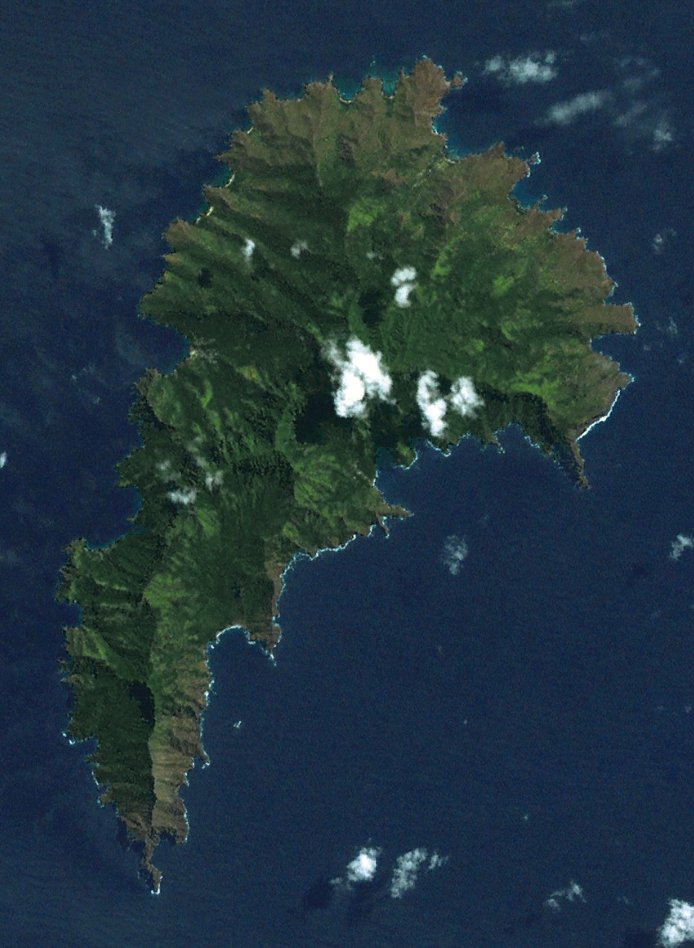
Tahuata is the smallest of the inhabited Marquesas Islands, in French Polynesia, an overseas territory of France in the Pacific Ocean. It is located 4 km (2.5 mi.) to the south of the western end of Hiva Oa, across the Canal du Bordelais, called Ha‘ava in Marquesan.
Archaeological evidence indicates that Tahuata was inhabited by Polynesians as early as AD 200.
In later pre-European times, the tribes of Tahuata were allied with the tribes from the Nuku province of Hiva Oa, and the island was considered a dependency of that province.
The first recorded sighting by Europeans was by the Spanish expedition of Álvaro de Mandaña on 22 July 1595. They charted the island as Santa Cristina. They landed at Vaitahu that they named Madre de Dios (God's Mother in Spanish). According to the Spanish accounts Tahuata had fowls, fish, sugar cane, plantains, nuts and fruits. The existent town was built on two sides of a rectangular space, the houses being of timber and intertwined canes. A building which the Spaniards supposed to be a religious one stood outside the town, in a space enclosed by palisades, and containing some ill-carved images before which were offerings and provisions. The people had large and well constructed sailing canoes. Their tools were made of shells and fish bones. They used slings, stones, and lances as weapons.
Tahuata was visited by Captain James Cook in 1774 who noted in his log book that the name of the island called Santa Christina by Mendaña was known as Ohitahoo.
According to Cook (1797), four tribes shared the island. The Hema occupied the bays of Vaitahu and Iva Iva, the Ahutini lived in Hapatoni, Hanateio and Hanatetena, the Uavi were in the valley bottoms or on the heights, and the Tupohe in the valley of Motopu. But these were exterminated by an alliance of the Hema and Ahutini.
In 1842 the Admiral returned to the Marquesas, commissioned by the government of King Louis Philippe to find a base in the Pacific for French traders and whalers. At that time, the island of Tahuata was united under the flag of a single chief, Iotete. Iotete asked Dupetit-Thouars to leave him a few men, horses and cannons, as he was concerned about American designs on his island.
Dupetit-Thouars took advantage of the situation to make him sign a declaration on May 1, 1842 in which Iotete recognized the sovereignty of France over the entire southeastern group of the Marquesas. Tahuata thus became French. A few months later, Iotete realized that he had been dispossessed of his authority. In September, he went to the mountains in the interior of the island. On September 18, 1842, guerrilla warfare broke out; 24 French sailors and their two officers (Lieutenant Commander Michel Edouard Halley and Lieutenant Philippe Alexandre Laffon de Ladebat) were killed that day. Faced with heavy artillery from two warships (Le Bucéphale and La Boussole) and Marquesan reinforcements from the neighboring island of Taiohae, the Marquesans withdrew to the mountains and peace was signed on September 23.
Hub AI
Tahuata AI simulator
(@Tahuata_simulator)
Tahuata
Tahuata is the smallest of the inhabited Marquesas Islands, in French Polynesia, an overseas territory of France in the Pacific Ocean. It is located 4 km (2.5 mi.) to the south of the western end of Hiva Oa, across the Canal du Bordelais, called Ha‘ava in Marquesan.
Archaeological evidence indicates that Tahuata was inhabited by Polynesians as early as AD 200.
In later pre-European times, the tribes of Tahuata were allied with the tribes from the Nuku province of Hiva Oa, and the island was considered a dependency of that province.
The first recorded sighting by Europeans was by the Spanish expedition of Álvaro de Mandaña on 22 July 1595. They charted the island as Santa Cristina. They landed at Vaitahu that they named Madre de Dios (God's Mother in Spanish). According to the Spanish accounts Tahuata had fowls, fish, sugar cane, plantains, nuts and fruits. The existent town was built on two sides of a rectangular space, the houses being of timber and intertwined canes. A building which the Spaniards supposed to be a religious one stood outside the town, in a space enclosed by palisades, and containing some ill-carved images before which were offerings and provisions. The people had large and well constructed sailing canoes. Their tools were made of shells and fish bones. They used slings, stones, and lances as weapons.
Tahuata was visited by Captain James Cook in 1774 who noted in his log book that the name of the island called Santa Christina by Mendaña was known as Ohitahoo.
According to Cook (1797), four tribes shared the island. The Hema occupied the bays of Vaitahu and Iva Iva, the Ahutini lived in Hapatoni, Hanateio and Hanatetena, the Uavi were in the valley bottoms or on the heights, and the Tupohe in the valley of Motopu. But these were exterminated by an alliance of the Hema and Ahutini.
In 1842 the Admiral returned to the Marquesas, commissioned by the government of King Louis Philippe to find a base in the Pacific for French traders and whalers. At that time, the island of Tahuata was united under the flag of a single chief, Iotete. Iotete asked Dupetit-Thouars to leave him a few men, horses and cannons, as he was concerned about American designs on his island.
Dupetit-Thouars took advantage of the situation to make him sign a declaration on May 1, 1842 in which Iotete recognized the sovereignty of France over the entire southeastern group of the Marquesas. Tahuata thus became French. A few months later, Iotete realized that he had been dispossessed of his authority. In September, he went to the mountains in the interior of the island. On September 18, 1842, guerrilla warfare broke out; 24 French sailors and their two officers (Lieutenant Commander Michel Edouard Halley and Lieutenant Philippe Alexandre Laffon de Ladebat) were killed that day. Faced with heavy artillery from two warships (Le Bucéphale and La Boussole) and Marquesan reinforcements from the neighboring island of Taiohae, the Marquesans withdrew to the mountains and peace was signed on September 23.