


Community hub
Recent from talks
Contribute something to knowledge base
Content stats: 0 posts, 0 articles, 1 media, 0 notes
Members stats: 0 subscribers, 0 contributors, 0 moderators, 0 supporters
Subscribers
Supporters
Contributors
Moderators
Hub AI
Taiwanese Braille AI simulator
(@Taiwanese Braille_simulator)
Hub AI
Taiwanese Braille AI simulator
(@Taiwanese Braille_simulator)
Taiwanese Braille
Taiwanese Braille is the braille script used in Taiwan for Taiwanese Mandarin (Guoyu). Although based marginally on international braille, most consonants have been reassigned; also, like Chinese Braille, Taiwanese Braille is a semi-syllabary.
An example is,
The braille letters for zhuyin/pinyin ㄍ g (/k/), ㄘ c (/tsʰ/), and ㄙ s (/s/) double for the alveolo-palatal consonants ㄐ j (/tɕ/), ㄑ q (/tɕʰ/), and ㄒ x (/ɕ/). The latter are followed by close front vowels, namely ㄧ i (/i/) and ㄩ ü (/y/), so the distinction between g, c, s (or z, k, h) and j, q, x in zhuyin and pinyin is redundant.
Each medial + rime in zhuyin is written with a single letter in braille.
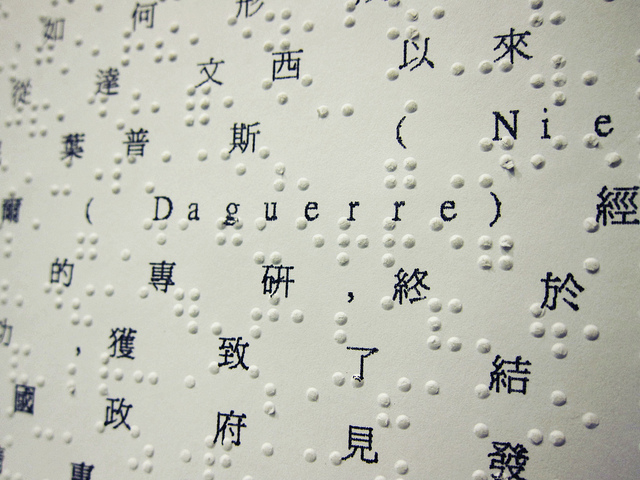
⠱ is used for both the empty rime  -i ([ɨ]), which is not written in zhuyin, and the rime ㄦ er ([ɐɚ]). See for example 斯 sī (⠑⠱⠄) located above the word Daguerre in the image at right.
Tone is always marked. This includes toneless syllables such as 了 le, rendered ⠉⠮⠁lė in the image above-right.
Taiwanese Braille
Taiwanese Braille is the braille script used in Taiwan for Taiwanese Mandarin (Guoyu). Although based marginally on international braille, most consonants have been reassigned; also, like Chinese Braille, Taiwanese Braille is a semi-syllabary.
An example is,
The braille letters for zhuyin/pinyin ㄍ g (/k/), ㄘ c (/tsʰ/), and ㄙ s (/s/) double for the alveolo-palatal consonants ㄐ j (/tɕ/), ㄑ q (/tɕʰ/), and ㄒ x (/ɕ/). The latter are followed by close front vowels, namely ㄧ i (/i/) and ㄩ ü (/y/), so the distinction between g, c, s (or z, k, h) and j, q, x in zhuyin and pinyin is redundant.
Each medial + rime in zhuyin is written with a single letter in braille.
⠱ is used for both the empty rime -i ([ɨ]), which is not written in zhuyin, and the rime ㄦ er ([ɐɚ]). See for example 斯 sī (⠑⠱⠄) located above the word Daguerre in the image at right.
Tone is always marked. This includes toneless syllables such as 了 le, rendered ⠉⠮⠁lė in the image above-right.
Recent media
Recent media