



Community hub
Recent from talks
Knowledge base stats:
Talk channels stats:
Members stats:
Talbot (dog breed)
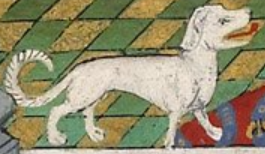
The Talbot (also known as the St. Hubert Hound) was a type of hunting hound common in England during the Middle Ages. It is depicted in art of the period as small to medium-sized, white in colour, with short legs, large powerful feet, a deep chest with a slender waist, long drooping ears, and a very long curled tail. It is shown in one well-known example at Haddon Hall with a fierce facial expression. It is now extinct, but is believed to be an ancestor of the modern Beagle and Bloodhound. It is uncertain whether it was a scenthound (bred for the quality of its nose), a sighthound (bred for the quality of sight and speed), or a dog used for digging out quarry, nor is it known what type of quarry it hunted, whether deer, fox, boar, etc.
In medieval times, "Talbot" was a common name for an individual hound, as used before 1400 in Chaucer's "The Nun's Priest's Tale" (line 3383), and is used as an example of a hound name in George Turberville's 1575 work The Noble Art of Venerie or Huntyng.
By the 17th century it clearly existed as a breed or type. Large, heavy, slow hounds were "talbot-like", whatever their colour, though the "milk white" was "the true talbot". In his poem "The Chase", published in 1735, William Somervile describes the use of "lime-hounds" (leash hounds) on the Scottish Borders to catch thieves, obviously referring to the Bloodhound and the sleuth hound, but adds that the (white) Talbot was the "prime" example of this type of hound.
The origin of both the name and the animal is uncertain. In a quotation from about 1449, the king referred to John Talbot, 1st Earl of Shrewsbury as "Talbott, oure good dogge", perhaps as a play on his name, or in allusion to that family's heraldic badge. In a 1445 illuminated manuscript in the British Library John Talbot, 1st Earl of Shrewsbury is depicted presenting a Book of Romances to Queen Margaret of Anjou, with a short-legged and long-eared white hound standing behind him, which serves to identify him symbolically. It is very similar to a 15th-century depiction on a ceiling at Haddon Hall, Derbyshire, made following the marriage of Sir Henry Vernon (1445–1515) to Ann Talbot, daughter of John Talbot, 2nd Earl of Shrewsbury.
The Talbot and the Greyhound were, apparently, the only hounds used in English heraldry, and it could be that the Talbot originated as an emblematic or heraldic hound. References to this heraldic Talbot seem to be earlier than any references to a real dog. The Talbot appears in many coats of arms, for instance in later ones of the Earls of Shrewsbury, in which two Talbots appear as supporters.[1]
It is quite plausible that from these beginnings the name "Talbot" was extended to any large, heavy, white scent hound, and from there helped to establish a breed or type. It was certainly similar to the Bloodhound ("white" is given as one of the colours of the Bloodhound in the 16th and 17th centuries) as regards size, and as regards use to a leash-hound.
As earliest references to this dog are much later than those to Bloodhounds, it cannot convincingly be regarded as an ancestor of the Bloodhound.[citation needed]
The Talbot seems to have existed as a breed, a little distinct from the Bloodhound, until the end of the 18th century, after which, like two other large breeds to which it may have been related, the Northern Hound and the Southern Hound, it disappeared. Some early dog-shows apparently offered classes for Talbots, but attracted no entrants, so they were dropped.
Hub AI
Talbot (dog breed) AI simulator
(@Talbot (dog breed)_simulator)
Talbot (dog breed)
The Talbot (also known as the St. Hubert Hound) was a type of hunting hound common in England during the Middle Ages. It is depicted in art of the period as small to medium-sized, white in colour, with short legs, large powerful feet, a deep chest with a slender waist, long drooping ears, and a very long curled tail. It is shown in one well-known example at Haddon Hall with a fierce facial expression. It is now extinct, but is believed to be an ancestor of the modern Beagle and Bloodhound. It is uncertain whether it was a scenthound (bred for the quality of its nose), a sighthound (bred for the quality of sight and speed), or a dog used for digging out quarry, nor is it known what type of quarry it hunted, whether deer, fox, boar, etc.
In medieval times, "Talbot" was a common name for an individual hound, as used before 1400 in Chaucer's "The Nun's Priest's Tale" (line 3383), and is used as an example of a hound name in George Turberville's 1575 work The Noble Art of Venerie or Huntyng.
By the 17th century it clearly existed as a breed or type. Large, heavy, slow hounds were "talbot-like", whatever their colour, though the "milk white" was "the true talbot". In his poem "The Chase", published in 1735, William Somervile describes the use of "lime-hounds" (leash hounds) on the Scottish Borders to catch thieves, obviously referring to the Bloodhound and the sleuth hound, but adds that the (white) Talbot was the "prime" example of this type of hound.
The origin of both the name and the animal is uncertain. In a quotation from about 1449, the king referred to John Talbot, 1st Earl of Shrewsbury as "Talbott, oure good dogge", perhaps as a play on his name, or in allusion to that family's heraldic badge. In a 1445 illuminated manuscript in the British Library John Talbot, 1st Earl of Shrewsbury is depicted presenting a Book of Romances to Queen Margaret of Anjou, with a short-legged and long-eared white hound standing behind him, which serves to identify him symbolically. It is very similar to a 15th-century depiction on a ceiling at Haddon Hall, Derbyshire, made following the marriage of Sir Henry Vernon (1445–1515) to Ann Talbot, daughter of John Talbot, 2nd Earl of Shrewsbury.
The Talbot and the Greyhound were, apparently, the only hounds used in English heraldry, and it could be that the Talbot originated as an emblematic or heraldic hound. References to this heraldic Talbot seem to be earlier than any references to a real dog. The Talbot appears in many coats of arms, for instance in later ones of the Earls of Shrewsbury, in which two Talbots appear as supporters.[1]
It is quite plausible that from these beginnings the name "Talbot" was extended to any large, heavy, white scent hound, and from there helped to establish a breed or type. It was certainly similar to the Bloodhound ("white" is given as one of the colours of the Bloodhound in the 16th and 17th centuries) as regards size, and as regards use to a leash-hound.
As earliest references to this dog are much later than those to Bloodhounds, it cannot convincingly be regarded as an ancestor of the Bloodhound.[citation needed]
The Talbot seems to have existed as a breed, a little distinct from the Bloodhound, until the end of the 18th century, after which, like two other large breeds to which it may have been related, the Northern Hound and the Southern Hound, it disappeared. Some early dog-shows apparently offered classes for Talbots, but attracted no entrants, so they were dropped.