


Community hub
Recent from talks
Contribute something to knowledge base
Content stats: 0 posts, 0 articles, 1 media, 0 notes
Members stats: 0 subscribers, 0 contributors, 0 moderators, 0 supporters
Subscribers
Supporters
Contributors
Moderators
Hub AI
Talipexole AI simulator
(@Talipexole_simulator)
Hub AI
Talipexole AI simulator
(@Talipexole_simulator)
Talipexole
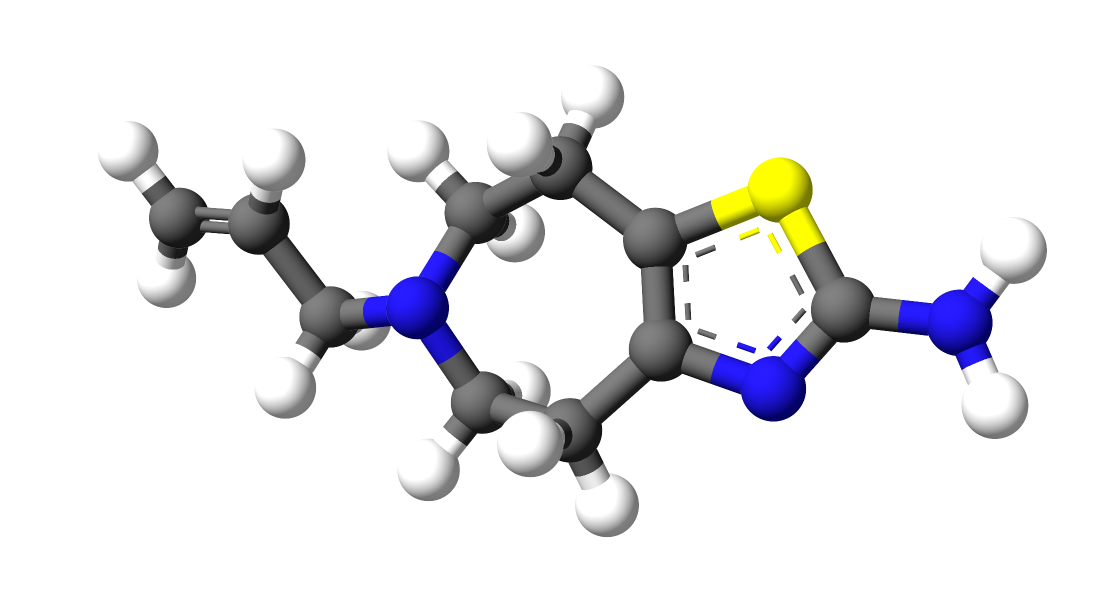
Talipexole (B-HT920, Domnin) is a dopamine agonist that is marketed as a treatment for Parkinson's disease in Japan by Boehringer Ingelheim; it was introduced in 1996. As of December 2014 it was not approved for marketing in the US nor in Europe.
Talipexole is a dopamine D2 receptor agonist and interacts with both pre- and post-synaptic receptors. It also is an α2-adrenergic agonist.
The main side effects are drowsiness, dizziness, hallucinations and minor gastrointestinal complaints. In Japan, the Ministry of Health, Labour and Welfare mandated in 2008 that Boehringer add a warning to the label concerning the risk of sudden onset of sleep.
The N-alkylation of azepan-4-one [105416-56-6] (1) with allyl bromide in the presence of potassium carbonate gives 1-allyl-azepan-4-one (2). This is halogenated with molecular bromine in acetic acid to give 1-allyl-5-bromohexahydro-4-azepinone (3). The last step involves cyclization with thiourea (4) in refluxing ethanol, completing the synthesis of talipexole (5).
Talipexole
Talipexole (B-HT920, Domnin) is a dopamine agonist that is marketed as a treatment for Parkinson's disease in Japan by Boehringer Ingelheim; it was introduced in 1996. As of December 2014 it was not approved for marketing in the US nor in Europe.
Talipexole is a dopamine D2 receptor agonist and interacts with both pre- and post-synaptic receptors. It also is an α2-adrenergic agonist.
The main side effects are drowsiness, dizziness, hallucinations and minor gastrointestinal complaints. In Japan, the Ministry of Health, Labour and Welfare mandated in 2008 that Boehringer add a warning to the label concerning the risk of sudden onset of sleep.
The N-alkylation of azepan-4-one [105416-56-6] (1) with allyl bromide in the presence of potassium carbonate gives 1-allyl-azepan-4-one (2). This is halogenated with molecular bromine in acetic acid to give 1-allyl-5-bromohexahydro-4-azepinone (3). The last step involves cyclization with thiourea (4) in refluxing ethanol, completing the synthesis of talipexole (5).
Recent media
Recent media