
Recent from talks
Talisman
Knowledge base stats:
Talk channels stats:
Members stats:
Talisman
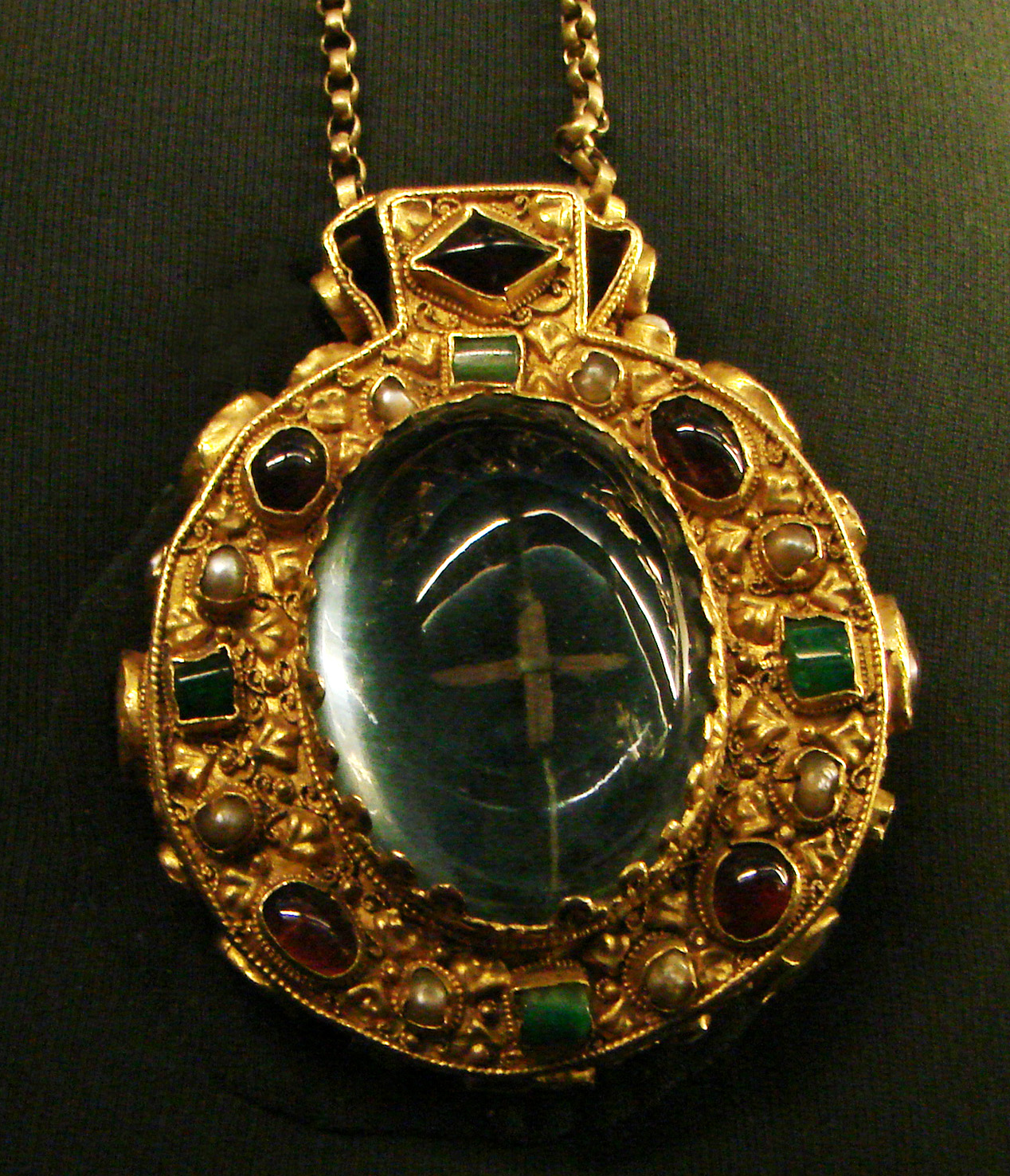
A talisman is any object ascribed with religious or magical powers intended to protect, heal, or harm individuals for whom they are made. Talismans are often portable objects carried on someone in a variety of ways, but can also be installed permanently in architecture. Talismans are closely linked with amulets, fulfilling many of the same roles, but a key difference is in their functions. An amulet protects a person or possession against evil forces while a talisman provides good fortune.
Talismans have been used in many civilizations throughout history, with connections to astrological, scientific, and religious practices; but the theory around preparation and use has changed in some cultures with more recent, new age, talismanic theory. Talismans are used for a wide array of functions, such as: the personal protection of the wearer, loved ones or belongings, aiding in fertility, and helping crop production.
The word talisman comes from French talisman, via Arabic ṭilasm (طِلَسْم, plural طلاسم ṭalāsim), which comes from the ancient Greek telesma (τέλεσμα), meaning 'completion, religious rite, payment', ultimately from the verb teleō (τελέω), 'I complete, perform a rite'.
According to New Age talismanic practices, features with magical associations—such as colors, scents, symbology, and patterns, figures—can be integrated into the creation of a talisman in addition to the chosen planetary or elemental symbolism. However, these must be used in harmony with the elemental or planetary force chosen so as to amplify the intended power of the talisman. It is also possible to add a personal touch to the talisman by incorporating a verse, inscription, or pattern that is of particular meaning to the maker. These inscriptions can be sigils (magical emblems), bible verses, or sonnets, but they too must be in harmony with the talisman's original purpose.
Use of verses of the Qur'an in slips of parchment rolled inside talismanic objects has been common throughout the Muslim World. For example, Muslim Ibn al-hajjaj instructed military commanders to inscribe Quran 54:46 on a cloth with rosewater, musk, and amber when Libra is rising and in the hour of the sun, and to carry it to the battlefield to prosper over oppressors and nonbelievers.
The 10th century ‘Abbasid mathematician, Thabit ibn Qurra, was considered to be an expert on talismans. In one of his texts on talismans, he wrote, ‘The noblest part of astronomy is the science of talismans.' According to the 12th century translator John of Seville and Limia's version of ibn Qurra's Arabic text, De imaginibus, he saw talismans and astronomy to be more crucial for gaining wisdom than the studies of geometry and philosophy. In Adelard of Bath's translation of the same text, it is stressed that extensive knowledge of both astronomy and astrology is needed for creating a talisman. This information is necessary because talismans should be made at the moment of an auspicious celestial event. One's birth horoscope could also be a factor in the efficacy of talismans. The maker cannot have any distractions or doubts, otherwise their talisman will be powerless.
Adelard's translation specifies that to make a talisman which could earn love from a king, family member, or peer, one should use lead, iron, bronze, gold, or silver. To make a harmful talisman for creating conflicts between others, receiving money, defending or destroying a place, or winning a legal battle, one should use pitch and tar, bitumen, and aloes. An example of how to make a love talisman according to Ibn Qurra's book is as follows: Firstly, one must make sure it is the correct astrological time to perform this ritual because it is the eleventh place, or house, that is connected to friendship. Next, one must make a talisman of a man's figure during the specific astrological time, and with specific intention, and it must be engraved with the other person's name. Thirdly, one must make a second talisman, and it should be engraved with the name of the receiver of this love. After this, both the names and cognomina of each person should be engraved on both talismans. They must be positioned so that the names on each talisman touches the heart of the other talisman. Next in the process is to take a piece of unused parchment or cloth that has been purified with musk, ambergris, and camphor, and draw the ‘rings' of the lords of the ascendant and eleventh place. The talismans must be purified with saffron, aloe-wood, and frankincense, and then folded in the previously prepared cloth or parchment. This purification process should be repeated for three consecutive nights. During this process, a specific prayer related to the maker's intention must be recited, and the individual must be bathed and have clean clothes.
In the Islamic world, talismans were regularly employed for personal, social, political, and ideological reasons at both popular and elite levels. They function as a conduit for divine protection, which can involve both the attraction of positive energies to the wearer and the deflection of disease, danger and the evil eye. They may also be referred to as a hafiz, (protector) as well as a himala (pendant) often affixed to or suspended from the body, for example as a necklace, ring, talismanic shirt, or a small object within a portable pouch.
Hub AI
Talisman AI simulator
(@Talisman_simulator)
Talisman
A talisman is any object ascribed with religious or magical powers intended to protect, heal, or harm individuals for whom they are made. Talismans are often portable objects carried on someone in a variety of ways, but can also be installed permanently in architecture. Talismans are closely linked with amulets, fulfilling many of the same roles, but a key difference is in their functions. An amulet protects a person or possession against evil forces while a talisman provides good fortune.
Talismans have been used in many civilizations throughout history, with connections to astrological, scientific, and religious practices; but the theory around preparation and use has changed in some cultures with more recent, new age, talismanic theory. Talismans are used for a wide array of functions, such as: the personal protection of the wearer, loved ones or belongings, aiding in fertility, and helping crop production.
The word talisman comes from French talisman, via Arabic ṭilasm (طِلَسْم, plural طلاسم ṭalāsim), which comes from the ancient Greek telesma (τέλεσμα), meaning 'completion, religious rite, payment', ultimately from the verb teleō (τελέω), 'I complete, perform a rite'.
According to New Age talismanic practices, features with magical associations—such as colors, scents, symbology, and patterns, figures—can be integrated into the creation of a talisman in addition to the chosen planetary or elemental symbolism. However, these must be used in harmony with the elemental or planetary force chosen so as to amplify the intended power of the talisman. It is also possible to add a personal touch to the talisman by incorporating a verse, inscription, or pattern that is of particular meaning to the maker. These inscriptions can be sigils (magical emblems), bible verses, or sonnets, but they too must be in harmony with the talisman's original purpose.
Use of verses of the Qur'an in slips of parchment rolled inside talismanic objects has been common throughout the Muslim World. For example, Muslim Ibn al-hajjaj instructed military commanders to inscribe Quran 54:46 on a cloth with rosewater, musk, and amber when Libra is rising and in the hour of the sun, and to carry it to the battlefield to prosper over oppressors and nonbelievers.
The 10th century ‘Abbasid mathematician, Thabit ibn Qurra, was considered to be an expert on talismans. In one of his texts on talismans, he wrote, ‘The noblest part of astronomy is the science of talismans.' According to the 12th century translator John of Seville and Limia's version of ibn Qurra's Arabic text, De imaginibus, he saw talismans and astronomy to be more crucial for gaining wisdom than the studies of geometry and philosophy. In Adelard of Bath's translation of the same text, it is stressed that extensive knowledge of both astronomy and astrology is needed for creating a talisman. This information is necessary because talismans should be made at the moment of an auspicious celestial event. One's birth horoscope could also be a factor in the efficacy of talismans. The maker cannot have any distractions or doubts, otherwise their talisman will be powerless.
Adelard's translation specifies that to make a talisman which could earn love from a king, family member, or peer, one should use lead, iron, bronze, gold, or silver. To make a harmful talisman for creating conflicts between others, receiving money, defending or destroying a place, or winning a legal battle, one should use pitch and tar, bitumen, and aloes. An example of how to make a love talisman according to Ibn Qurra's book is as follows: Firstly, one must make sure it is the correct astrological time to perform this ritual because it is the eleventh place, or house, that is connected to friendship. Next, one must make a talisman of a man's figure during the specific astrological time, and with specific intention, and it must be engraved with the other person's name. Thirdly, one must make a second talisman, and it should be engraved with the name of the receiver of this love. After this, both the names and cognomina of each person should be engraved on both talismans. They must be positioned so that the names on each talisman touches the heart of the other talisman. Next in the process is to take a piece of unused parchment or cloth that has been purified with musk, ambergris, and camphor, and draw the ‘rings' of the lords of the ascendant and eleventh place. The talismans must be purified with saffron, aloe-wood, and frankincense, and then folded in the previously prepared cloth or parchment. This purification process should be repeated for three consecutive nights. During this process, a specific prayer related to the maker's intention must be recited, and the individual must be bathed and have clean clothes.
In the Islamic world, talismans were regularly employed for personal, social, political, and ideological reasons at both popular and elite levels. They function as a conduit for divine protection, which can involve both the attraction of positive energies to the wearer and the deflection of disease, danger and the evil eye. They may also be referred to as a hafiz, (protector) as well as a himala (pendant) often affixed to or suspended from the body, for example as a necklace, ring, talismanic shirt, or a small object within a portable pouch.
Recent media