Hubbry Logo
PendantPendantMain
Open search
Pendant
Community hub
Pendant
logo
8 pages, 0 posts
0 subscribers
Be the first to start a discussion here.
Pendant
Pendant
from Wikipedia

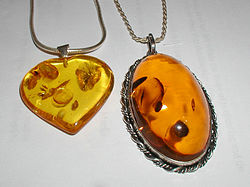
Amber pendants
Pushpaka Thali - Wedding pendant used by Pushpaka Brahmins of Kerala, India
Wedding pendant with 21 beads used by Saint Thomas Christians of India
Spanish pendant at Victoria and Albert Museum.
Indonesian pendants

A pendant is a loose-hanging piece of jewellery, generally attached by a small loop to a necklace, which may be known as a "pendant necklace".[1] A pendant earring is an earring with a piece hanging down. Its name stems from the Latin word pendere and Old French word pendr, both of which translate to "to hang down". In modern French, pendant is the gerund form of pendre ("to hang") and also means "during". The extent to which the design of a pendant can be incorporated into an overall necklace makes it not always accurate to treat them as separate items.[2]

In some cases, though, the separation between necklace and pendant is far clearer.[2]

Overview

[edit]
Carved agarwood imperial pendant, Qing dynasty, China. Adilnor Collection, Sweden.

Pendants are among the oldest recorded types of bodily adornment. Stone, shell, pottery, and more perishable materials were used. Ancient Egyptians commonly wore pendants, some shaped like hieroglyphs.

Pendants can have several functions, which may be combined:

The many specialized types of pendants include lockets which open, often to reveal an image, and pendilia, which hang from larger objects of metalwork.

Types

[edit]

Throughout the ages, pendants have come in a variety of forms to serve a variety of purposes.

Amulet

[edit]

Though amulets come in many forms, a wearable amulet worn around the neck or on the arm or leg in the form of a pendant is the most common. These are objects believed to possess magical or spiritual power to protect the wearer from danger or dispel evil influences.[3]

Talisman

[edit]

Similar to an amulet, a talisman is an object believed to possess supernatural traits. However, while an amulet is strictly a defensive object, a talisman is meant to confer special benefits or powers upon the wearer.[4]

Locket

[edit]

A locket is a small object that opens to reveal a space which serves to hold a small object, usually a photograph or a curl of hair. They typically come in the form of a pendant hanging from a necklace, though they will occasionally be hung from a charm bracelet.[5]

Medallion

[edit]

A medallion is most often a coin-shaped piece of metal worn as a pendant around the neck or pinned onto clothing. These are generally granted as awards, recognitions, or religious blessings.[6]

Painting

[edit]

Pendant is the name given to one of two paintings conceived as a pair. They usually are gift from couples and some cultures consider the act of giving one a marry proposition.[7]

Functional pendants

[edit]
Traveller's sundial pendant (a portable form of astronomical rings) used to tell time from the sun.

Tools worn as pendants include Maori pounamu pendants. Shepherd's whistles, bosun's whistles, and ocarinas can also be made as pendants. Portable astronomical and navigational instruments were made as pendants.

In the first decade of the 21st century, jewellers started to incorporate USB flash drives into pendants.[8][9]

Fashion pendants

[edit]

Fashion pendants include a small creative piece often made from precious or non-precious stones and metals like diamonds or pearls hanging freely from a chain or necklace. These are generally worn as a statement piece or a fashion ornament.[10]

Other types

[edit]
  • Harness pendant

See also

[edit]

References

[edit]
Revisions and contributorsEdit on WikipediaRead on Wikipedia
from Grokipedia
A pendant is a suspended ornament in jewelry, typically a loose-hanging piece attached by a loop or to a , , , or other wearable item, designed to dangle freely and often featuring decorative motifs, gemstones, or engravings. The word "pendant" originates from the Old French term pendant, meaning "hanging," which derives from the Latin verb pendere, "to hang" or "to suspend." Pendants have been integral to human adornment since prehistoric times, evolving from simple talismans to elaborate expressions of status, spirituality, and across cultures. In , pendants and amulets—crafted from materials like , , semi-precious stones, beads, shells, or bones—held profound magical significance, worn by all social classes to protect against , evil spirits, and misfortune while ensuring safe passage in the ; for instance, heartscarabs inscribed with spells from the were placed over the deceased's heart during mummification. For example, in the Roman period during the 2nd–3rd century CE, pendants symbolized wealth, gender, and social standing, often integrated into gold necklaces inlaid with colored gemstones like garnets and emeralds, influenced by Hellenistic, Etruscan, and imperial trade expansions that popularized vibrant materials. In Minoan Crete around 2000 BCE, pendants represented innovative regional craftsmanship, such as those used in mortuary rituals, blending artistic novelty with spiritual function. Through the and into modern eras, pendants diversified into functional forms like lockets for concealing portraits or messages and vinaigrettes to mask odors, while maintaining roles in religious devotion (e.g., crosses or icons) and cultural expression; materials expanded to include enamels, cameos, and synthetic stones, reflecting technological and societal shifts. Today, pendants continue to blend with contemporary design, often personalized to convey emotions, beliefs, or heritage.

Introduction and Definition

Etymology and Basic Characteristics

A pendant derives its name from the Latin verb pendere, meaning "to hang," which entered the in the early through the term pendant, denoting something hanging down. In its basic form, a pendant is a loose-hanging piece of jewelry, generally attached by a small loop to a , cord, or similar strand and worn around the neck for ornamental purposes. This design allows it to dangle freely, and pendants may also appear as drops in styles. Unlike fixed adornments such as brooches, which are secured by pins to , pendants emphasize mobility and suspension. Key physical attributes of pendants include a compact size to ensure they remain proportionate and visible when suspended. They are affixed to their supporting or cord via a —a metal loop or hook—or a simple drilled hole serving as an attachment point. Common shapes range from basic geometric forms like circles and ovals to figurative motifs, such as hearts, crosses, or stylized figures, providing versatility in while maintaining the essential hanging quality. While pendants are chiefly associated with neck today, historical examples demonstrate their use in other contexts, including attachments to belts as ornaments or integration into headdresses for ceremonial wear.

Historical Origins

The origins of pendants trace back to the era, around 40,000 BCE, when early humans fashioned proto-pendants from perforated shells and animal teeth for personal . These items, such as pierced teeth discovered in European sites like the Bachokirian layers of , served as early forms of body decoration, likely signifying or ritual significance within communities. Archaeological evidence from contexts indicates that these ornaments were strung together, marking the beginnings of suspended jewelry traditions that emphasized individual expression and group identity. In , by approximately 3000 BCE, pendants evolved into sophisticated amulets, particularly scarabs shaped like hieroglyphs and crafted from for protective purposes in the . These scarabs, symbolizing rebirth and often inscribed with spells from the , were worn or placed on mummies to safeguard the deceased. A prominent example is the pectoral of , a and jeweled scarab necklace from his tomb (c. 1323 BCE), featuring a central scarab pushing the sun disk, flanked by protective deities, which exemplifies the integration of religious symbolism and elite craftsmanship. Around 2500 BCE, in and the Indus Valley Civilization, pendants took on roles as status symbols, with cylinder seals in often worn as necklaces alongside lapis lazuli beads imported over long distances. Mesopotamian seals, carved from stone and depicting mythological scenes or administrative motifs, functioned both as identity markers and jewelry, suspended from cords for daily wear by elites. In the Indus Valley, lapis lazuli beads from Afghan mines, strung into elaborate necklaces, signified wealth and were buried with high-status individuals, highlighting early trade networks that connected to . During the Classical period (c. 500 BCE–500 CE), Greek and Roman cultures refined pendants with lunulae—crescent-shaped amulets—and intaglio gems engraved with deities for apotropaic or decorative purposes. Greek lunulae, often worn by women, evoked lunar goddesses and , while Roman intaglios, such as those depicting gods like Bonus Eventus, were mounted in settings as pendants to convey divine favor or personal devotion. In the post-Roman Medieval European era (c. 500–1500 CE), pendants shifted toward Christian , with religious crosses and pendants containing saintly fragments emerging as widespread protective items. These enkolpia, worn close to the chest, blended Byzantine influences with local traditions, serving as talismans against evil. Key milestones in pendant evolution include the spread via trade routes like the , which from the 2nd century BCE facilitated the exchange of Asian pendants into Central and Western , influencing designs with motifs of dragons and ritual symbols prized for their purported spiritual powers.

Materials and Manufacturing

Traditional Materials and Techniques

Traditional pendants were primarily crafted from natural materials sourced locally or through early trade networks, reflecting the availability and cultural significance of resources before the . Natural stones such as , mined extensively in ancient from regions like the sites, were prized for their hardness and symbolic associations with purity and immortality, often shaped into discoid or animal-form pendants. , abundant in the American Southwest and , served as a ceremonial material for pendants among Native American tribes, valued for its vibrant blue color evoking sky and water. Organic materials like shells, bone, and were widely used due to their accessibility; for instance, coastal and inland communities fashioned pendants from marine shells, animal bones, and or , which provided workable yet durable surfaces for adornment. Early metals, including , silver, and , marked a shift toward prestige items, with gold's malleability enabling elaborate designs in ancient societies. Semi-precious gems enhanced pendants with symbolic depth, often chosen for protective or spiritual attributes. , harvested from deposits, featured prominently in Viking-era pendants carved into animal motifs to invoke the creature's strength and , symbolizing resilience and connection to . , sourced from Mediterranean and reefs, was strung into beads and pendants believed to ward off evil and promote health, its red hue representing life force in ancient Mediterranean cultures. Pearls, gathered from coastal waters, carried connotations of purity and divine favor, incorporated into pendants in and to signify status and chastity. Artisans employed labor-intensive, manual techniques suited to these materials, emphasizing skill over mechanization. Hand-carving with stone tools, including burins—chisel-like flakes dating back over 50,000 years—was essential for incising and shaping shells, bone, ivory, and stones into intricate pendant forms. Metalworking advanced through , a method used in ancient Egyptian gold pendants where a wax model was coated in clay, heated to remove the wax, and filled with molten gold to capture fine details like hieroglyphs or deities. Stringing pendants involved twisting natural fibers from plants such as , bark, or into cords, or using thongs from animal hides, creating flexible yet sturdy attachments for wear. In Byzantine contexts around 500 CE, early enameling techniques fused glass powders onto gold bases in pendants, adding colorful religious motifs through cloisonné-like cells for symbolic enhancement. Material sourcing in antiquity relied on regional mines, , and expansive , often straining local while fostering cultural exchange. Jade and turquoise were extracted from specific geological deposits in and the , respectively, with leading to depleted sites by late prehistoric periods. Organic materials like shells and were harvested sustainably at first but faced scarcity from overhunting, prompting shifts to . Metals and gems exemplified long-distance networks; for Egyptian pendants traveled over 3,000 miles from Afghan mines in since the fourth millennium BCE, its deep blue symbolizing the heavens and traded at great cost. Amber and followed similar routes via Mediterranean and northern European exchanges, underscoring how pendants embodied interconnected ancient economies.

Modern Materials and Innovations

Following the , pendant materials shifted toward standardized alloys that balanced durability, affordability, and aesthetics. , comprising 92.5% pure silver alloyed with copper for hardness, emerged as a post-1800 standard for jewelry due to its luster and workability, enabling widespread use in pendants. Similarly, 14k gold—58.33% pure gold mixed with metals like copper or nickel—became a common benchmark in the 19th and 20th centuries for its resistance to wear while maintaining a luxurious appearance in pendant designs. , introduced to fine jewelry in the late 19th century after advancements like the oxyhydrogen torch in the 1850s allowed refining, is typically alloyed with 5-10% to enhance strength (Mohs hardness approximately 4-4.5), making it ideal for intricate pendant settings that resist . plating, applied since the early 20th century to white gold or silver pendants, provides a scratch-resistant, bright white finish and properties, extending the lifespan of these pieces. Synthetic and alternative materials have further democratized pendant production since the mid-20th century, offering diamond-like sparkle at lower costs. , a lab-created , gained prominence in jewelry from the late after Soviet scientists stabilized its cubic form, serving as an affordable simulant for in pendants without the ethical concerns of mining. Lab-grown , first synthesized in 1954 by using high-pressure methods, replicate natural diamond composition (carbon crystals) and became viable for gem-quality pendants by the , providing identical optical and thermal properties at a fraction of the cost. Polymers such as PA12 and acrylics, along with 3D-printed resins, enable lightweight, customizable pendants; these materials, processed via additive , reduce production expenses and material waste, appealing to budget-conscious consumers. Technological innovations have transformed pendant design and fabrication from the 1990s onward. (CAD) software, adopted widely in jewelry studios during this period, allows precise digital modeling for complex geometries, streamlining prototyping before physical creation. , a precision technique using focused beams for detailed , has become standard for motifs or text onto metal and synthetic pendants, enhancing individuality without compromising structural integrity. drives recent advancements, with 2020s brands incorporating recycled metals—reclaimed from e-waste or industrial scraps—and bio-based plastics derived from plant sources, reducing environmental impact while maintaining aesthetic appeal in eco-conscious pendants. Manufacturing has evolved from artisanal methods to industrialized processes, facilitating and personalization. Stamping, involving dies to press into shapes, and injection molding for polymers, enable efficient replication of pendant designs at scale, lowering costs since the . Online platforms like , since the , have popularized for custom pendants, where users upload designs for resin-based prototypes that are cast into metals, bridging with options.

Types and Forms

Protective and Symbolic Pendants

Protective and symbolic pendants, often manifesting as amulets or talismans, have been crafted across cultures to safeguard wearers from harm or to invoke beneficial forces. Amulets primarily serve as defensive objects believed to ward off , danger, or misfortune, while talismans are intended to actively bestow power, luck, or . These pendants frequently incorporate specific motifs, materials, or inscriptions that encode their protective or empowering intent, drawing on longstanding spiritual traditions. Amulets as pendants emphasize protection against malevolent influences, such as the "," a widespread belief in Mediterranean cultures dating back to ancient times. Evil eye beads, typically blue glass or stone orbs mimicking the , were worn to deflect envy-induced harm and have persisted in Greek, Turkish, and Italian traditions. In Jewish and Islamic contexts, the hand—a stylized open palm with an eye at its center—functions similarly as an amulet against the evil eye and general misfortune, its origins predating both religions but integrated into protective jewelry by the medieval period. Ancient Egyptian amulets, including those placed on , further exemplify this role, using forms like scarabs or figures to renew strength and shield from afterlife perils. Talismans, in contrast, pendants designed to confer positive attributes, often feature astrological or animal symbols to harness cosmic or natural energies. Chinese jade dragon pendants symbolize imperial power and prosperity, with jade's purity believed to attract wealth and good fortune since the period. Astrological zodiac pendants, engraved with signs like Aries or Scorpio, were used in Greco-Roman and medieval European traditions to align the wearer with planetary influences for success or protection. These items differ from amulets by their proactive symbolism, aiming to empower rather than merely defend. Symbolic motifs in protective pendants encode deeper spiritual meanings, transcending mere decoration. The , adopted as a pendant symbol from the CE following Constantine's vision, represents salvation and victory over death, evolving from a mark of execution to a widespread of faith. In , the —a looped —signified eternal life and was commonly fashioned into amulets or pendants to invoke vitality and divine protection. Materials also carry symbolic weight; black tourmaline pendants are valued in contemporary spiritual practices for their grounding properties, believed to absorb and promote stability. Cultural variations highlight the adaptability of these pendants. Among Native American Ojibwe people, dreamcatchers—web-like structures sometimes miniaturized as pendants—serve as protective talismans to filter nightmares and allow positive dreams to pass through, a tradition originating in the but drawing on ancient symbolism. In West African and contexts, gri-gri bags—small pouches containing herbs, stones, or inscriptions—function as portable amulets for personal protection and enhancement, carried or worn as pendants in Vodou-influenced practices from to New Orleans. These examples underscore how protective pendants integrate local beliefs into wearable forms of spiritual defense.

Commemorative and Personal Pendants

Commemorative and personal pendants serve as intimate keepsakes that capture significant life events, relationships, or memories, often designed to hold personal mementos or inscriptions. These items emphasize emotional connections rather than symbolic protection or aesthetic display, evolving from early European traditions to diverse cultural expressions worldwide. Lockets, hinged cases typically worn as pendants, originated in 16th-century Europe as protective enclosures for portrait miniatures painted on . These early examples, such as Nicholas Hilliard's enamel-covered gold locket depicting Queen Elizabeth I around 1600, allowed wearers to carry small, detailed likenesses of loved ones or patrons for sentimental or diplomatic purposes. By the (1837–1901), lockets became prominent in mourning jewelry, influenced by Queen Victoria's prolonged grief over Prince Albert's death in 1861; many featured compartments for locks of hair, photographs, or even small amounts of ashes, serving as tangible memorials to the deceased. Medallions, resembling coin-like discs suspended as pendants, commemorate achievements or milestones and have been awarded in various forms since antiquity, but gained modern prominence in the late . The first Olympic medals, introduced at the 1896 Games, were silver for first-place winners (accompanied by olive wreaths and diplomas) and bronze for second-place winners (with laurel wreaths and diplomas), marking athletic excellence and worn as pendants by victors. Similarly, military dog tags emerged as identification pendants during the (1861–1865), with soldiers etching names on discs to ensure posthumous recognition; formalized by the U.S. Army in 1906, these oval aluminum tags, stamped with personal details and worn on neck chains, evolved into enduring symbols of service and sacrifice. Personalization enhances the commemorative value of pendants through engravings of names, dates, or symbols, a practice traceable to ancient civilizations but widespread in European jewelry by the 18th and 19th centuries for marking births, weddings, or losses. pendants, associating specific gems with months of birth, draw from biblical references to Aaron's (Exodus 28) and solidified as a tradition in 16th-century Poland or , with the modern list standardized by U.S. jewelers in 1912 to represent and familial bonds. In Indian culture, the wedding thali—a pendant on a beaded chain—symbolizes the marital vow, presented by the groom during Hindu ceremonies in ; designs often include floral motifs or coins, with varieties like those featuring multiple beads (up to 21 in elaborate forms) signifying prosperity and unity. This evolution from portrait enclosures to 20th-century photo lockets reflects technological advances like , enabling more accessible while preserving the pendant's role as a portable emotional archive.

Functional and Utility Pendants

Functional and utility pendants integrate practical tools or mechanisms into jewelry designs, allowing wearers to carry essential devices discreetly while maintaining an aesthetic appeal. These items extend beyond decoration to provide tangible benefits, such as navigation, timekeeping, or response, often evolving from historical necessities to contemporary technological aids. Historical examples include 18th-century pendants, which served travelers by combining with personal adornment in an era of . Renaissance pocket sundials, functioning as wearable variants of larger timepieces, incorporated gnomons and elements into compact pendants for portable time measurement under sunlight. pendants also emerged for signaling purposes, particularly among , enabling quick communication through a simple, neck-worn device. In the Victorian era, perfume vial pendants allowed women to carry scents for personal refreshment, often featuring small glass reservoirs suspended as necklaces or chatelaines. Magnifying glass pendants, popular from the late 19th century, aided reading fine print and were crafted with lenses set in ornate frames for everyday utility. Modern innovations build on these traditions with digital integrations, such as USB drive pendants that emerged in the 2000s for portable data storage; SanDisk's 2008 gold necklace model exemplified this by housing a 4GB flash drive in a diamond-accented jewel. Bluetooth key finder trackers, available since the 2010s, attach as pendants to locate lost items via smartphone apps, enhancing personal organization. In the 21st century, GPS-enabled medical alert pendants for the elderly provide location tracking and emergency response, with devices like those from Lifeline incorporating waterproof wearables for fall detection and 24/7 monitoring. Design integration in these pendants emphasizes concealing mechanisms to preserve jewelry , using hidden clasps or enclosures that protect functional components without compromising visual elegance. This approach ensures utility remains subtle, blending seamlessly with chains or settings to function as both accessory and tool.

Artistic and Fashion Pendants

Artistic pendants emphasize intricate craftsmanship and visual expression, often featuring miniature paintings or sculptural elements that transform the wearer into a canvas for . In 16th-century , pendants became renowned for their detailed portraits and scenes, produced by workshops that applied translucent enamels over or bases to create lifelike depictions of or mythological figures, as seen in pieces from the reign of Francis I. These enamel miniatures, fired at high temperatures to achieve vibrant colors, represented a pinnacle of jewelry art, blending techniques with wearable form. Sculptural pendants further elevated artistic pendants into three-dimensional masterpieces, with Russian jeweler innovating pendant variants of his famous Imperial Easter Eggs in the late 19th and early 20th centuries. These included enameled gold pendants adorned with diamonds, rubies, and miniature surprises like clockwork mechanisms, commissioned for the Russian aristocracy and exemplifying Art Nouveau's organic motifs and technical virtuosity. 's designs showcased engraving and plique-à-jour enameling, making them coveted as both jewelry and portable . In the realm of pendants, oversized statement pieces emerged as bold expressions of personal style, particularly during the 1980s when designers like created shoulder-dusting chains with large gemstone clusters or abstract geometric forms, reflecting the era's opulent power-dressing aesthetic. These pendants, often featuring , , or cultured pearls in asymmetrical arrangements, were popularized by celebrities and influenced by the bold silhouettes of houses like . High-fashion pendants continue to draw from brand iconography, as exemplified by Chanel's interlocking CC logo pendants introduced in the 1980s and refined in subsequent collections, crafted in gold with pearl or crystal accents to embody Coco Chanel's timeless elegance. Contemporary trends have shifted toward layered bohemian styles in the , where multiple delicate pendants with feathers, beads, or etched motifs are stacked for an eclectic, free-spirited look, as promoted by influencers and brands like . By the 2020s, minimalist geometric pendants gained prominence, featuring clean lines and subtle materials like oxidized silver or lab-grown diamonds, aligning with sustainable and understated luxury movements led by designers such as Jennifer Fisher. The enduring influence of pioneering jewelers like , founded in 1837, underscores the evolution of fashion pendants, with their signature heart motifs and blue enamel designs evolving from Victorian lockets to modern abstract pieces that blend artistry with wearable trendsetting. These pendants prioritize aesthetic innovation, often incorporating enamel or miniatures that depict scenic landscapes or abstract compositions rather than mere symbols, ensuring their appeal as both collectible art and stylistic statements.

Cultural and Social Significance

Religious and Traditional Roles

In , pendants such as crucifixes and medals hold profound devotional significance, often worn as symbols of faith and protection. The , originating from apparitions of the Virgin Mary to St. Catherine Labouré in 1830, was first produced with Church approval in 1832 and is commonly worn as a medal to invoke Mary's intercession for graces and safeguarding. medals, formalized by Pope St. Pius X in 1910, serve as a substitute for the traditional cloth scapulars, representing enrollment in the Brown confraternity and devotion to for spiritual benefits. Similarly, medals depicting St. Christopher, the of travelers, are worn by Catholics to seek protection during journeys, drawing from legends of the saint carrying the across a river. Within and , pendants featuring religious symbols underscore personal piety and communal identity. In Islamic traditions, particularly among Sufis, —small pouches or pendants containing Quranic verses or prayers—are worn as amulets for and against misfortune, reflecting practices rooted in mystical devotion. Pendants inscribed with "" are permissible when worn respectfully to express faith and seek divine guidance, provided they avoid any form of disrespect. In , the Magen David () pendant symbolizes divine and the harmony between heaven and earth, as interpreted in Kabbalistic traditions, and is worn to affirm Jewish heritage and spiritual connection. Hinduism and Buddhism incorporate pendants into meditative and merit-making practices. Om symbol pendants represent the primordial sound of the universe and the essence of ultimate reality (Brahman), worn by devotees to foster spiritual awareness and closeness to the divine during prayer or daily life. Rudraksha bead pendants, derived from seeds sacred to Lord Shiva, are strung into malas and worn against the skin to enhance meditation, promote inner peace, and invoke Shiva's blessings, with traditions emphasizing continuous wear for optimal energetic benefits. In Thai Buddhism, Buddha amulets—small pendants blessed by monks—are donned for protection from harm, good fortune, and the accumulation of merit, embodying supernatural blessings tied to Buddhist devotion. Traditional ethnic practices further highlight pendants' ancestral and ritualistic roles. Among the Maori of , the , a carved jade pendant in human form, symbolizes the first human and is passed down as a family heirloom to honor ancestry and convey cultural continuity. In 18th-century , agarwood served as Buddhist pendants for counting mantras during rituals, valued for their aromatic wood believed to purify the mind and aid spiritual contemplation. These items often feature in ceremonies, such as the Kerala Minnu in Syrian Christian weddings, where the groom ties a gold leaf-shaped pendant bearing a around the bride's neck with seven threads, symbolizing the marital covenant and divine union.

Societal and Fashion Influences

Pendants have historically signified , particularly among the elite. In , commissioned pendants adorned with heraldic family to display lineage, loyalty, and membership in aristocratic circles, often crafted in gold or enamel for public ostentation. This tradition persisted into the 20th century through celebrity influence, as exemplified by Elvis Presley's TCB (Taking Care of Business) lightning bolt necklace, designed in 1970 by jeweler Lowell Hays and featuring diamonds set in 18-karat gold; it symbolized Presley's inner circle mantra and inspired widespread adoption among fans, elevating pendants as emblems of cool and exclusivity in 1970s pop culture. Beyond status, pendants enable expression of personal and communal identity in secular contexts. Since the late , rainbow-motif pendants have served as visible markers of LGBTQ+ pride, inspired by Gilbert Baker's 1978 , which used its spectrum of colors to represent diversity, hope, and inclusivity within the community; these pieces, often in enamel or gemstone accents, allow wearers to signal solidarity without overt declaration. Similarly, the symbol (♀)—an astrological glyph for the planet and goddess , standardized as a gender by in the 1750s—has been reinterpreted in feminist pendants since the of the 1960s and , embodying female empowerment, autonomy, and resistance to patriarchal norms through minimalist silver or gold designs. Fashion trends have continually reshaped pendant styles, reflecting broader societal shifts. The 1920s movement introduced geometric pendants with sharp angles, settings, and or inlays, capturing the era's exuberance, machine-age optimism, and flapper-era liberation from Victorian excess. By the 1970s, rebelled with heavy chain pendants incorporating studs, spikes, and safety pins—often in silver or leather—drawn from DIY ethos and anti-establishment attitudes, as seen in designs by that democratized edgy accessories for youth rebellion. In the 2020s, luxury pendants emphasize sustainability, with brands prioritizing ethical sourcing of conflict-free verified under the Kimberley Process and recycled metals, aligning with consumer demands for transparency and environmental responsibility in high-end fashion. Cultural and gender dynamics further influence pendant adoption. Following the counterculture and hippie movements, unisex designs proliferated, challenging binary norms through shared bold motifs like peace symbols or abstract geometrics; Cartier's Aldo Cipullo epitomized this with the 1971 Juste un Clou pendant and , a hammered nail-inspired piece worn by both men and women to evoke raw, egalitarian self-expression. Global fusions enhance this evolution, as pendants—ancient interwoven patterns symbolizing eternity and interconnectedness from circa 2000 B.C.—integrate into modern American fashion via or gold iterations, appealing to heritage seekers and blending Irish-Scottish motifs with minimalist, everyday aesthetics in urban streetwear and bohemian styles.

Collecting and Valuation

Antique and Historical Pendants

Antique and historical pendants, primarily from periods before the , are highly sought after by collectors for their cultural, artistic, and material significance as artifacts. These items often embody symbolic meanings tied to ancient rituals or personal sentiments, with value driven by rarity, condition, and documented history. Key collectibles include Egyptian scarabs, which served as amulets and seals in , and Victorian lockets from the , prized for their intricate designs and sentimental enclosures. Authentic Egyptian scarabs, carved from materials like steatite or , can command high prices at when confirms their antiquity and origin; for example, a New Kingdom example featuring royal inscriptions sold for USD 9,375. Similarly, historical lockets with established , such as a Georgian-era example linked to royalty, often fetch $7,000 or more, reflecting their or silver construction and engraved details that evoke mourning or romantic themes. Authentication relies on hallmarks for European pieces, which indicate maker, purity, and date through stamped symbols assayed by official bureaus. For metal composition, () spectroscopy non-destructively analyzes elemental alloys, helping distinguish period-specific formulations like high-carat in ancient works. Organic components, such as or inlays, undergo carbon dating to verify age via radiocarbon decay measurement. Major institutional collections, like the British Museum's holdings of ancient pendants—including gold Etruscan beech-nut examples and Late Antique glass pieces—preserve thousands of such artifacts, offering insights into historical craftsmanship across civilizations. Auction records highlight their market appeal; for instance, a rare Fabergé jewelled rock crystal 'snowflake' pendant from circa 1913 sold at in 2019 for £56,250 (approximately $72,000), underscoring the premium for imperial Russian provenance and enamel work. Preservation poses significant challenges, as metals in antique pendants readily tarnish from exposure to compounds in air, forming black patinas that require careful cleaning to avoid abrasion. Enamels, often or champlevé in historical pieces, fade or crack due to mismatches with underlying metals, demanding controlled humidity and light levels for stability. Restoration ethics emphasize minimal intervention, as over-polishing or repainting diminishes authenticity and market value, with conservators prioritizing reversible techniques to honor the artifact's historical integrity. The global market, encompassing pendants as a leading product type due to their affordability and customization potential, reached USD 50.03 billion in 2024 and is projected to reach USD 52.32 billion in 2025 (as of October 2025). This growth is propelled by the expansion of channels, which offer convenient access to diverse selections and have seen the fastest among distribution methods from 2025 onward. Platforms like Amazon facilitate broad consumer reach through , while brands such as drive sales via innovative, modular pendant collections that support and gifting. Emerging trends in the pendant sector highlight technological integration and digital innovation. In the , AI design tools have revolutionized , enabling users to generate custom pendants—such as those incorporating , initials, or unique motifs—through simple text prompts or sketches, with platforms like Arcade and ReelMind streamlining the process from concept to production in minutes. Since 2022, technology has introduced NFT-linked digital pendants, allowing owners to pair physical pieces with verifiable digital certificates of authenticity, enhancing exclusivity in the and appealing to collectors seeking hybrid phygital assets from brands like . Collectibility remains a key driver, with limited-edition designer pendants commanding high resale values on secondary markets. Collaborations between and luxury brands, such as the 2017 Supreme x line that included exclusive accessories, exemplify how fuels demand, often leading to auctions on where rare pieces appreciate significantly post-release. Platforms like have become central to this ecosystem, hosting verified resales of high-end pendants from designers like , where limited holiday editions from 2022 continue to trade at premiums. External influences are shaping production and consumer preferences toward ethical and sentimental value. Following the , demand for meaningful jewelry has risen, with pendants symbolizing personal connections—such as family heirlooms or commemorative designs—experiencing sustained popularity as emotional anchors in uncertain times. Sustainability certifications, particularly Fairmined gold for that ensures fair wages and environmental protections, are increasingly adopted by brands, influencing pendant manufacturing and appealing to eco-conscious buyers in a market projected to grow at 9.73% CAGR through 2033.

References

Add your contribution
Related Hubs
User Avatar
No comments yet.