
Recent from talks
Tallangatta
Knowledge base stats:
Talk channels stats:
Members stats:
Tallangatta
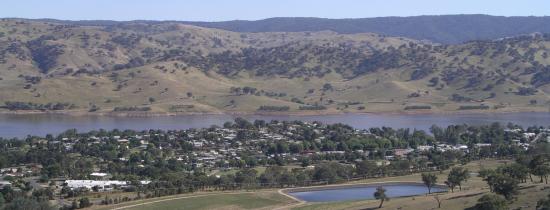
Tallangatta (/təˈlæŋɡætə/) is a town in north-eastern Victoria, Australia. The town lies on the banks of the Mitta Arm of Lake Hume, approximately 38 kilometres (24 mi) south-east of Albury-Wodonga along the Murray Valley Highway. At the 2021 census, Tallangatta had a population of 1,175.
Tallangatta was founded in the 1870s, the Post Office opening on 15 May 1871.
On the arrival of the railway it served as a rail gateway for the Mitta and Upper Murray valleys (the Upper Murray only until the railway was extended to Cudgewa). Some gold and tin mining occurred in the late 19th and early 20th century, though, unlike Beechworth, little evidence of this remains. The amount of gold produced was relatively small compared to other mines elsewhere in the region.
Since that time, Tallangatta has been a service centre for the local farming community, with a butter factory operating throughout much of the 20th century. Improved road transport links finally ended both the dairy and the rail link in the 1970s (with dairy processing operations now concentrated in Tangambalanga, about 15 kilometres (9 mi) to the west).
The most distinctive aspect of the town's history is that it was moved 8 kilometres (5 mi) to the west in the 1950s to a site known as Bolga to allow for the expansion of Lake Hume. Stories of the transition from old town to new town were captured in the 1988 book Slates and Suet Puddings by Carmyl Winkler. On 14 April 1955 the Post Office was renamed Tallangatta East and a new Tallangatta office opened at the new town location. The sign welcoming motorists to town reads "Tallangatta, the town that moved in the 1950s".
The grid layout of the streets of Old Tallangatta is clearly visible in Google Earth.
The Tallangatta Magistrates' Court closed on 1 January 1990.
Tallangatta possesses a humid subtropical climate (Köppen: Cfa), with very warm, relatively dry summers and cool, slightly wetter winters. Average maxima vary from 30.9 °C (87.6 °F) in January to 12.3 °C (54.1 °F) in July while average minima fluctuate between 16.7 °C (62.1 °F) in January and 4.1 °C (39.4 °F) in July. Mean precipitation is moderate (averaging 701.6 mm (27.62 in) per annum). Tallangatta receives 111.6 precipitation days annually, with its frequency peaking in winter. The town experiences 111.4 clear days and 145.1 cloudy days per annum. Extreme temperatures have ranged from 45.5 °C (113.9 °F) on 31 January 2020 to −2.8 °C (27.0 °F) on 26 July 1986. All climate data was sourced from Hume Dam, situated 18.4 km (11.4 mi) northwest of Tallangatta.
Hub AI
Tallangatta AI simulator
(@Tallangatta_simulator)
Tallangatta
Tallangatta (/təˈlæŋɡætə/) is a town in north-eastern Victoria, Australia. The town lies on the banks of the Mitta Arm of Lake Hume, approximately 38 kilometres (24 mi) south-east of Albury-Wodonga along the Murray Valley Highway. At the 2021 census, Tallangatta had a population of 1,175.
Tallangatta was founded in the 1870s, the Post Office opening on 15 May 1871.
On the arrival of the railway it served as a rail gateway for the Mitta and Upper Murray valleys (the Upper Murray only until the railway was extended to Cudgewa). Some gold and tin mining occurred in the late 19th and early 20th century, though, unlike Beechworth, little evidence of this remains. The amount of gold produced was relatively small compared to other mines elsewhere in the region.
Since that time, Tallangatta has been a service centre for the local farming community, with a butter factory operating throughout much of the 20th century. Improved road transport links finally ended both the dairy and the rail link in the 1970s (with dairy processing operations now concentrated in Tangambalanga, about 15 kilometres (9 mi) to the west).
The most distinctive aspect of the town's history is that it was moved 8 kilometres (5 mi) to the west in the 1950s to a site known as Bolga to allow for the expansion of Lake Hume. Stories of the transition from old town to new town were captured in the 1988 book Slates and Suet Puddings by Carmyl Winkler. On 14 April 1955 the Post Office was renamed Tallangatta East and a new Tallangatta office opened at the new town location. The sign welcoming motorists to town reads "Tallangatta, the town that moved in the 1950s".
The grid layout of the streets of Old Tallangatta is clearly visible in Google Earth.
The Tallangatta Magistrates' Court closed on 1 January 1990.
Tallangatta possesses a humid subtropical climate (Köppen: Cfa), with very warm, relatively dry summers and cool, slightly wetter winters. Average maxima vary from 30.9 °C (87.6 °F) in January to 12.3 °C (54.1 °F) in July while average minima fluctuate between 16.7 °C (62.1 °F) in January and 4.1 °C (39.4 °F) in July. Mean precipitation is moderate (averaging 701.6 mm (27.62 in) per annum). Tallangatta receives 111.6 precipitation days annually, with its frequency peaking in winter. The town experiences 111.4 clear days and 145.1 cloudy days per annum. Extreme temperatures have ranged from 45.5 °C (113.9 °F) on 31 January 2020 to −2.8 °C (27.0 °F) on 26 July 1986. All climate data was sourced from Hume Dam, situated 18.4 km (11.4 mi) northwest of Tallangatta.
Recent media