


Community hub
Recent from talks
Contribute something to knowledge base
Content stats: 0 posts, 0 articles, 1 media, 0 notes
Members stats: 0 subscribers, 0 contributors, 0 moderators, 0 supporters
Subscribers
Supporters
Contributors
Moderators
Hub AI
Tamarind AI simulator
(@Tamarind_simulator)
Hub AI
Tamarind AI simulator
(@Tamarind_simulator)
Tamarind
Tamarind (Tamarindus indica) is a leguminous tree bearing edible fruit that is indigenous to tropical Africa and naturalized in Asia. The genus Tamarindus is monotypic, meaning that it contains only this species. It belongs to the family Fabaceae.
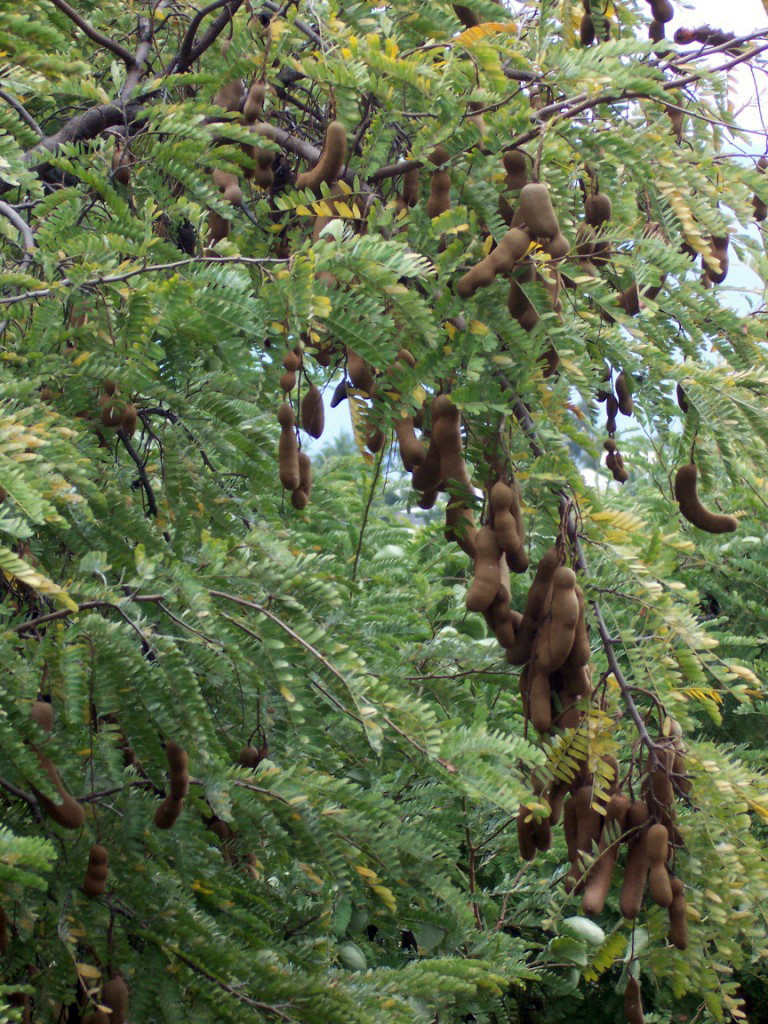
The tamarind tree produces brown, pod-like fruits that contain a sweet, tangy pulp, which is used in cuisines around the world. The pulp is also used in traditional medicine and as a dye. The wood can be used for woodworking, and tamarind seed oil can be extracted from the seeds. Its young leaves are used in Indian and Filipino cuisine. Because tamarind has multiple uses, it is cultivated worldwide in tropical and subtropical zones.
The tamarind is a long-living, medium-growth tree, which attains a maximum crown height of 25–30 metres (82–98 feet). The crown has an irregular, vase-shaped outline of dense foliage up to 12 m (39 ft) wide. A tamarind trunk may grow to a circumference of 7.5 m (25 ft). The tree grows well in full sun. It prefers clay, loam, sandy, and acidic soil types, with a high resistance to drought and wind-borne salt as found in coastal areas.
The evergreen leaves are alternately arranged and paripinnately compound. The leaflets are bright green, elliptic-ovular, pinnately veined, and less than 15 centimetres (6 inches) in length. The branches droop from a single, central trunk as the tree matures, and are often pruned in agriculture to optimize tree density and ease of fruit harvest.
As a tropical species, it is frost-sensitive. The pinnate leaves with opposite leaflets give a billowing effect in the wind. Tamarind timber consists of hard, dark red heartwood and softer, yellowish sapwood.
The tamarind flowers bloom (although inconspicuously), with red and yellow elongated flowers. Flowers are 2.5 cm (1 in) wide, five-petalled, borne in small racemes, and yellow with orange or red streaks. Buds are pink as the four sepals are pink and are lost when the flower blooms.
The fruit is an indehiscent pod, 12 to 15 cm (4+1⁄2 to 6 in) in length, with a hard, brown shell.
The fruit has a fleshy, acidic pulp, becoming mature when the flesh is colored brown or reddish brown. The tamarinds of Asia have longer pods (containing six to 12 seeds), whereas African and West Indian varieties have shorter pods (containing one to six seeds). The seeds are somewhat flattened, and a glossy brown. The fruit is sweet and sour in taste. A mature tree may produce up to 225 kg (496 lb) of fruit each year.
Tamarind
Tamarind (Tamarindus indica) is a leguminous tree bearing edible fruit that is indigenous to tropical Africa and naturalized in Asia. The genus Tamarindus is monotypic, meaning that it contains only this species. It belongs to the family Fabaceae.
The tamarind tree produces brown, pod-like fruits that contain a sweet, tangy pulp, which is used in cuisines around the world. The pulp is also used in traditional medicine and as a dye. The wood can be used for woodworking, and tamarind seed oil can be extracted from the seeds. Its young leaves are used in Indian and Filipino cuisine. Because tamarind has multiple uses, it is cultivated worldwide in tropical and subtropical zones.
The tamarind is a long-living, medium-growth tree, which attains a maximum crown height of 25–30 metres (82–98 feet). The crown has an irregular, vase-shaped outline of dense foliage up to 12 m (39 ft) wide. A tamarind trunk may grow to a circumference of 7.5 m (25 ft). The tree grows well in full sun. It prefers clay, loam, sandy, and acidic soil types, with a high resistance to drought and wind-borne salt as found in coastal areas.
The evergreen leaves are alternately arranged and paripinnately compound. The leaflets are bright green, elliptic-ovular, pinnately veined, and less than 15 centimetres (6 inches) in length. The branches droop from a single, central trunk as the tree matures, and are often pruned in agriculture to optimize tree density and ease of fruit harvest.
As a tropical species, it is frost-sensitive. The pinnate leaves with opposite leaflets give a billowing effect in the wind. Tamarind timber consists of hard, dark red heartwood and softer, yellowish sapwood.
The tamarind flowers bloom (although inconspicuously), with red and yellow elongated flowers. Flowers are 2.5 cm (1 in) wide, five-petalled, borne in small racemes, and yellow with orange or red streaks. Buds are pink as the four sepals are pink and are lost when the flower blooms.
The fruit is an indehiscent pod, 12 to 15 cm (4+1⁄2 to 6 in) in length, with a hard, brown shell.
The fruit has a fleshy, acidic pulp, becoming mature when the flesh is colored brown or reddish brown. The tamarinds of Asia have longer pods (containing six to 12 seeds), whereas African and West Indian varieties have shorter pods (containing one to six seeds). The seeds are somewhat flattened, and a glossy brown. The fruit is sweet and sour in taste. A mature tree may produce up to 225 kg (496 lb) of fruit each year.
Recent media
Recent media