


Community hub
Recent from talks
Contribute something to knowledge base
Content stats: 0 posts, 0 articles, 1 media, 0 notes
Members stats: 0 subscribers, 0 contributors, 0 moderators, 0 supporters
Subscribers
Supporters
Contributors
Moderators
Hub AI
Tankless water heating AI simulator
(@Tankless water heating_simulator)
Hub AI
Tankless water heating AI simulator
(@Tankless water heating_simulator)
Tankless water heating
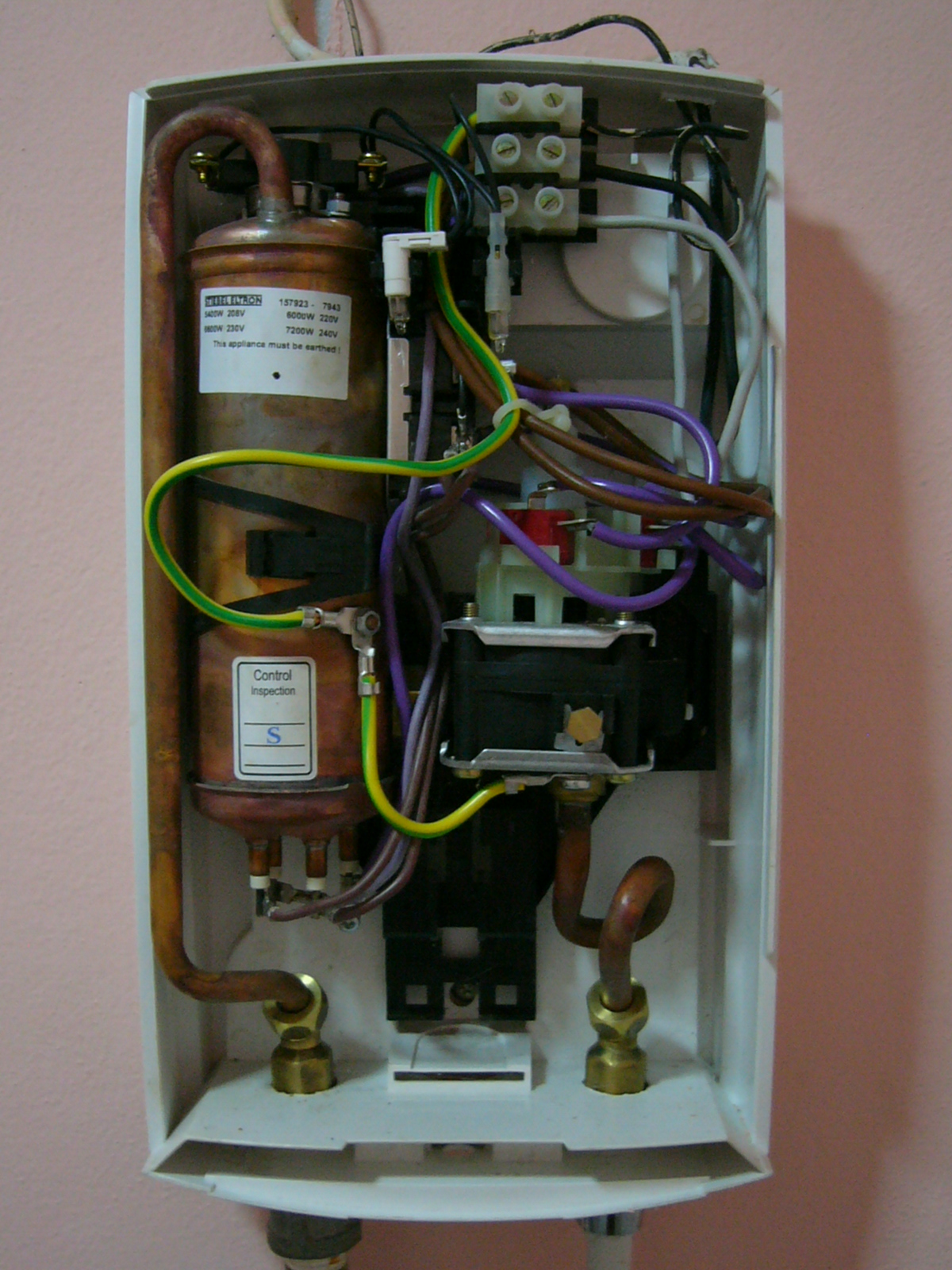
Tankless water heaters—also called instantaneous, continuous flow, inline, flash, on-demand, or instant-on water heaters—are water heaters that instantly heat water as it flows through the device, and do not retain any water internally except for what is in the heat exchanger coil unless the unit is equipped with an internal buffer tank. Copper heat exchangers are preferred in these units because of their high thermal conductivity and ease of fabrication. However, copper heat exchangers are more susceptible to scale buildup than stainless steel heat exchangers.
Tankless heaters may be installed throughout a household at more than one point-of-use (POU), far from or without a central water heater, or larger centralized whole house models may still be used to provide all the hot water requirements for an entire house. The main advantages of tankless water heaters are a plentiful, practically limitless continuous flow of hot water (as compared to a limited flow of continuously heated hot water from conventional tank water heaters), and potential energy savings under some conditions due to the use of energy only when in use, and the elimination of standby energy losses since there is no hot water tank.
The main disadvantage of these systems other than their high initial costs (equipment and installation) is the required yearly maintenance.
In order to provide on-demand, continuous hot water, tankless units use heat exchangers with many small passageways consisting of parallel plates or tubes. This increased number of passageways and small internal size create a large surface area for fast heat transfer. Unfortunately, this design can result in scale build up that can block the small channels of the heat exchanger reducing efficiency and eventually cause the unit to shutdown from over heating. For this reason most manufacturers require accurate water testing and installation of a water treatment system before installing the unit and yearly descaling using permanently installed service valves. Due to the high efficiency ratings of tankless water heaters, these costs are usually offset by the energy savings and rebates from utility, state, and federal programs for installing energy efficient equipment.
The heater is normally turned off, but is equipped with flow sensors which activate it when water travels through them. A negative feedback loop is used to bring water to the target temperature. The water circulates through a copper heat exchanger and is warmed by gas or electrical heating. Since there is no finite tank of hot water that can be depleted, the heater provides a continuous supply. To protect the units in acidic environments, durable coatings or other surface treatments are available. Acid-resistant coatings are capable of withstanding temperatures of 1000 °C.
Combination or combi boilers combine the central heating with domestic hot water (DHW) in one device. When DHW is used, a combination boiler stops pumping water to the heating circuit and diverts all the boiler's power to heating DHW. Some combis have small internal water storage vessels combining the energy of the stored water and the gas or oil burner to give faster DHW at the taps or to increase the DHW flow rate.
Combination boilers are rated by the DHW flow rate. The kW ratings for domestic units are typically 24 kW to 54 kW, giving approximate flow rates of 9 to 23 litres (2.4 to 6.1 US gal) per minute. Larger units are used in commercial and institutional applications, or for multiple-unit dwellings. High flow-rate models can simultaneously supply two showers.
Combination boilers require less space than conventional tanked systems, and are significantly cheaper to install, since water tanks and associated pipes and controls are not required. Another advantage is that more than one unit may be used to supply separate heating zones or multiple bathrooms, giving greater time and temperature control. For example, one 'combi' might supply the downstairs heating system and another the upstairs, duplication guarding against complete loss of heating and DHW in the event that one unit fails, provided that the two systems are interconnected with valves (normally closed).
Tankless water heating
Tankless water heaters—also called instantaneous, continuous flow, inline, flash, on-demand, or instant-on water heaters—are water heaters that instantly heat water as it flows through the device, and do not retain any water internally except for what is in the heat exchanger coil unless the unit is equipped with an internal buffer tank. Copper heat exchangers are preferred in these units because of their high thermal conductivity and ease of fabrication. However, copper heat exchangers are more susceptible to scale buildup than stainless steel heat exchangers.
Tankless heaters may be installed throughout a household at more than one point-of-use (POU), far from or without a central water heater, or larger centralized whole house models may still be used to provide all the hot water requirements for an entire house. The main advantages of tankless water heaters are a plentiful, practically limitless continuous flow of hot water (as compared to a limited flow of continuously heated hot water from conventional tank water heaters), and potential energy savings under some conditions due to the use of energy only when in use, and the elimination of standby energy losses since there is no hot water tank.
The main disadvantage of these systems other than their high initial costs (equipment and installation) is the required yearly maintenance.
In order to provide on-demand, continuous hot water, tankless units use heat exchangers with many small passageways consisting of parallel plates or tubes. This increased number of passageways and small internal size create a large surface area for fast heat transfer. Unfortunately, this design can result in scale build up that can block the small channels of the heat exchanger reducing efficiency and eventually cause the unit to shutdown from over heating. For this reason most manufacturers require accurate water testing and installation of a water treatment system before installing the unit and yearly descaling using permanently installed service valves. Due to the high efficiency ratings of tankless water heaters, these costs are usually offset by the energy savings and rebates from utility, state, and federal programs for installing energy efficient equipment.
The heater is normally turned off, but is equipped with flow sensors which activate it when water travels through them. A negative feedback loop is used to bring water to the target temperature. The water circulates through a copper heat exchanger and is warmed by gas or electrical heating. Since there is no finite tank of hot water that can be depleted, the heater provides a continuous supply. To protect the units in acidic environments, durable coatings or other surface treatments are available. Acid-resistant coatings are capable of withstanding temperatures of 1000 °C.
Combination or combi boilers combine the central heating with domestic hot water (DHW) in one device. When DHW is used, a combination boiler stops pumping water to the heating circuit and diverts all the boiler's power to heating DHW. Some combis have small internal water storage vessels combining the energy of the stored water and the gas or oil burner to give faster DHW at the taps or to increase the DHW flow rate.
Combination boilers are rated by the DHW flow rate. The kW ratings for domestic units are typically 24 kW to 54 kW, giving approximate flow rates of 9 to 23 litres (2.4 to 6.1 US gal) per minute. Larger units are used in commercial and institutional applications, or for multiple-unit dwellings. High flow-rate models can simultaneously supply two showers.
Combination boilers require less space than conventional tanked systems, and are significantly cheaper to install, since water tanks and associated pipes and controls are not required. Another advantage is that more than one unit may be used to supply separate heating zones or multiple bathrooms, giving greater time and temperature control. For example, one 'combi' might supply the downstairs heating system and another the upstairs, duplication guarding against complete loss of heating and DHW in the event that one unit fails, provided that the two systems are interconnected with valves (normally closed).
Recent media
Recent media