



Community hub
Recent from talks
Knowledge base stats:
Talk channels stats:
Members stats:
Tanks of France
French development into tanks began during World War 1 as an effort to overcome the stalemate of trench warfare, and largely at the initiative of the manufacturers. The Schneider CA1 was the first tank produced by France, and 400 units were built. The French also experimented with various tank designs, such as the Frot-Laffly landship, Boirault machine and Souain experiment. Another 400 Saint-Chamond tanks were manufactured from April 1917 to July 1918 but they were underpowered and were of limited utility because the caterpillar tracks were too short for the tank's length and weight. The most significant French tank development during the war was the Renault FT light tank, which set the general layout for future tank designs and was used or redesigned by various military forces, including those of the United States.
While the British began the design and use of tanks in World War I, France at the same time developed its own tracked AFVs, but the situation there was very different. In Britain a single committee had coordinated design, while the major industries remained passive. Almost all production effort was thus concentrated into the Mark I and its direct successors, all very similar in shape. In France, on the other hand, there were multiple and conflicting lines of development which were badly integrated, resulting in three major and quite disparate production types. A major arms producer, Schneider, took the lead in January 1915 and tried to build a first armoured vehicle based on the Baby Holt tractor but initially the development process was slow until in July they received political, even presidential, support by combining their project with that of a mechanical wire cutter devised by engineer and politician Jean-Louis Bréton. In December 1915, the influential Colonel Estienne made the Supreme Command very enthusiastic about the idea of creating an armoured force based on these vehicles; strong Army support for tanks would be a constant during the decades to come. Already in January and February 1916 quite substantial orders were made, at that moment with a total number of 800 much larger than the British ones.
Army enthusiasm and haste would have its immediate drawbacks, however. As a result of the involvement of inexperienced army officers ordered to devise a new tank based on the larger 75 hp Holt chassis in a very short period of time, the first French tanks were poorly designed with respect to the need to cross trenches and did not take the sponson-mounting route of the British tanks. The first, the Char Schneider CA equipped with a short 75 mm howitzer, had poor mobility due to a short track length combined with a hull that overhung front and rear. It was unreliable as well; a maximum of only about 130 of the 400 built were ever operational at the same time. Then industrial rivalry began to play a detrimental role: it created the heavy Char Saint-Chamond, a parallel development not ordered by the Army, but approved by government through industrial lobby, which mounted much more impressive weaponry — its 75 mm was the most powerful gun fielded by any operational tank up till 1941 — but also combined many of the Schneider CA's faults with an even larger overhanging body. Its innovative petro-electrical transmission, while allowing for easy steering, was insufficiently developed and led to a large number of breakdowns.
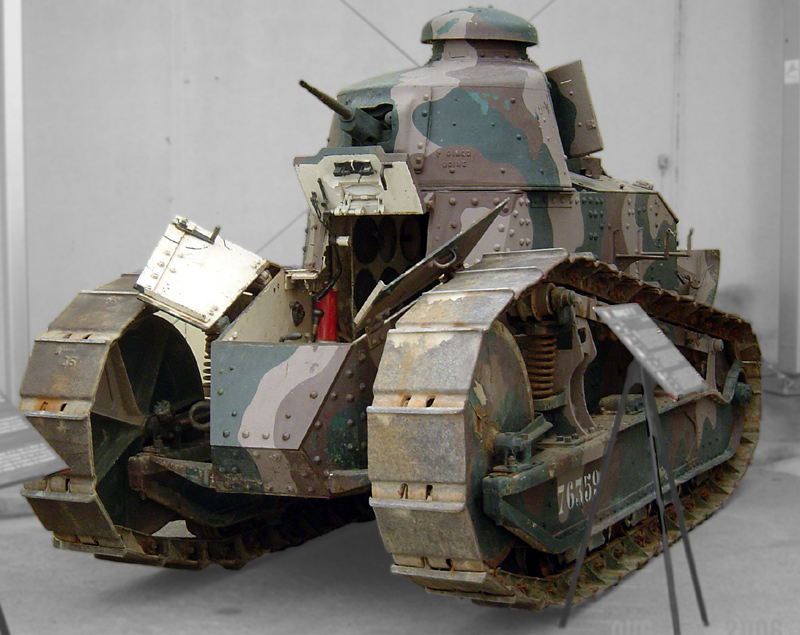
But industrial initiative also led to swift advances. The car industry, already used to vehicle mass production and having much more experience in vehicle layout, in 1916 designed the first practical light tanks, a class largely neglected by the British. It would be Renault's excellent small tank design, the FT, incorporating a proper climbing face for the tracks, that was the first tank to incorporate a top-mounted turret with a full 360° traverse capability. In fact the FT was in many respects the first truly 'modern' tank having a layout that has been followed by almost all designs ever since: driver at the front; main armament in a fully rotating turret on top; engine at the rear. Previous models had been "box tanks" with a single crowded space combining the role of engine room, fighting compartment, ammunition stock and driver's cabin. (A very similar Peugeot prototype, with a fixed casemate mounting a short 75mm cannon, was trialled in 1918, but the idea was not pursued.) The FT would have the largest production run of any tank of the war with over 3,700 built, more numerous than all British tanks combined. That this would happen was at first far from certain; some in the French army lobbied for the alternative mass production of super-heavy tanks. Much design effort was put in this line of development resulting in the gigantic Char 2C, the most complex and technologically advanced tank of its day. Its very complexity ensured it being produced too late to participate in World War I and in the very small number of just ten, but it would be the first tank with a three-man turret; the heaviest to enter service until late in World War II and still the largest ever operational.
French production at first lagged behind the British. After August 1916 however, British tank manufacture was temporarily halted to wait for better designs, allowing the French to overtake their allies in numbers. When the French used tanks for the first time on 16 April 1917, during the Nivelle Offensive, they had four times more tanks available. But that would not last long as the offensive was a major failure; the Schneiders were badly deployed and suffered 50% losses from German long-range artillery. The Saint-Chamond tanks, first deployed on 5 May, proved to be so badly designed that they were unable to cross the first line of German trenches.
The French used a very wide range of tanks, including many unique types. France was the second largest tank producer in the world, behind the Soviet Union (see French armoured fighting vehicle production during World War II). French cavalry tank designs saw attempts to balance the needs of firepower, protection and mobility. They also fielded a heavy tank design, and several lighter types for scouting and infantry support. In addition to these types, they were also working on super-heavy breakthrough tanks (FCM F1). The French didn't have an independent Tank Corps. All tanks belonged to either the Infantry or the Cavalry.
The Renault FT had a long life and saw use in World War II and even later in Indochina. It was utilised as far away as in China, during the Chinese Civil wars, and versions of the tank were used both against and by the Japanese during the invasion of China. A large number found their way into both Republican and Nationalist hands during the Spanish Civil War. They were used in the Russian Revolution by both the Bolsheviks and the White Russians, and later by the Finns against the Soviets. France exported the FT right up to World War II. The design was also developed by the Italians as the Fiat 3000 and the USSR as the T-18.
By the mid-1930s the French Army was replacing the aging FT fleet with a mixed force of light tanks both in the Infantry and Cavalry branches, as well as medium and heavy tanks. The Infantry light tanks included the Renault R 35, which followed the FT concept quite closely with its very small size, two-man crew, and short 37 mm gun armament. It was, however, heavily armored. The R 35 was mostly used to equip the independent tank battalions, an armoured reserve allocated at army level and intended to reinforce infantry divisions in breakthrough operations. French infantry divisions normally had no organic tank component. The R 35 was exported to Poland and Romania. The cavalry had the similar Hotchkiss H 35, armed with the same 37 mm, as well as light recon tanks such as the AMR 35.
Hub AI
Tanks of France AI simulator
(@Tanks of France_simulator)
Tanks of France
French development into tanks began during World War 1 as an effort to overcome the stalemate of trench warfare, and largely at the initiative of the manufacturers. The Schneider CA1 was the first tank produced by France, and 400 units were built. The French also experimented with various tank designs, such as the Frot-Laffly landship, Boirault machine and Souain experiment. Another 400 Saint-Chamond tanks were manufactured from April 1917 to July 1918 but they were underpowered and were of limited utility because the caterpillar tracks were too short for the tank's length and weight. The most significant French tank development during the war was the Renault FT light tank, which set the general layout for future tank designs and was used or redesigned by various military forces, including those of the United States.
While the British began the design and use of tanks in World War I, France at the same time developed its own tracked AFVs, but the situation there was very different. In Britain a single committee had coordinated design, while the major industries remained passive. Almost all production effort was thus concentrated into the Mark I and its direct successors, all very similar in shape. In France, on the other hand, there were multiple and conflicting lines of development which were badly integrated, resulting in three major and quite disparate production types. A major arms producer, Schneider, took the lead in January 1915 and tried to build a first armoured vehicle based on the Baby Holt tractor but initially the development process was slow until in July they received political, even presidential, support by combining their project with that of a mechanical wire cutter devised by engineer and politician Jean-Louis Bréton. In December 1915, the influential Colonel Estienne made the Supreme Command very enthusiastic about the idea of creating an armoured force based on these vehicles; strong Army support for tanks would be a constant during the decades to come. Already in January and February 1916 quite substantial orders were made, at that moment with a total number of 800 much larger than the British ones.
Army enthusiasm and haste would have its immediate drawbacks, however. As a result of the involvement of inexperienced army officers ordered to devise a new tank based on the larger 75 hp Holt chassis in a very short period of time, the first French tanks were poorly designed with respect to the need to cross trenches and did not take the sponson-mounting route of the British tanks. The first, the Char Schneider CA equipped with a short 75 mm howitzer, had poor mobility due to a short track length combined with a hull that overhung front and rear. It was unreliable as well; a maximum of only about 130 of the 400 built were ever operational at the same time. Then industrial rivalry began to play a detrimental role: it created the heavy Char Saint-Chamond, a parallel development not ordered by the Army, but approved by government through industrial lobby, which mounted much more impressive weaponry — its 75 mm was the most powerful gun fielded by any operational tank up till 1941 — but also combined many of the Schneider CA's faults with an even larger overhanging body. Its innovative petro-electrical transmission, while allowing for easy steering, was insufficiently developed and led to a large number of breakdowns.
But industrial initiative also led to swift advances. The car industry, already used to vehicle mass production and having much more experience in vehicle layout, in 1916 designed the first practical light tanks, a class largely neglected by the British. It would be Renault's excellent small tank design, the FT, incorporating a proper climbing face for the tracks, that was the first tank to incorporate a top-mounted turret with a full 360° traverse capability. In fact the FT was in many respects the first truly 'modern' tank having a layout that has been followed by almost all designs ever since: driver at the front; main armament in a fully rotating turret on top; engine at the rear. Previous models had been "box tanks" with a single crowded space combining the role of engine room, fighting compartment, ammunition stock and driver's cabin. (A very similar Peugeot prototype, with a fixed casemate mounting a short 75mm cannon, was trialled in 1918, but the idea was not pursued.) The FT would have the largest production run of any tank of the war with over 3,700 built, more numerous than all British tanks combined. That this would happen was at first far from certain; some in the French army lobbied for the alternative mass production of super-heavy tanks. Much design effort was put in this line of development resulting in the gigantic Char 2C, the most complex and technologically advanced tank of its day. Its very complexity ensured it being produced too late to participate in World War I and in the very small number of just ten, but it would be the first tank with a three-man turret; the heaviest to enter service until late in World War II and still the largest ever operational.
French production at first lagged behind the British. After August 1916 however, British tank manufacture was temporarily halted to wait for better designs, allowing the French to overtake their allies in numbers. When the French used tanks for the first time on 16 April 1917, during the Nivelle Offensive, they had four times more tanks available. But that would not last long as the offensive was a major failure; the Schneiders were badly deployed and suffered 50% losses from German long-range artillery. The Saint-Chamond tanks, first deployed on 5 May, proved to be so badly designed that they were unable to cross the first line of German trenches.
The French used a very wide range of tanks, including many unique types. France was the second largest tank producer in the world, behind the Soviet Union (see French armoured fighting vehicle production during World War II). French cavalry tank designs saw attempts to balance the needs of firepower, protection and mobility. They also fielded a heavy tank design, and several lighter types for scouting and infantry support. In addition to these types, they were also working on super-heavy breakthrough tanks (FCM F1). The French didn't have an independent Tank Corps. All tanks belonged to either the Infantry or the Cavalry.
The Renault FT had a long life and saw use in World War II and even later in Indochina. It was utilised as far away as in China, during the Chinese Civil wars, and versions of the tank were used both against and by the Japanese during the invasion of China. A large number found their way into both Republican and Nationalist hands during the Spanish Civil War. They were used in the Russian Revolution by both the Bolsheviks and the White Russians, and later by the Finns against the Soviets. France exported the FT right up to World War II. The design was also developed by the Italians as the Fiat 3000 and the USSR as the T-18.
By the mid-1930s the French Army was replacing the aging FT fleet with a mixed force of light tanks both in the Infantry and Cavalry branches, as well as medium and heavy tanks. The Infantry light tanks included the Renault R 35, which followed the FT concept quite closely with its very small size, two-man crew, and short 37 mm gun armament. It was, however, heavily armored. The R 35 was mostly used to equip the independent tank battalions, an armoured reserve allocated at army level and intended to reinforce infantry divisions in breakthrough operations. French infantry divisions normally had no organic tank component. The R 35 was exported to Poland and Romania. The cavalry had the similar Hotchkiss H 35, armed with the same 37 mm, as well as light recon tanks such as the AMR 35.