



Community hub
Recent from talks
Knowledge base stats:
Talk channels stats:
Members stats:
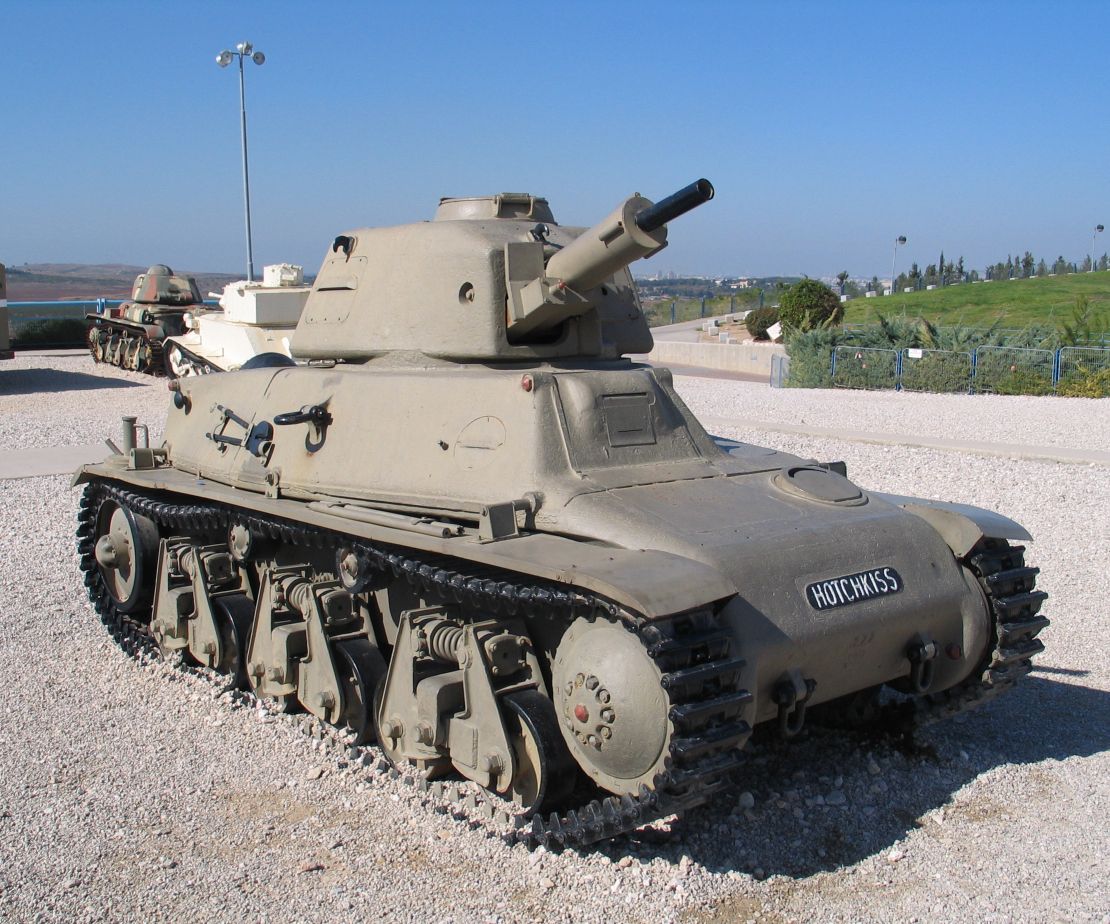
Hotchkiss H35
The Hotchkiss H35 or Char léger modèle 1935 H was a French cavalry tank developed prior to World War II. Despite having been designed from 1933 as a rather slow but well-armoured light infantry support tank, the type was initially rejected by the French Infantry because steering proved difficult during cross-country use, and was instead adopted in 1936 by the French Cavalry arm.
From 1938 an improved version was produced with a more powerful engine, the Char léger modèle 1935 H modifié 39, which from 1940 was also fitted with a longer, more powerful 37 mm gun. It was intended to make this improved variant the standard light tank, with at least four thousand produced to equip new armoured divisions of both the Cavalry and the Infantry arms, but due to the defeat of France in June 1940, total production of both subtypes was limited to about 1200 vehicles.
For the remainder of the war Germany and its allies used captured Hotchkiss tanks in several modifications.
In 1926, it had been decided to provide armour support to the regular infantry divisions by creating autonomous tank battalions equipped with a light and cheap infantry tank, a char d'accompagnement. For this role at first the Char D1 was developed which type however, proved to be neither particularly light nor cheap. In 1933, the Hotchkiss company under its own initiative presented a plan to produce a lighter design—this was made possible by the application of a new technology to produce cast steel sections to construct an entire hull. On 30 June 1933, this proposal was approved by the Conseil Consultatif de l'Armement. On 2 August 1933 the specifications were issued: a weight of 6 long tons (6.1 t) and 30 mm (1.2 in) armour protection all around. Three prototypes were ordered from Hotchkiss, but the French industry as a whole was also invited to provide alternative proposals for a nouveau char léger.
This allowed the Renault company to beat Hotchkiss in delivering the first prototype, which later was developed into the Renault R35. On 18 January 1935, the first Hotchkiss prototype, not yet made of armour steel, was presented to the Commission d'Expérience du Matériel Automobile (CEMA) at Vincennes; it was a machine gun-armed tankette without turret. It was tested until 4 March 1935, when it was replaced by the second identical prototype to be tested until 6 May. Both had to be rejected because new specifications had been made on 21 June 1934 that increased the desired armour thickness to 40 mm (1.6 in). On 27 June 1935 the commission approved the type on the provision that the necessary changes would be made. On 19 August the third prototype was delivered, equipped with a cast APX turret and featuring a redesigned hull; it was tested until 20 September and accepted.
On 6 November 1935 a first order was made for 200 vehicles. Though it should have been completed between July 1936 and July 1937, the first production vehicle was in fact delivered on 12 September 1936. A first additional order had already been made of 92 on 7 September 1936, to be completed in November 1937. A third one of 108 vehicles followed on 23 January 1937, to be completed in September 1938. These vehicles had the series number 40000 to 40400. By 1 January 1937 132 hulls had been produced. None of these had at that date been fitted with a turret.
The first series vehicle was again extensively and intensively tested until 4 December 1936. The testing soon showed that its cross-country handling qualities were unacceptably poor; it proved impossible to safely steer the vehicle on an uneven surface, posing an extreme danger to nearby friendly infantry. The Infantry therefore initially rejected any further procurement. Eventually, in 1937, it decided to accept only the last hundred tanks to equip just two battalions with the type: the 13e and 38e Bataillon de Chars de Combat.[citation needed]
For political reasons however, stopping production of the tank was unacceptable. As a result, the first three hundred vehicles of the production run were offered to the Cavalry, which was forced to accept them because it would not have been granted a budget for other tanks anyway. As the cavalry units would be making more use of the road network and of mounted infantry, its cross-country handling problem was of less consequence. The H35 was, at 28 km/h (17 mph), also somewhat faster than the Renault R35, which was capable of 20 km/h (12 mph), although in practice its average speed was lower than that of the R 35 because of its inferior gear box.
Hub AI
Hotchkiss H35 AI simulator
(@Hotchkiss H35_simulator)
Hotchkiss H35
The Hotchkiss H35 or Char léger modèle 1935 H was a French cavalry tank developed prior to World War II. Despite having been designed from 1933 as a rather slow but well-armoured light infantry support tank, the type was initially rejected by the French Infantry because steering proved difficult during cross-country use, and was instead adopted in 1936 by the French Cavalry arm.
From 1938 an improved version was produced with a more powerful engine, the Char léger modèle 1935 H modifié 39, which from 1940 was also fitted with a longer, more powerful 37 mm gun. It was intended to make this improved variant the standard light tank, with at least four thousand produced to equip new armoured divisions of both the Cavalry and the Infantry arms, but due to the defeat of France in June 1940, total production of both subtypes was limited to about 1200 vehicles.
For the remainder of the war Germany and its allies used captured Hotchkiss tanks in several modifications.
In 1926, it had been decided to provide armour support to the regular infantry divisions by creating autonomous tank battalions equipped with a light and cheap infantry tank, a char d'accompagnement. For this role at first the Char D1 was developed which type however, proved to be neither particularly light nor cheap. In 1933, the Hotchkiss company under its own initiative presented a plan to produce a lighter design—this was made possible by the application of a new technology to produce cast steel sections to construct an entire hull. On 30 June 1933, this proposal was approved by the Conseil Consultatif de l'Armement. On 2 August 1933 the specifications were issued: a weight of 6 long tons (6.1 t) and 30 mm (1.2 in) armour protection all around. Three prototypes were ordered from Hotchkiss, but the French industry as a whole was also invited to provide alternative proposals for a nouveau char léger.
This allowed the Renault company to beat Hotchkiss in delivering the first prototype, which later was developed into the Renault R35. On 18 January 1935, the first Hotchkiss prototype, not yet made of armour steel, was presented to the Commission d'Expérience du Matériel Automobile (CEMA) at Vincennes; it was a machine gun-armed tankette without turret. It was tested until 4 March 1935, when it was replaced by the second identical prototype to be tested until 6 May. Both had to be rejected because new specifications had been made on 21 June 1934 that increased the desired armour thickness to 40 mm (1.6 in). On 27 June 1935 the commission approved the type on the provision that the necessary changes would be made. On 19 August the third prototype was delivered, equipped with a cast APX turret and featuring a redesigned hull; it was tested until 20 September and accepted.
On 6 November 1935 a first order was made for 200 vehicles. Though it should have been completed between July 1936 and July 1937, the first production vehicle was in fact delivered on 12 September 1936. A first additional order had already been made of 92 on 7 September 1936, to be completed in November 1937. A third one of 108 vehicles followed on 23 January 1937, to be completed in September 1938. These vehicles had the series number 40000 to 40400. By 1 January 1937 132 hulls had been produced. None of these had at that date been fitted with a turret.
The first series vehicle was again extensively and intensively tested until 4 December 1936. The testing soon showed that its cross-country handling qualities were unacceptably poor; it proved impossible to safely steer the vehicle on an uneven surface, posing an extreme danger to nearby friendly infantry. The Infantry therefore initially rejected any further procurement. Eventually, in 1937, it decided to accept only the last hundred tanks to equip just two battalions with the type: the 13e and 38e Bataillon de Chars de Combat.[citation needed]
For political reasons however, stopping production of the tank was unacceptable. As a result, the first three hundred vehicles of the production run were offered to the Cavalry, which was forced to accept them because it would not have been granted a budget for other tanks anyway. As the cavalry units would be making more use of the road network and of mounted infantry, its cross-country handling problem was of less consequence. The H35 was, at 28 km/h (17 mph), also somewhat faster than the Renault R35, which was capable of 20 km/h (12 mph), although in practice its average speed was lower than that of the R 35 because of its inferior gear box.