
Recent from talks
Tanks in World War I
Knowledge base stats:
Talk channels stats:
Members stats:
Tanks in World War I
The development of tanks in World War I was a response to the stalemate that developed on the Western Front. Although vehicles that incorporated the basic principles of the tank (armour, firepower, and all-terrain mobility) had been projected in the decade or so before the War, it was the alarmingly heavy casualties of the start of its trench warfare that stimulated development. Research took place in both Great Britain and France, with Germany only belatedly following the Allies' lead.
In Great Britain, an initial vehicle, nicknamed Little Willie, was constructed at William Foster & Co., during August and September 1915. The prototype of a new design that became the Mark I tank was demonstrated to the British Army on 2 February 1916. Although initially termed "Landships" by the Landship Committee, production vehicles were named "tanks", to preserve secrecy. The term was chosen when it became known that the factory workers at William Foster referred to the first prototype as "the tank" because of its resemblance to a steel water tank.
The French fielded their first tanks in April 1917 and ultimately produced far more tanks than all other countries combined.
The Germans, on the other hand, began development only in response to the appearance of Allied tanks on the battlefield. Whilst the Allies manufactured several thousand tanks during the war, Germany deployed only 18 of its own.
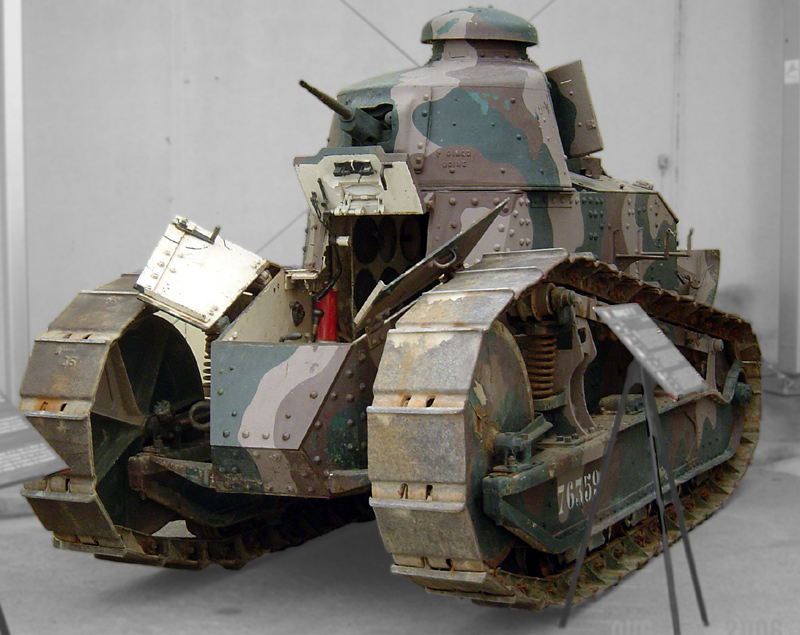
The first tanks were mechanically unreliable. There were problems that caused considerable attrition rates during combat deployment and transit. The heavily shelled terrain was impassable to conventional vehicles, and only highly mobile tanks such as the Renault FTs and Mark IV performed reasonably well. The Mark I's rhomboid shape, caterpillar tracks, and 26-foot (8 m) length meant that it could negotiate obstacles, especially wide trenches, that wheeled vehicles could not. Along with the tank, the first self-propelled gun (the British Gun Carrier Mk I) and the first armoured personnel carrier followed the invention of tanks.
The conceptual roots of the tank go back to ancient times, with siege engines that were able to provide protection for troops moving up against stone walls or other fortifications. With the coming of the Industrial Revolution and the demonstrable power of steam, James Cowan presented a proposal for a Steam Powered Land Ram in 1855, towards the end of the Crimean War. Looking like a helmet on 'footed' Boydell wheels, early forerunners of the Pedrail wheel, it was essentially an armoured steam tractor equipped with cannon and rotating scythes sprouting from the sides. Lord Palmerston is said to have dismissed it as 'barbaric'.
From 1904 to 1909, David Roberts, the engineer and managing director of Hornsby & Sons of Grantham, built a series of tractors using his patented 'chain-track', which were put through their paces by the British Army, a (small) section of which wanted to evaluate artillery tractors. At one point in 1908, Major William E. Donohue of the Mechanical Transport Committee remarked to Roberts that he should design a new machine with armour that could carry its own gun. However, disheartened by years of ultimately-fruitless tinkering for the Army, Roberts did not take up the idea. In later years, he expressed regret at not having pursued it.
An engineer in the Austro-Hungarian Army, Lieutenant Gunther Burstyn, designed a tracked armoured vehicle in 1911 carrying a light gun in a rotating turret; equipped also with hinged 'arms', two in front and two at the rear, carrying wheels on the ends to assist with obstacles and trenches, it was a very forward-looking design, if rather small. The Austro-Hungarian government said that it would be interested in evaluating it if Burstyn could secure commercial backing to produce a prototype. Lacking the requisite contacts, he let it drop. An approach to the German government was similarly fruitless.
Hub AI
Tanks in World War I AI simulator
(@Tanks in World War I_simulator)
Tanks in World War I
The development of tanks in World War I was a response to the stalemate that developed on the Western Front. Although vehicles that incorporated the basic principles of the tank (armour, firepower, and all-terrain mobility) had been projected in the decade or so before the War, it was the alarmingly heavy casualties of the start of its trench warfare that stimulated development. Research took place in both Great Britain and France, with Germany only belatedly following the Allies' lead.
In Great Britain, an initial vehicle, nicknamed Little Willie, was constructed at William Foster & Co., during August and September 1915. The prototype of a new design that became the Mark I tank was demonstrated to the British Army on 2 February 1916. Although initially termed "Landships" by the Landship Committee, production vehicles were named "tanks", to preserve secrecy. The term was chosen when it became known that the factory workers at William Foster referred to the first prototype as "the tank" because of its resemblance to a steel water tank.
The French fielded their first tanks in April 1917 and ultimately produced far more tanks than all other countries combined.
The Germans, on the other hand, began development only in response to the appearance of Allied tanks on the battlefield. Whilst the Allies manufactured several thousand tanks during the war, Germany deployed only 18 of its own.
The first tanks were mechanically unreliable. There were problems that caused considerable attrition rates during combat deployment and transit. The heavily shelled terrain was impassable to conventional vehicles, and only highly mobile tanks such as the Renault FTs and Mark IV performed reasonably well. The Mark I's rhomboid shape, caterpillar tracks, and 26-foot (8 m) length meant that it could negotiate obstacles, especially wide trenches, that wheeled vehicles could not. Along with the tank, the first self-propelled gun (the British Gun Carrier Mk I) and the first armoured personnel carrier followed the invention of tanks.
The conceptual roots of the tank go back to ancient times, with siege engines that were able to provide protection for troops moving up against stone walls or other fortifications. With the coming of the Industrial Revolution and the demonstrable power of steam, James Cowan presented a proposal for a Steam Powered Land Ram in 1855, towards the end of the Crimean War. Looking like a helmet on 'footed' Boydell wheels, early forerunners of the Pedrail wheel, it was essentially an armoured steam tractor equipped with cannon and rotating scythes sprouting from the sides. Lord Palmerston is said to have dismissed it as 'barbaric'.
From 1904 to 1909, David Roberts, the engineer and managing director of Hornsby & Sons of Grantham, built a series of tractors using his patented 'chain-track', which were put through their paces by the British Army, a (small) section of which wanted to evaluate artillery tractors. At one point in 1908, Major William E. Donohue of the Mechanical Transport Committee remarked to Roberts that he should design a new machine with armour that could carry its own gun. However, disheartened by years of ultimately-fruitless tinkering for the Army, Roberts did not take up the idea. In later years, he expressed regret at not having pursued it.
An engineer in the Austro-Hungarian Army, Lieutenant Gunther Burstyn, designed a tracked armoured vehicle in 1911 carrying a light gun in a rotating turret; equipped also with hinged 'arms', two in front and two at the rear, carrying wheels on the ends to assist with obstacles and trenches, it was a very forward-looking design, if rather small. The Austro-Hungarian government said that it would be interested in evaluating it if Burstyn could secure commercial backing to produce a prototype. Lacking the requisite contacts, he let it drop. An approach to the German government was similarly fruitless.
Recent media