



Community hub
Recent from talks
Knowledge base stats:
Talk channels stats:
Members stats:
Tap changer
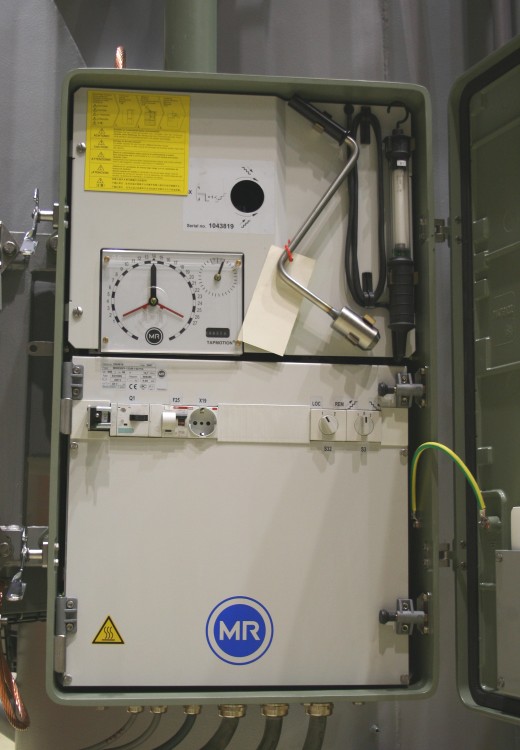
A tap changer is a mechanism in transformers that allows for variable turn ratios to be selected in distinct steps. This is done by connecting to a number of access points, known as taps along either the primary or secondary windings.
Tap changers exist in two primary types, no-load tap changers (NLTC), which must be de-energized before the turn ratio is adjusted, and on-load tap changers (OLTC), which may adjust their turn ratio during operation. The tap selection on any tap changer may be made via an automatic system, as is often the case for OLTC, or a manual tap changer, which is more common for NLTC. Automatic tap changers can be placed on a lower or higher voltage winding, but for high-power generation and transmission applications, automatic tap changers are often placed on the higher voltage (lower current) transformer winding for easy access and to minimize the current load during operation.
No-load tap changer (NLTC), also known as Off-circuit tap changer (OCTC) or De-energized tap changer (DETC), is a tap changer utilized in situations in which a transformer's turn ratio does not require frequent changing and it is permissible to de-energize the transformer system. This type of transformer is frequently employed in low power- low voltage transformers in which the tap point often may take the form of a transformer connection terminal, requiring the input line to be disconnected by hand and connected to the new terminal. Alternatively, in some systems, the process of tap changing may be assisted using a rotary or slider switch.
No-load tap changers are also employed in high-voltage distribution-type transformers in which the system includes a no-load tap changer on the primary winding to accommodate transmission system variations within a narrow band around the nominal rating. In such systems, the tap changer will often be set just once, at the time of installation, although it may be changed later to accommodate a long-term change in the system voltage profile.
On-load tap changer (OLTC), also known as On-circuit tap changer (OCTC), is a tap changer in applications where a supply interruption during a tap change is unacceptable, the transformer is often fitted with a more expensive and complex on-load tap changing mechanism. On-load tap changers may be generally classified as either mechanical, electronically assisted, or fully electronic.
These systems usually possess 33 taps (one at center "Rated" tap and sixteen to increase and decrease the turn ratio) and allow for ±10% variation (each step providing 0.625% variation) from the nominal transformer rating which, in turn, allows for stepped voltage regulation of the output.
Tap changers typically use numerous tap selector switches which may not be switched under load, broken into even and odd banks, and switch between the banks with a heavy-duty diverter switch which can switch between them under load. The result operates like a dual-clutch transmission, with the tap selector switches taking the place of the gearbox and the diverter switch taking the place of the clutch.
A mechanical tap changer physically makes the new connection before releasing the old using multiple tap selector switches but avoids creating high circulating currents by using a diverter switch to temporarily place a large diverter impedance in series with the short-circuited turns. This technique overcomes the problems with open or short circuit taps. In a resistance type tap changer, the changeover must be made rapidly to avoid overheating of the diverter. A reactance type tap changer uses a dedicated preventive autotransformer winding to function as the diverter impedance, and a reactance type tap changer is usually designed to sustain off-tap loading indefinitely.
Hub AI
Tap changer AI simulator
(@Tap changer_simulator)
Tap changer
A tap changer is a mechanism in transformers that allows for variable turn ratios to be selected in distinct steps. This is done by connecting to a number of access points, known as taps along either the primary or secondary windings.
Tap changers exist in two primary types, no-load tap changers (NLTC), which must be de-energized before the turn ratio is adjusted, and on-load tap changers (OLTC), which may adjust their turn ratio during operation. The tap selection on any tap changer may be made via an automatic system, as is often the case for OLTC, or a manual tap changer, which is more common for NLTC. Automatic tap changers can be placed on a lower or higher voltage winding, but for high-power generation and transmission applications, automatic tap changers are often placed on the higher voltage (lower current) transformer winding for easy access and to minimize the current load during operation.
No-load tap changer (NLTC), also known as Off-circuit tap changer (OCTC) or De-energized tap changer (DETC), is a tap changer utilized in situations in which a transformer's turn ratio does not require frequent changing and it is permissible to de-energize the transformer system. This type of transformer is frequently employed in low power- low voltage transformers in which the tap point often may take the form of a transformer connection terminal, requiring the input line to be disconnected by hand and connected to the new terminal. Alternatively, in some systems, the process of tap changing may be assisted using a rotary or slider switch.
No-load tap changers are also employed in high-voltage distribution-type transformers in which the system includes a no-load tap changer on the primary winding to accommodate transmission system variations within a narrow band around the nominal rating. In such systems, the tap changer will often be set just once, at the time of installation, although it may be changed later to accommodate a long-term change in the system voltage profile.
On-load tap changer (OLTC), also known as On-circuit tap changer (OCTC), is a tap changer in applications where a supply interruption during a tap change is unacceptable, the transformer is often fitted with a more expensive and complex on-load tap changing mechanism. On-load tap changers may be generally classified as either mechanical, electronically assisted, or fully electronic.
These systems usually possess 33 taps (one at center "Rated" tap and sixteen to increase and decrease the turn ratio) and allow for ±10% variation (each step providing 0.625% variation) from the nominal transformer rating which, in turn, allows for stepped voltage regulation of the output.
Tap changers typically use numerous tap selector switches which may not be switched under load, broken into even and odd banks, and switch between the banks with a heavy-duty diverter switch which can switch between them under load. The result operates like a dual-clutch transmission, with the tap selector switches taking the place of the gearbox and the diverter switch taking the place of the clutch.
A mechanical tap changer physically makes the new connection before releasing the old using multiple tap selector switches but avoids creating high circulating currents by using a diverter switch to temporarily place a large diverter impedance in series with the short-circuited turns. This technique overcomes the problems with open or short circuit taps. In a resistance type tap changer, the changeover must be made rapidly to avoid overheating of the diverter. A reactance type tap changer uses a dedicated preventive autotransformer winding to function as the diverter impedance, and a reactance type tap changer is usually designed to sustain off-tap loading indefinitely.