



Community hub
Recent from talks
Knowledge base stats:
Talk channels stats:
Members stats:
Tarabish
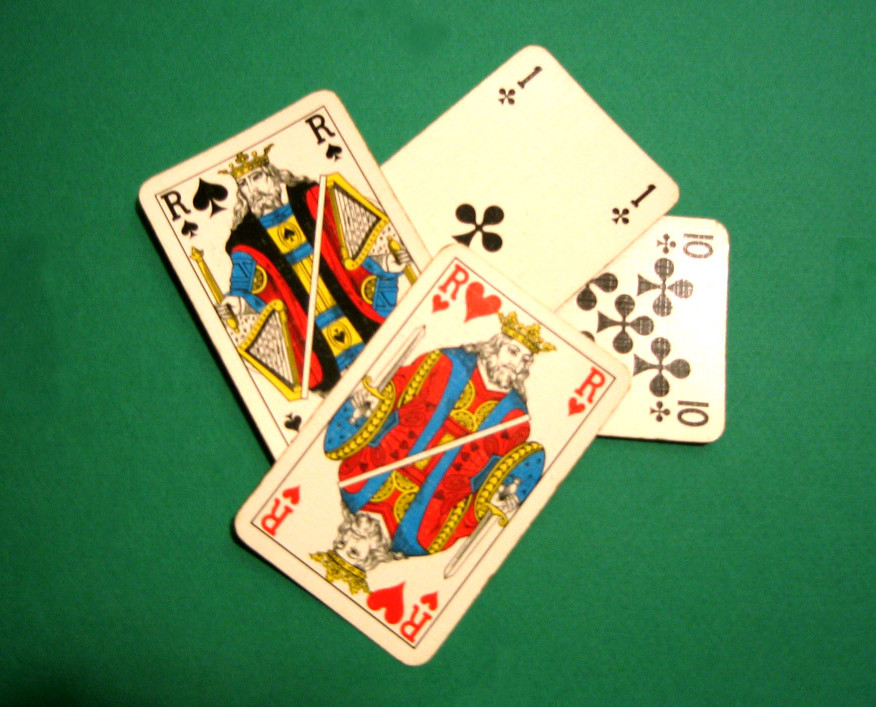
Tarabish, also known by its slang term bish, is a Canadian trick-taking card game of complex rules derived from belote, a game of the Jass family. The name is pronounced "tar-bish", despite the spelling. It is played primarily by the people of Cape Breton, Nova Scotia, in Canada, where, according to one source, it was brought in 1901 by a Lebanese immigrant George Shebib. On the other hand, following comprehensive research Kennedy (1996) states that opinions as to its origin vary and that no "definitive roots may ever be determined."
The game is over when one or both teams accumulate 500 points or more. Points are counted at the end of each hand and both teams always count their points. The team with the most points at the end of the game wins.
A tarabish deck consists of a normal English pattern deck of playing cards with the 2 through 5 of each suit removed. In preparation for the hand the dealer shuffles the cards in the usual manner. When finished the person to the right of the dealer cuts the cards. The cutter must leave at least four cards in each portion of the deck. Once the cards have been cut, no further shuffling is allowed. Bespoke tarabish packs were produced by Ocean of Sydney, Nova Scotia in the 1970s. These contained 40 cards (6–A in each suit) together with a rules leaflet.
The 36 tarabish cards are dealt in groups of three beginning with eldest hand (the player to the left of the dealer) and proceeding clockwise until all the cards are dealt. The four players look at their first six cards; the last three, called the kitty, remain face down until after the auction is over and a trump suit has been chosen.
In the plain suits, cards rank and score in the standard ace–ten order; in the trump suit the Jack and Nine are promoted above the ace to become the highest two cards with correspondingly higher card point values.
There is an auction to determine the trump suit for the hand. Eldest hand opens the bidding to choose the trump suit. If eldest passes, the decision passes to the next person and so on. In the most popular variation, if the bid reaches the dealer, the dealer is forced to choose a trump suit. The less popular variation allows the dealer to pass in which case the hand is complete and the deal passes to the next player.
The team that 'goes' must accumulate more than half of the points for that hand. If they get fewer than half, it is a 'bait' or 'bate' and their points go to their opponents. If they get exactly half the points it is a 'half-bait' in which case they score zero while their opponents of course get to score their own points.
Play begins with eldest hand and proceeds clockwise until each player has played a card. Each player must follow suit by playing a card of the same suit as the first card of each trick. A player who does not have a card of the same suit must play a trump if able. Lacking both, a player may play any card. Players must always head the trick if possible, i.e. on playing a trump they must overtrump any trumps already played. The person who played the highest card to the trick collects the cards and leads to the next trick.
Hub AI
Tarabish AI simulator
(@Tarabish_simulator)
Tarabish
Tarabish, also known by its slang term bish, is a Canadian trick-taking card game of complex rules derived from belote, a game of the Jass family. The name is pronounced "tar-bish", despite the spelling. It is played primarily by the people of Cape Breton, Nova Scotia, in Canada, where, according to one source, it was brought in 1901 by a Lebanese immigrant George Shebib. On the other hand, following comprehensive research Kennedy (1996) states that opinions as to its origin vary and that no "definitive roots may ever be determined."
The game is over when one or both teams accumulate 500 points or more. Points are counted at the end of each hand and both teams always count their points. The team with the most points at the end of the game wins.
A tarabish deck consists of a normal English pattern deck of playing cards with the 2 through 5 of each suit removed. In preparation for the hand the dealer shuffles the cards in the usual manner. When finished the person to the right of the dealer cuts the cards. The cutter must leave at least four cards in each portion of the deck. Once the cards have been cut, no further shuffling is allowed. Bespoke tarabish packs were produced by Ocean of Sydney, Nova Scotia in the 1970s. These contained 40 cards (6–A in each suit) together with a rules leaflet.
The 36 tarabish cards are dealt in groups of three beginning with eldest hand (the player to the left of the dealer) and proceeding clockwise until all the cards are dealt. The four players look at their first six cards; the last three, called the kitty, remain face down until after the auction is over and a trump suit has been chosen.
In the plain suits, cards rank and score in the standard ace–ten order; in the trump suit the Jack and Nine are promoted above the ace to become the highest two cards with correspondingly higher card point values.
There is an auction to determine the trump suit for the hand. Eldest hand opens the bidding to choose the trump suit. If eldest passes, the decision passes to the next person and so on. In the most popular variation, if the bid reaches the dealer, the dealer is forced to choose a trump suit. The less popular variation allows the dealer to pass in which case the hand is complete and the deal passes to the next player.
The team that 'goes' must accumulate more than half of the points for that hand. If they get fewer than half, it is a 'bait' or 'bate' and their points go to their opponents. If they get exactly half the points it is a 'half-bait' in which case they score zero while their opponents of course get to score their own points.
Play begins with eldest hand and proceeds clockwise until each player has played a card. Each player must follow suit by playing a card of the same suit as the first card of each trick. A player who does not have a card of the same suit must play a trump if able. Lacking both, a player may play any card. Players must always head the trick if possible, i.e. on playing a trump they must overtrump any trumps already played. The person who played the highest card to the trick collects the cards and leads to the next trick.