



Community hub
Recent from talks
Knowledge base stats:
Talk channels stats:
Members stats:
Taxes on knowledge
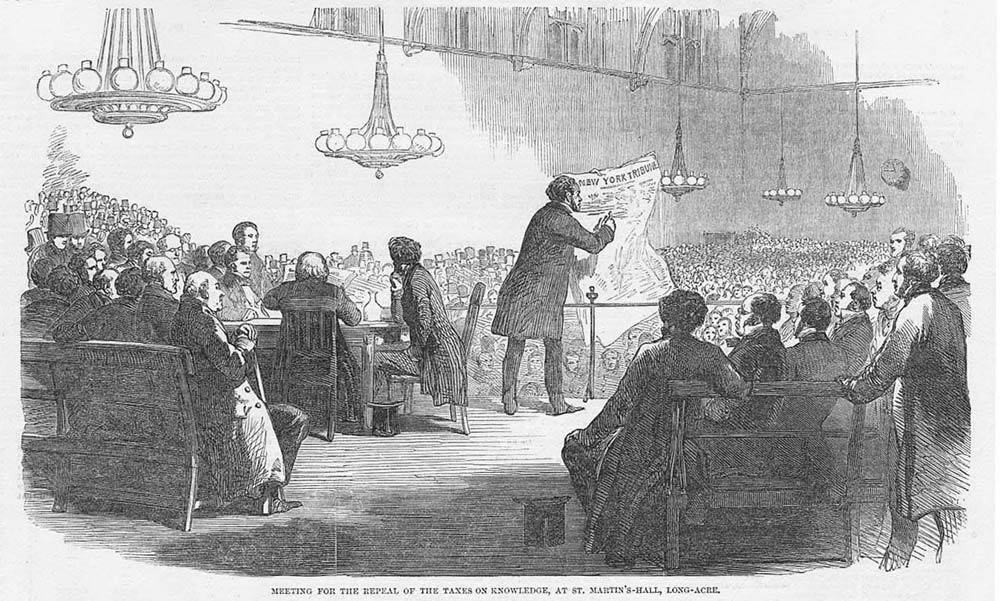
Taxes on knowledge was a slogan defining an extended British campaign against duties and taxes on newspapers, their advertising content, and the paper they were printed on. The paper tax was early identified as an issue: "A tax upon Paper, is a tax upon Knowledge" is a saying attributed to Alexander Adam (1741–1809), a Scottish headmaster.
The "taxes on knowledge" were at their peak in 1815, as the Napoleonic Wars ended. The Liverpool administration actively discouraged certain sections of the press, with prosecutions, including those for seditious libel, aimed at editors and writers. The principle of taxing publications and pamphlets had been introduced by the Stamp Act 1712, at the level of a halfpenny (½d.). The duty had risen over time to 4d.
The Newspaper and Stamp Duties Act 1819 was not very effective in controlling the circulation of news, but cramped the development of newspapers. It was aimed at the journalism of William Cobbett, the Hunt brothers (The Examiner), and Thomas Jonathan Wooler (The Black Dwarf). From 1819, "newspaper" was defined carefully, and the fiscal burden fell on all periodicals that were more frequently published than monthly, and priced below 6d. It had a negative effect on the English provincial press, i.e. newspapers outside London; and drove out cheap political papers.
Stamp duty was levied on newspapers, and the first phase of the campaign was the distribution of newspapers that were unstamped, and therefore illegal. A central figure of this "war of the unstamped" was Henry Hetherington. His unstamped paper, The Poor Man's Guardian, was launched in 1831. It tested the boundaries of the government's willingness to enforce the duty, recruiting hundreds of paper sellers and flaunting its illegal status. The National Union of the Working Classes took up the attack on "taxes on knowledge"; it had an Owenite background, with the British Association for Promoting Co-operative Knowledge founded in 1829.
The Whig government of the time faced the opinion of Lord Brougham, Lord Chancellor from 1830 to 1834, that newspapers should be available for 1d., rather than 7d. John Crawfurd in 1836 attempted an account of the "taxes on knowledge" total, including amounts for taxation of paper and advertisements, and postal charges.
The "war of the unstamped" saw nearly 800 people imprisoned. In 1834 the stamp duty was abolished on pamphlets; and in the Stamp Duties on Newspapers Act 1836 (6 & 7 Will. 4. c. 76) newspaper duty was reduced to 1d., from 4d., by Thomas Spring Rice as Chancellor of the Exchequer. On the other hand, the penalties for evasion of the duties were made more serious, and the definition of periodicals in the scope of the duty was broadened. The measures did not make for a cheap press or a free one.
Figures for number of stamps issued for newspapers are: 1801 16,085,085; 1824 26,308,003; 1837 53,897,926; 1846 78,298,125. The year 1836 also saw the creation of the Provincial Newspaper Society, a trade association later called the Newspaper Society, which came to oppose further fiscal reform, as did The Times.
John Francis of The Athenaeum was a persistent campaigner against taxes affecting publications, as they stood in the later 1830s, including paper duty at 1½d. per pound, and advertisement duty at a flat rate of 1s. 6d. Advertising duty had been cut in 1833: before that it had stood at 3s. 6d; paper duty had been 3d. per pound to 1837. Charles Knight the publisher of the Library of Useful Knowledge wanted paper duty abolished, but saw reason in the newspaper duty to avoid a popular radical press. The short-lived Association of Working Men to Procure a Cheap and Honest Press of early 1836 in effect became in a matter of months the London Working Men's Association.
Hub AI
Taxes on knowledge AI simulator
(@Taxes on knowledge_simulator)
Taxes on knowledge
Taxes on knowledge was a slogan defining an extended British campaign against duties and taxes on newspapers, their advertising content, and the paper they were printed on. The paper tax was early identified as an issue: "A tax upon Paper, is a tax upon Knowledge" is a saying attributed to Alexander Adam (1741–1809), a Scottish headmaster.
The "taxes on knowledge" were at their peak in 1815, as the Napoleonic Wars ended. The Liverpool administration actively discouraged certain sections of the press, with prosecutions, including those for seditious libel, aimed at editors and writers. The principle of taxing publications and pamphlets had been introduced by the Stamp Act 1712, at the level of a halfpenny (½d.). The duty had risen over time to 4d.
The Newspaper and Stamp Duties Act 1819 was not very effective in controlling the circulation of news, but cramped the development of newspapers. It was aimed at the journalism of William Cobbett, the Hunt brothers (The Examiner), and Thomas Jonathan Wooler (The Black Dwarf). From 1819, "newspaper" was defined carefully, and the fiscal burden fell on all periodicals that were more frequently published than monthly, and priced below 6d. It had a negative effect on the English provincial press, i.e. newspapers outside London; and drove out cheap political papers.
Stamp duty was levied on newspapers, and the first phase of the campaign was the distribution of newspapers that were unstamped, and therefore illegal. A central figure of this "war of the unstamped" was Henry Hetherington. His unstamped paper, The Poor Man's Guardian, was launched in 1831. It tested the boundaries of the government's willingness to enforce the duty, recruiting hundreds of paper sellers and flaunting its illegal status. The National Union of the Working Classes took up the attack on "taxes on knowledge"; it had an Owenite background, with the British Association for Promoting Co-operative Knowledge founded in 1829.
The Whig government of the time faced the opinion of Lord Brougham, Lord Chancellor from 1830 to 1834, that newspapers should be available for 1d., rather than 7d. John Crawfurd in 1836 attempted an account of the "taxes on knowledge" total, including amounts for taxation of paper and advertisements, and postal charges.
The "war of the unstamped" saw nearly 800 people imprisoned. In 1834 the stamp duty was abolished on pamphlets; and in the Stamp Duties on Newspapers Act 1836 (6 & 7 Will. 4. c. 76) newspaper duty was reduced to 1d., from 4d., by Thomas Spring Rice as Chancellor of the Exchequer. On the other hand, the penalties for evasion of the duties were made more serious, and the definition of periodicals in the scope of the duty was broadened. The measures did not make for a cheap press or a free one.
Figures for number of stamps issued for newspapers are: 1801 16,085,085; 1824 26,308,003; 1837 53,897,926; 1846 78,298,125. The year 1836 also saw the creation of the Provincial Newspaper Society, a trade association later called the Newspaper Society, which came to oppose further fiscal reform, as did The Times.
John Francis of The Athenaeum was a persistent campaigner against taxes affecting publications, as they stood in the later 1830s, including paper duty at 1½d. per pound, and advertisement duty at a flat rate of 1s. 6d. Advertising duty had been cut in 1833: before that it had stood at 3s. 6d; paper duty had been 3d. per pound to 1837. Charles Knight the publisher of the Library of Useful Knowledge wanted paper duty abolished, but saw reason in the newspaper duty to avoid a popular radical press. The short-lived Association of Working Men to Procure a Cheap and Honest Press of early 1836 in effect became in a matter of months the London Working Men's Association.