



Community hub
Recent from talks
Knowledge base stats:
Talk channels stats:
Members stats:
Tay Bridge
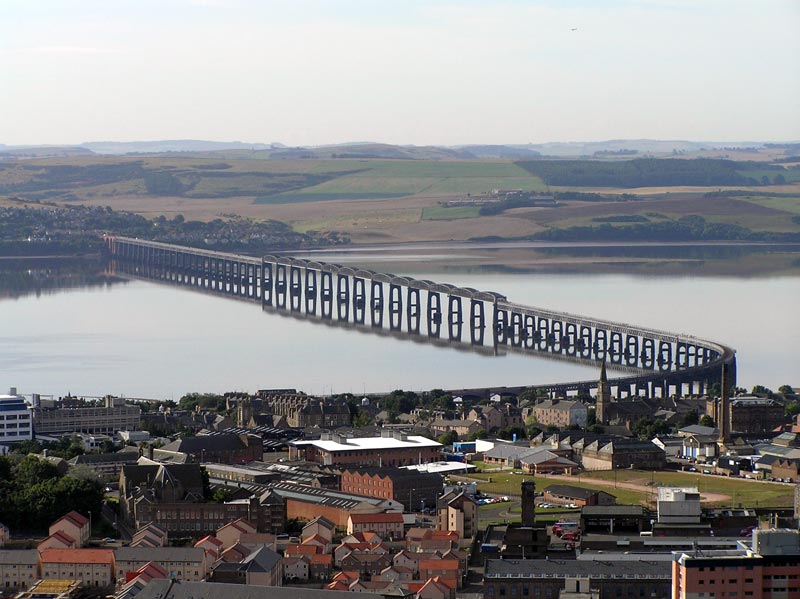
The Tay Bridge carries rail traffic across the Firth of Tay in Scotland between Dundee and the suburb of Wormit in Fife. Its span is 3,286 metres (2.042 miles). It is the second bridge to occupy the site.
Plans for a bridge over the Tay to replace the train ferry service emerged in 1854, but the first Tay Bridge did not open until 1878. It was a lightweight lattice design of relatively low cost with a single track. On 28 December 1879, the bridge suddenly collapsed in high winds while a train was crossing, killing everybody on board. The incident is one of the worst bridge-related engineering disasters in history. An enquiry determined that the bridge was insufficiently engineered to cope with high winds.
It was replaced by a second bridge constructed of iron and steel, with a double track, parallel to the remains of the first bridge. Work commenced on 6 July 1883 and the bridge opened in 1887. The new bridge was subject to extensive testing by the Board of Trade, which resulted in a favourable report. In 2003, the bridge was strengthened and refurbished, winning a British Construction Industry Engineering Award to mark the scale and difficulty of the project.
Proposals to build a bridge across the Tay date to 1854 but it was not until 15 July 1870 that the North British Railway (Tay Bridge and Railways) Act 1870 (33 & 34 Vict. c. cxxxv) received royal assent. On 22 July 1871, the foundation stone of the bridge was laid.
The bridge was designed by engineer Thomas Bouch, who received a knighthood following the bridge's completion. The bridge was a lattice-grid design, combining cast and wrought iron. The design had been used by Thomas W. Kennard in the Crumlin Viaduct in South Wales in 1858, after the use of cast iron in the Crystal Palace. The Crystal Palace was not as heavily loaded as a railway bridge. An earlier cast-iron design, the Dee bridge collapsed in 1847, having failed because of poor use of cast-iron girders. Gustave Eiffel used a similar design to create several large viaducts in the Massif Central in 1867.
The original design was for lattice girders supported by brick piers resting on the bedrock, shown by trial borings to lie at no great depth under the river. At either end of the bridge, the single track ran on top of the bridge girder, most of which lay below the pier tops. At the centre section of the bridge (the high girders), the railway ran inside the bridge girder, which was above the pier tops to give clearance for the passage of sailing ships. To accommodate thermal expansion, there were non-rigid connections between girders and piers.
As the bridge extended out into the river, by December 1873, it became clear that the bedrock lay much deeper, too deep to act as a foundation for the bridge piers. Bouch redesigned the bridge to reduce the number of piers and increase the span of the girders. The pier foundations were no longer resting on bedrock; instead they were constructed by sinking brick-lined wrought-iron caissons onto the riverbed, removing sand until they rested on the consolidated gravel layer which had been misreported as rock, and then filling the caissons with concrete.
To reduce the weight that the ground underneath the caissons would have to support, the brick piers were replaced by open lattice iron skeleton piers. Each pier had multiple cast-iron columns taking the weight of the bridging girders, with wrought iron horizontal braces and diagonal tiebars linking the columns to give rigidity and stability. The basic concept was well known, having been used by Kennard in the Crumlin Viaduct in South Wales in 1858. Bouch had used the technique for viaducts, including the Belah Viaduct (1860) on the South Durham & Lancashire Union Railway line over Stainmore, but for the Tay Bridge, even with the largest practicable caissons, the pier dimensions were constrained by their size. Bouch's pier design set six columns in a hexagon maximising the pier width but not the number of diagonal braces directly resisting sideways forces.
Hub AI
Tay Bridge AI simulator
(@Tay Bridge_simulator)
Tay Bridge
The Tay Bridge carries rail traffic across the Firth of Tay in Scotland between Dundee and the suburb of Wormit in Fife. Its span is 3,286 metres (2.042 miles). It is the second bridge to occupy the site.
Plans for a bridge over the Tay to replace the train ferry service emerged in 1854, but the first Tay Bridge did not open until 1878. It was a lightweight lattice design of relatively low cost with a single track. On 28 December 1879, the bridge suddenly collapsed in high winds while a train was crossing, killing everybody on board. The incident is one of the worst bridge-related engineering disasters in history. An enquiry determined that the bridge was insufficiently engineered to cope with high winds.
It was replaced by a second bridge constructed of iron and steel, with a double track, parallel to the remains of the first bridge. Work commenced on 6 July 1883 and the bridge opened in 1887. The new bridge was subject to extensive testing by the Board of Trade, which resulted in a favourable report. In 2003, the bridge was strengthened and refurbished, winning a British Construction Industry Engineering Award to mark the scale and difficulty of the project.
Proposals to build a bridge across the Tay date to 1854 but it was not until 15 July 1870 that the North British Railway (Tay Bridge and Railways) Act 1870 (33 & 34 Vict. c. cxxxv) received royal assent. On 22 July 1871, the foundation stone of the bridge was laid.
The bridge was designed by engineer Thomas Bouch, who received a knighthood following the bridge's completion. The bridge was a lattice-grid design, combining cast and wrought iron. The design had been used by Thomas W. Kennard in the Crumlin Viaduct in South Wales in 1858, after the use of cast iron in the Crystal Palace. The Crystal Palace was not as heavily loaded as a railway bridge. An earlier cast-iron design, the Dee bridge collapsed in 1847, having failed because of poor use of cast-iron girders. Gustave Eiffel used a similar design to create several large viaducts in the Massif Central in 1867.
The original design was for lattice girders supported by brick piers resting on the bedrock, shown by trial borings to lie at no great depth under the river. At either end of the bridge, the single track ran on top of the bridge girder, most of which lay below the pier tops. At the centre section of the bridge (the high girders), the railway ran inside the bridge girder, which was above the pier tops to give clearance for the passage of sailing ships. To accommodate thermal expansion, there were non-rigid connections between girders and piers.
As the bridge extended out into the river, by December 1873, it became clear that the bedrock lay much deeper, too deep to act as a foundation for the bridge piers. Bouch redesigned the bridge to reduce the number of piers and increase the span of the girders. The pier foundations were no longer resting on bedrock; instead they were constructed by sinking brick-lined wrought-iron caissons onto the riverbed, removing sand until they rested on the consolidated gravel layer which had been misreported as rock, and then filling the caissons with concrete.
To reduce the weight that the ground underneath the caissons would have to support, the brick piers were replaced by open lattice iron skeleton piers. Each pier had multiple cast-iron columns taking the weight of the bridging girders, with wrought iron horizontal braces and diagonal tiebars linking the columns to give rigidity and stability. The basic concept was well known, having been used by Kennard in the Crumlin Viaduct in South Wales in 1858. Bouch had used the technique for viaducts, including the Belah Viaduct (1860) on the South Durham & Lancashire Union Railway line over Stainmore, but for the Tay Bridge, even with the largest practicable caissons, the pier dimensions were constrained by their size. Bouch's pier design set six columns in a hexagon maximising the pier width but not the number of diagonal braces directly resisting sideways forces.