
Recent from talks
Team roping
Knowledge base stats:
Talk channels stats:
Members stats:
Team roping
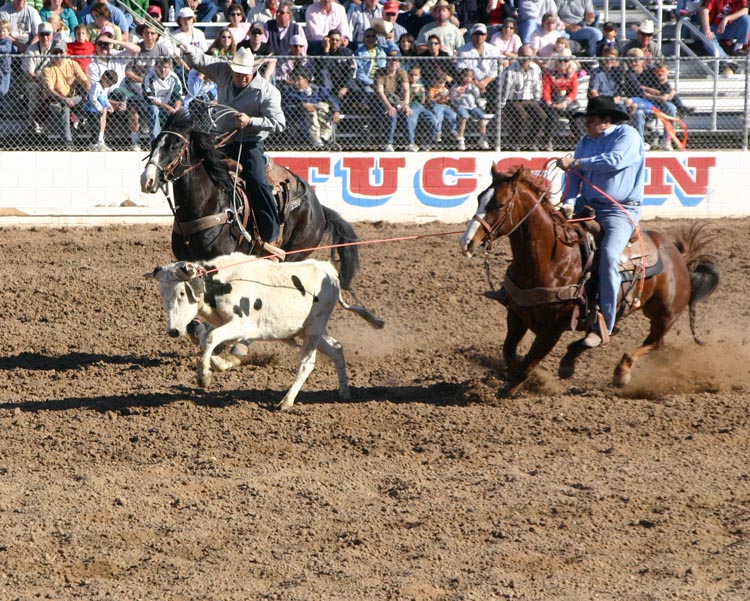
Team roping, also known as heading and heeling, is a rodeo event that features a steer (typically a Corriente) and two mounted riders. The first roper is referred to as the "header", the person who ropes the front of the steer, usually around the horns, but it is also legal for the rope to go around the neck, or go around one horn and the nose resulting in what they call a "half head". Once the steer is caught by one of the three legal head catches, the header must dally (wrap the rope around the rubber covered saddle horn) and use their horse to turn the steer to the left.
The second roper is the "heeler", who ropes the steer by its hind feet after the "header" has turned the steer, with a five-second penalty assessed to the end time if only one leg is caught. Team roping is the only rodeo event where men and women compete equally together in professionally sanctioned competition, in both single-gender or mixed-gender teams.
Cowboys originally developed this technique on working ranches when it was necessary to capture and restrain a full-grown animal that was too large to handle by a single man. Over the years, as the sport has grown, a numbering system was added to rate each ropers individual talent level. The numbers go from one to ten (1-10) for headers and one to ten (1-10) for heelers. Using these numbers, a handicap system (the subtraction of time) has been developed to even the competition. Today there are tens of thousands of amateur ropers who compete for millions of dollars in prize money.
There is specialized equipment used by team ropers:
Steers used for roping are moved from a holding corral through a series of narrow alleyways that lead to the roping arena. The alleyways allow the steers to be lined up in single file. Then, one at a time, a steer is moved into a chute with spring-loaded doors in front and a solid gate behind, so that only one animal is released at a time. On each side of the chute is an area called the box that is big enough to hold a horse and rider. The header is on one side (usually the left, for a right-handed header) whose job is to rope the steer around the horns, then turn the steer so its hind legs can be roped by the "heeler", who starts from the box on the other side of the chute.
A taut rope, called the barrier, runs in front of the header's box and is fastened to an easily released rope on the neck of the steer of a designated length, used to ensure that the steer gets a head start. An electronic barrier, consisting of an electric eye connected to a timing device, is sometimes used in place of the barrier rope.
When the header is ready, they call for the steer and an assistant pulls a lever, opening the chute doors. The freed steer breaks out running. When the steer reaches the end of the rope, the barrier releases. The header must rope the steer with one of three legal catches: a clean horn catch around both horns, a neck catch around the neck or a half-head catch around the neck and one horn. The header then takes a dally, a couple of wraps of the rope around the horn of the saddle. Some ropers have lost fingers in this event. Once the header has made the dally, the rider turns the horse, usually to the left, and the steer will follow, still running.
The heeler waits until the header has turned the steer. When they have a clear throw, the heeler throws a loop of rope under the running steer's hind legs and catches them. As soon as the heeler also dallies tight, the header turns their horse to directly face the steer and heeler. Both horses back up slightly to stretch out the steer's hind legs, immobilizing the animal. As soon as the steer is stretched out, an official waves a flag and the time is taken. The steer is released and trots off. There is a 5-second penalty for roping only one hind leg and a 10-second penalty for breaking the barrier if both occur on the same run then the penalties are added together for a total of 15 seconds added.
Hub AI
Team roping AI simulator
(@Team roping_simulator)
Team roping
Team roping, also known as heading and heeling, is a rodeo event that features a steer (typically a Corriente) and two mounted riders. The first roper is referred to as the "header", the person who ropes the front of the steer, usually around the horns, but it is also legal for the rope to go around the neck, or go around one horn and the nose resulting in what they call a "half head". Once the steer is caught by one of the three legal head catches, the header must dally (wrap the rope around the rubber covered saddle horn) and use their horse to turn the steer to the left.
The second roper is the "heeler", who ropes the steer by its hind feet after the "header" has turned the steer, with a five-second penalty assessed to the end time if only one leg is caught. Team roping is the only rodeo event where men and women compete equally together in professionally sanctioned competition, in both single-gender or mixed-gender teams.
Cowboys originally developed this technique on working ranches when it was necessary to capture and restrain a full-grown animal that was too large to handle by a single man. Over the years, as the sport has grown, a numbering system was added to rate each ropers individual talent level. The numbers go from one to ten (1-10) for headers and one to ten (1-10) for heelers. Using these numbers, a handicap system (the subtraction of time) has been developed to even the competition. Today there are tens of thousands of amateur ropers who compete for millions of dollars in prize money.
There is specialized equipment used by team ropers:
Steers used for roping are moved from a holding corral through a series of narrow alleyways that lead to the roping arena. The alleyways allow the steers to be lined up in single file. Then, one at a time, a steer is moved into a chute with spring-loaded doors in front and a solid gate behind, so that only one animal is released at a time. On each side of the chute is an area called the box that is big enough to hold a horse and rider. The header is on one side (usually the left, for a right-handed header) whose job is to rope the steer around the horns, then turn the steer so its hind legs can be roped by the "heeler", who starts from the box on the other side of the chute.
A taut rope, called the barrier, runs in front of the header's box and is fastened to an easily released rope on the neck of the steer of a designated length, used to ensure that the steer gets a head start. An electronic barrier, consisting of an electric eye connected to a timing device, is sometimes used in place of the barrier rope.
When the header is ready, they call for the steer and an assistant pulls a lever, opening the chute doors. The freed steer breaks out running. When the steer reaches the end of the rope, the barrier releases. The header must rope the steer with one of three legal catches: a clean horn catch around both horns, a neck catch around the neck or a half-head catch around the neck and one horn. The header then takes a dally, a couple of wraps of the rope around the horn of the saddle. Some ropers have lost fingers in this event. Once the header has made the dally, the rider turns the horse, usually to the left, and the steer will follow, still running.
The heeler waits until the header has turned the steer. When they have a clear throw, the heeler throws a loop of rope under the running steer's hind legs and catches them. As soon as the heeler also dallies tight, the header turns their horse to directly face the steer and heeler. Both horses back up slightly to stretch out the steer's hind legs, immobilizing the animal. As soon as the steer is stretched out, an official waves a flag and the time is taken. The steer is released and trots off. There is a 5-second penalty for roping only one hind leg and a 10-second penalty for breaking the barrier if both occur on the same run then the penalties are added together for a total of 15 seconds added.
Recent media