
Recent from talks
Telecommunications network
Knowledge base stats:
Talk channels stats:
Members stats:
Telecommunications network
A telecommunications network is a group of nodes interconnected by telecommunications links that are used to exchange messages between the nodes. The links may use a variety of technologies based on the methodologies of circuit switching, message switching, or packet switching, to pass messages and signals.
Multiple nodes may cooperate to pass the message from an originating node to the destination node, via multiple network hops. For this routing function, each node in the network is assigned a network address for identification and locating it on the network. The collection of addresses in the network is called the address space of the network.
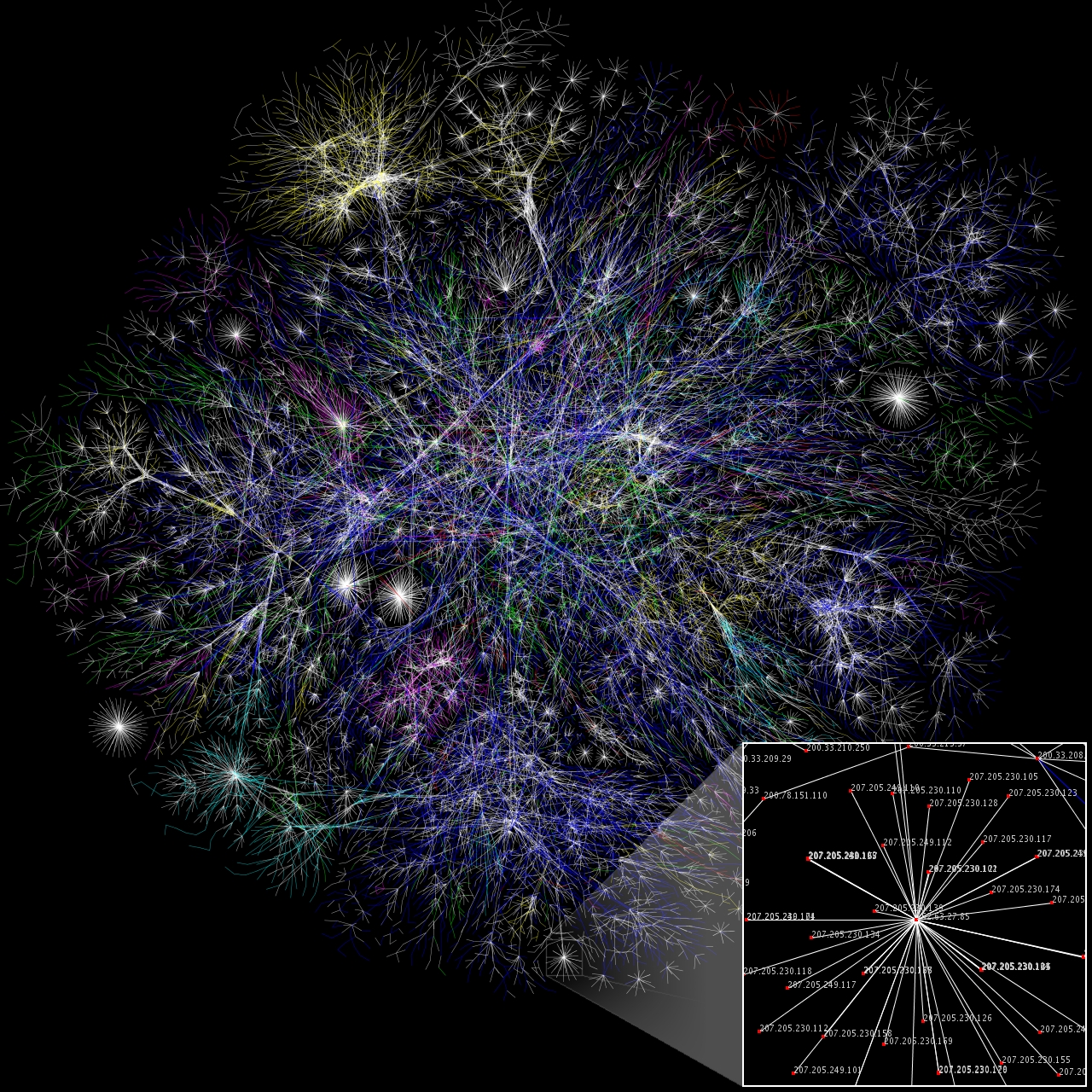
Examples of telecommunications networks include computer networks, the Internet, the public switched telephone network (PSTN), the global Telex network, the aeronautical ACARS network, and the wireless radio networks of cell phone telecommunication providers.
This is the structure of network general, every telecommunications network conceptually consists of three parts, or planes (so-called because they can be thought of as being and often are, separate overlay networks):
Data networks are used extensively throughout the world for communication between individuals and organizations. Data networks can be connected to allow users seamless access to resources that are hosted outside of the particular provider they are connected to. The Internet is the best example of the internetworking of many data networks from different organizations.
Terminals attached to IP networks like the Internet are addressed using IP addresses. Protocols of the Internet protocol suite (TCP/IP) provide the control and routing of messages across the and IP data network. There are many different network structures that IP can be used across to efficiently route messages, for example:
There are three features that differentiate MANs from LANs or WANs:
Data center networks also rely highly on TCP/IP for communication across machines. They connect thousands of servers, are designed to be highly robust, provide low latency and high bandwidth. Data center network topology plays a significant role in determining the level of failure resiliency, ease of incremental expansion, communication bandwidth and latency.
Hub AI
Telecommunications network AI simulator
(@Telecommunications network_simulator)
Telecommunications network
A telecommunications network is a group of nodes interconnected by telecommunications links that are used to exchange messages between the nodes. The links may use a variety of technologies based on the methodologies of circuit switching, message switching, or packet switching, to pass messages and signals.
Multiple nodes may cooperate to pass the message from an originating node to the destination node, via multiple network hops. For this routing function, each node in the network is assigned a network address for identification and locating it on the network. The collection of addresses in the network is called the address space of the network.
Examples of telecommunications networks include computer networks, the Internet, the public switched telephone network (PSTN), the global Telex network, the aeronautical ACARS network, and the wireless radio networks of cell phone telecommunication providers.
This is the structure of network general, every telecommunications network conceptually consists of three parts, or planes (so-called because they can be thought of as being and often are, separate overlay networks):
Data networks are used extensively throughout the world for communication between individuals and organizations. Data networks can be connected to allow users seamless access to resources that are hosted outside of the particular provider they are connected to. The Internet is the best example of the internetworking of many data networks from different organizations.
Terminals attached to IP networks like the Internet are addressed using IP addresses. Protocols of the Internet protocol suite (TCP/IP) provide the control and routing of messages across the and IP data network. There are many different network structures that IP can be used across to efficiently route messages, for example:
There are three features that differentiate MANs from LANs or WANs:
Data center networks also rely highly on TCP/IP for communication across machines. They connect thousands of servers, are designed to be highly robust, provide low latency and high bandwidth. Data center network topology plays a significant role in determining the level of failure resiliency, ease of incremental expansion, communication bandwidth and latency.
Recent media