



Community hub
Recent from talks
Knowledge base stats:
Talk channels stats:
Members stats:
Telecommunications relay service
A telecommunications relay service, also known as TRS, relay service, or IP-relay, or Web-based relay service, is an operator service that allows people who are deaf, hard of hearing, deafblind, or have a speech disorder to place calls to standard telephone users via a keyboard or assistive device. Originally, relay services were designed to be connected through a TDD, teletypewriter (TTY) or other assistive telephone device. Services gradually have expanded to include almost any real-time text capable technology such as a personal computer, laptop, mobile phone, PDA, and many other devices. The first TTY was invented by deaf scientist Robert Weitbrecht in 1964. The first relay service was established in 1974 by Converse Communications of Connecticut.
Depending on the technical and physical abilities and physical environments of users, different call types are possible via relay services.
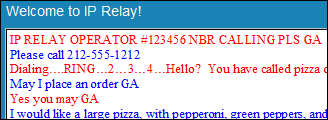
Once the most common type of TRS call, TTY calls involve a call from a deaf or hard-of-hearing person who utilizes a TTY to a hearing person. In this type of call, typed messages are relayed as voice messages by a TRS operator, (also known as Communication Assistant (CA), Relay Operator (RO), Relay Assistant (RA), or relay agent (agent)), and vice versa. This allows callers who are unable to use a regular telephone to be able to place calls to people who use a regular telephone and vice versa. When the person who is hearing is ready for a response, it is customary to say "go ahead" or "GA" to indicate that it is the TTY (teletypewriter) user's turn to talk and "stop keying", "SK", or "ready to hang up" when ending the call and vice versa. This mode of communication has largely been superseded by other modes of communications, including the utilization of IP relay, VPs, VRS, and VRI.
A common type of call is voice carry over, VCO. This allows a person who is hard of hearing or deaf but can speak to use their voice while receiving responses from a person who is hearing via the operator's typed text. There are many variations of VCO, including two-line VCO and VCO with privacy.
The operator will not hear the VCO user's voiced messages and the VCO user does not need to voice GA. The operator will hear the person who is hearing, and the person who is hearing must give the GA each time to alert the operator it is the VCO user's turn. The VCO user does not need to voice GA, because the VCO user types it or presses the "VCO GA" button on the VCO phone when it's the voice user's turn to talk.
Two-line VCO allows a VCO user using a TTY or computer to call a TRS operator, who in turn calls the VCO user on a second telephone line, which serves as the voice line. The user puts the operator on a brief hold to initiate a three-way call with the hearing person. This method is frequently used by people who are hard of hearing and like to use some of their residual hearing as well as not having to say "go ahead". With two-line VCO, the VCO user and the voice user can interrupt each other. VCO with Privacy cannot be used with two-line VCO, because the operator, VCO user, and hearing person are on a three-way call.
A less common call type is hearing carry over (HCO). HCO allows a person who is speech-disabled but can hear to use their hearing while sending responses to a person who is hearing via the HCO user's typed text. The operator voices the HCO user's typed messages, and then the HCO users picks up the handset and listens to the other voice user's response. There are many variations of HCO, including two-line HCO and HCO with privacy.
The operator will not hear the voice user's voiced messages and the voice user does not need to voice GA. The operator will voice for the person who is Speech-Disabled, and the person who is Speech–Disabled must give the GA each time to alert the operator it is the voice user's turn. The voice user does not need to voice GA, because the HCO user can hear when the voice user finishes talking.
Hub AI
Telecommunications relay service AI simulator
(@Telecommunications relay service_simulator)
Telecommunications relay service
A telecommunications relay service, also known as TRS, relay service, or IP-relay, or Web-based relay service, is an operator service that allows people who are deaf, hard of hearing, deafblind, or have a speech disorder to place calls to standard telephone users via a keyboard or assistive device. Originally, relay services were designed to be connected through a TDD, teletypewriter (TTY) or other assistive telephone device. Services gradually have expanded to include almost any real-time text capable technology such as a personal computer, laptop, mobile phone, PDA, and many other devices. The first TTY was invented by deaf scientist Robert Weitbrecht in 1964. The first relay service was established in 1974 by Converse Communications of Connecticut.
Depending on the technical and physical abilities and physical environments of users, different call types are possible via relay services.
Once the most common type of TRS call, TTY calls involve a call from a deaf or hard-of-hearing person who utilizes a TTY to a hearing person. In this type of call, typed messages are relayed as voice messages by a TRS operator, (also known as Communication Assistant (CA), Relay Operator (RO), Relay Assistant (RA), or relay agent (agent)), and vice versa. This allows callers who are unable to use a regular telephone to be able to place calls to people who use a regular telephone and vice versa. When the person who is hearing is ready for a response, it is customary to say "go ahead" or "GA" to indicate that it is the TTY (teletypewriter) user's turn to talk and "stop keying", "SK", or "ready to hang up" when ending the call and vice versa. This mode of communication has largely been superseded by other modes of communications, including the utilization of IP relay, VPs, VRS, and VRI.
A common type of call is voice carry over, VCO. This allows a person who is hard of hearing or deaf but can speak to use their voice while receiving responses from a person who is hearing via the operator's typed text. There are many variations of VCO, including two-line VCO and VCO with privacy.
The operator will not hear the VCO user's voiced messages and the VCO user does not need to voice GA. The operator will hear the person who is hearing, and the person who is hearing must give the GA each time to alert the operator it is the VCO user's turn. The VCO user does not need to voice GA, because the VCO user types it or presses the "VCO GA" button on the VCO phone when it's the voice user's turn to talk.
Two-line VCO allows a VCO user using a TTY or computer to call a TRS operator, who in turn calls the VCO user on a second telephone line, which serves as the voice line. The user puts the operator on a brief hold to initiate a three-way call with the hearing person. This method is frequently used by people who are hard of hearing and like to use some of their residual hearing as well as not having to say "go ahead". With two-line VCO, the VCO user and the voice user can interrupt each other. VCO with Privacy cannot be used with two-line VCO, because the operator, VCO user, and hearing person are on a three-way call.
A less common call type is hearing carry over (HCO). HCO allows a person who is speech-disabled but can hear to use their hearing while sending responses to a person who is hearing via the HCO user's typed text. The operator voices the HCO user's typed messages, and then the HCO users picks up the handset and listens to the other voice user's response. There are many variations of HCO, including two-line HCO and HCO with privacy.
The operator will not hear the voice user's voiced messages and the voice user does not need to voice GA. The operator will voice for the person who is Speech-Disabled, and the person who is Speech–Disabled must give the GA each time to alert the operator it is the voice user's turn. The voice user does not need to voice GA, because the HCO user can hear when the voice user finishes talking.