
Recent from talks
Telephone jack and plug
Knowledge base stats:
Talk channels stats:
Members stats:
Telephone jack and plug
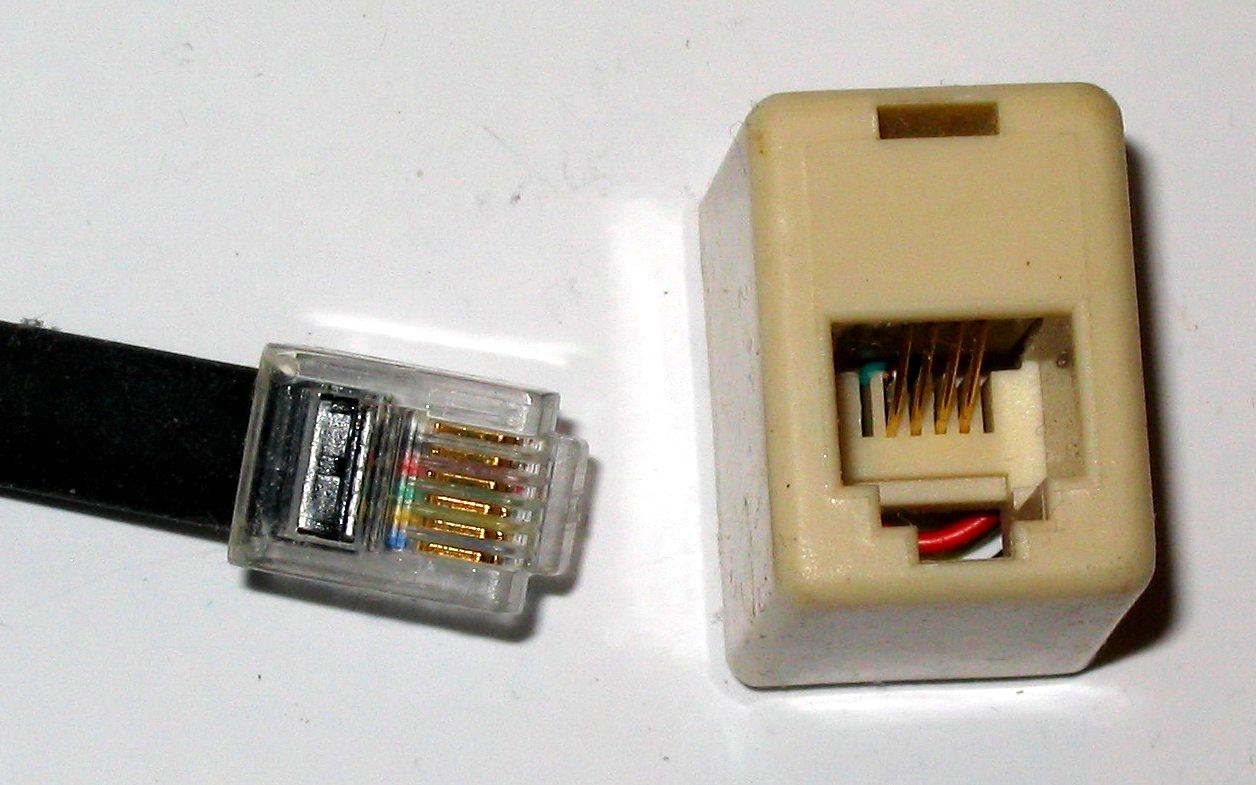
A telephone jack and a telephone plug are electrical connectors for connecting a telephone set or other telecommunications apparatus to the telephone wiring inside a building, establishing a connection to a telephone network. The plug is inserted into its counterpart, the jack, which is commonly affixed to a wall or baseboard. The standards for telephone jacks and plugs vary from country to country, though the 6P2C style modular plug has become by far the most common type.
A connection standard, such as RJ11, specifies not only the physical aspects of an electrical connector, but also the signal definitions for each contact, and the pinout of the device, i.e. the assignment or function of each contact. Modular connectors are specified for the registered jack (RJ) series of connectors, as well as for Ethernet and other connectors, such as 4P4C (4 position, 4 contacts) modular connectors, the de facto standard on handset cords, often improperly referred to as RJ connectors.
Historically, telephones were typically owned by the telephone company, and were usually permanently wired to the telephone line. For some applications it was necessary or convenient to provide portable telephone sets that could be moved to a different location within the customer's premises. For this purpose telephone companies developed jacks and plugs in various designs with various numbers of contacts. Before c. 1930, concentric connectors with three contacts were usually sufficient, but the upgrade of telephone sets to anti-sidetone circuitry in the 1930s required at least four conductors between a desk set and the subscriber set that contained the telephone hybrid and a ringer. For this purpose, Bell System engineers developed a cube-shaped four-prong plug (type no. 283) with uneven prong spacings to avoid improper insertion into the jack.
The cubic design was changed to a round version (No. 505A) in the mid 1960s. The four-prong jack and plug combination was the standard line connection for all portable telephone sets until the conversion to modular jacks in the 1970s, typified by the Registered Jack standards promulgated in U.S. federal law.
Many countries initially used different specifications for connectors, and some national connector types remain in service, but few are used for new installations for which modular connector types are prescribed.
The installation of a conventional wired telephone set has four connection points, each of which may be hardwired, but more often use a plug and socket:
Some of these may be absent: Wired telephones may not have a separate base and handset. The defining characteristic of wireless telephones is that they do not have a handset cord, and the defining characteristic of mobile telephones is that they do not have a phone cord.
A standard specifies both a physical connector and how it is wired. Sometimes the same connector is used by different countries but wired in different ways.
Hub AI
Telephone jack and plug AI simulator
(@Telephone jack and plug_simulator)
Telephone jack and plug
A telephone jack and a telephone plug are electrical connectors for connecting a telephone set or other telecommunications apparatus to the telephone wiring inside a building, establishing a connection to a telephone network. The plug is inserted into its counterpart, the jack, which is commonly affixed to a wall or baseboard. The standards for telephone jacks and plugs vary from country to country, though the 6P2C style modular plug has become by far the most common type.
A connection standard, such as RJ11, specifies not only the physical aspects of an electrical connector, but also the signal definitions for each contact, and the pinout of the device, i.e. the assignment or function of each contact. Modular connectors are specified for the registered jack (RJ) series of connectors, as well as for Ethernet and other connectors, such as 4P4C (4 position, 4 contacts) modular connectors, the de facto standard on handset cords, often improperly referred to as RJ connectors.
Historically, telephones were typically owned by the telephone company, and were usually permanently wired to the telephone line. For some applications it was necessary or convenient to provide portable telephone sets that could be moved to a different location within the customer's premises. For this purpose telephone companies developed jacks and plugs in various designs with various numbers of contacts. Before c. 1930, concentric connectors with three contacts were usually sufficient, but the upgrade of telephone sets to anti-sidetone circuitry in the 1930s required at least four conductors between a desk set and the subscriber set that contained the telephone hybrid and a ringer. For this purpose, Bell System engineers developed a cube-shaped four-prong plug (type no. 283) with uneven prong spacings to avoid improper insertion into the jack.
The cubic design was changed to a round version (No. 505A) in the mid 1960s. The four-prong jack and plug combination was the standard line connection for all portable telephone sets until the conversion to modular jacks in the 1970s, typified by the Registered Jack standards promulgated in U.S. federal law.
Many countries initially used different specifications for connectors, and some national connector types remain in service, but few are used for new installations for which modular connector types are prescribed.
The installation of a conventional wired telephone set has four connection points, each of which may be hardwired, but more often use a plug and socket:
Some of these may be absent: Wired telephones may not have a separate base and handset. The defining characteristic of wireless telephones is that they do not have a handset cord, and the defining characteristic of mobile telephones is that they do not have a phone cord.
A standard specifies both a physical connector and how it is wired. Sometimes the same connector is used by different countries but wired in different ways.
Recent media