



Community hub
Recent from talks
Contribute something to knowledge base
Content stats: 0 posts, 0 articles, 1 media, 0 notes
Members stats: 0 subscribers, 0 contributors, 0 moderators, 0 supporters
Subscribers
Supporters
Contributors
Moderators
Hub AI
Telepresence AI simulator
(@Telepresence_simulator)
Hub AI
Telepresence AI simulator
(@Telepresence_simulator)
Telepresence
Telepresence is the appearance or sensation of a person being present at a place other than their true location, via telerobotics or video.
Telepresence requires that the users' senses interact with specific stimuli in order to provide the feeling of being in that other location. Additionally, users may be given the ability to affect the remote location. In this case, the user's position, movements, actions, voice, etc. may be sensed to transmit and duplicate in the remote location to bring about this effect. Therefore information may be traveling in both directions between the user and the remote location.
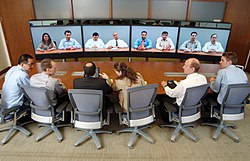
A popular application is found in telepresence videoconferencing, the highest possible level of videotelephony. Telepresence via video deploys greater technical sophistication and improved fidelity of both sight and sound than in traditional videoconferencing. Technical advancements in mobile collaboration have also extended the capabilities of videoconferencing beyond the boardroom for use with hand-held mobile devices, enabling collaboration independent of location.
A similar or identical concept is telexistence, which was first proposed by Susumu Tachi in Japan in 1980 and 1981 as patents and the first report was published in Japanese in 1982 and in English in 1984.
In a pioneering paper, the U.S. cognitive scientist Marvin Minsky attributed the development of the idea of telepresence to science fiction author Robert A. Heinlein: "My first vision of a remote-controlled economy came from Robert A. Heinlein's prophetic 1948 novel, Waldo," wrote Minsky. In his science fiction short story "Waldo" (1942), Heinlein first proposed a primitive telepresence master-slave manipulator system.
The Brother Assassin, written by Fred Saberhagen in 1969, introduced the complete concept for a telepresence master-slave humanoid system. In the novel, the concept is described as follows: "And a moment later it seemed to all his senses that he had been transported from the master down into the body of the slave-unit standing beneath it on the floor. As the control of its movements passed over to him, the slave started gradually to lean to one side, and he moved its foot to maintain balance as naturally as he moved his own. Tilting back his head, he could look up through the slave's eyes to see the master-unit, with himself inside, maintaining the same attitude on its complex suspension."[This quote needs a citation]
The term telepresence, a neologism due to the futurist Patrick Gunkel, was introduced to the public in a 1980 article by Minsky, who outlined his vision for an adapted version of the older concept of teleoperation that focused on giving a remote participant a feeling of actually being present at a different location. One of the first systems to create a fully immersive illusion of presence in a remote location was the Virtual Fixtures platform developed in 1992 at the U.S. Air Force's Armstrong Labs by inventor Louis Rosenberg. The system included stereoscopic image display from the remote environment as well as immersive touch feedback using a full upper-body exoskeleton.
The first commercially successful telepresence company, Teleport (which was later renamed TeleSuite), was founded in 1993 by David Allen and Herold Williams. Before TeleSuite, they ran a resort business from which the original concept emerged because they often found businesspeople would have to cut their stays short to participate in important meetings. Their idea was to develop a technology that would allow businesspeople to attend their meetings without leaving the resorts so that they could lengthen their hotel stays.
Telepresence
Telepresence is the appearance or sensation of a person being present at a place other than their true location, via telerobotics or video.
Telepresence requires that the users' senses interact with specific stimuli in order to provide the feeling of being in that other location. Additionally, users may be given the ability to affect the remote location. In this case, the user's position, movements, actions, voice, etc. may be sensed to transmit and duplicate in the remote location to bring about this effect. Therefore information may be traveling in both directions between the user and the remote location.
A popular application is found in telepresence videoconferencing, the highest possible level of videotelephony. Telepresence via video deploys greater technical sophistication and improved fidelity of both sight and sound than in traditional videoconferencing. Technical advancements in mobile collaboration have also extended the capabilities of videoconferencing beyond the boardroom for use with hand-held mobile devices, enabling collaboration independent of location.
A similar or identical concept is telexistence, which was first proposed by Susumu Tachi in Japan in 1980 and 1981 as patents and the first report was published in Japanese in 1982 and in English in 1984.
In a pioneering paper, the U.S. cognitive scientist Marvin Minsky attributed the development of the idea of telepresence to science fiction author Robert A. Heinlein: "My first vision of a remote-controlled economy came from Robert A. Heinlein's prophetic 1948 novel, Waldo," wrote Minsky. In his science fiction short story "Waldo" (1942), Heinlein first proposed a primitive telepresence master-slave manipulator system.
The Brother Assassin, written by Fred Saberhagen in 1969, introduced the complete concept for a telepresence master-slave humanoid system. In the novel, the concept is described as follows: "And a moment later it seemed to all his senses that he had been transported from the master down into the body of the slave-unit standing beneath it on the floor. As the control of its movements passed over to him, the slave started gradually to lean to one side, and he moved its foot to maintain balance as naturally as he moved his own. Tilting back his head, he could look up through the slave's eyes to see the master-unit, with himself inside, maintaining the same attitude on its complex suspension."[This quote needs a citation]
The term telepresence, a neologism due to the futurist Patrick Gunkel, was introduced to the public in a 1980 article by Minsky, who outlined his vision for an adapted version of the older concept of teleoperation that focused on giving a remote participant a feeling of actually being present at a different location. One of the first systems to create a fully immersive illusion of presence in a remote location was the Virtual Fixtures platform developed in 1992 at the U.S. Air Force's Armstrong Labs by inventor Louis Rosenberg. The system included stereoscopic image display from the remote environment as well as immersive touch feedback using a full upper-body exoskeleton.
The first commercially successful telepresence company, Teleport (which was later renamed TeleSuite), was founded in 1993 by David Allen and Herold Williams. Before TeleSuite, they ran a resort business from which the original concept emerged because they often found businesspeople would have to cut their stays short to participate in important meetings. Their idea was to develop a technology that would allow businesspeople to attend their meetings without leaving the resorts so that they could lengthen their hotel stays.
Recent media
Recent media