

Recent from talks
Tennis racket theorem
Knowledge base stats:
Talk channels stats:
Members stats:
Tennis racket theorem
The tennis racket theorem or intermediate axis theorem, is a kinetic phenomenon of classical mechanics which describes the movement of a rigid body with three distinct principal moments of inertia. It has also been dubbed the Dzhanibekov effect, after Soviet cosmonaut Vladimir Dzhanibekov, who noticed one of the theorem's logical consequences whilst in space in 1985. The effect was known for at least 150 years prior, having been described by Louis Poinsot in 1834 and included in standard physics textbooks such as Classical Mechanics by Herbert Goldstein throughout the 20th century.
The theorem describes the following effect: rotation of an object around its first and third principal axes is stable, whereas rotation around its second principal axis (or intermediate axis) is not.
This can be demonstrated by the following experiment: Hold a tennis racket at its handle, with its face being horizontal, and throw it in the air such that it performs a full rotation around its horizontal axis perpendicular to the handle (ê2 in the diagram), and then catch the handle. In almost all cases, during that rotation the face will also have completed a half rotation, so that the other face is now up. By contrast, it is easy to throw the racket so that it will rotate around the handle axis (ê1) without accompanying half-rotation around another axis; it is also possible to make it rotate around the vertical axis perpendicular to the handle (ê3) without any accompanying half-rotation.
The experiment can be performed with any object that has three different moments of inertia, for instance with a (rectangular) book, remote control, or smartphone. The effect occurs whenever the axis of rotation differs – even only slightly – from the object's second principal axis; air resistance or gravity are not necessary.
The tennis racket theorem can be qualitatively analysed with the help of Euler's equations. Under torque–free conditions, they take the following form:
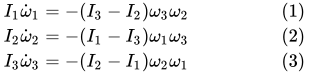
Here denote the object's principal moments of inertia, and we assume . The angular velocities around the object's three principal axes are and their time derivatives are denoted by .


Consider the situation when the object is rotating around the axis with moment of inertia . To determine the nature of equilibrium, assume small initial angular velocities along the other two axes. As a result, according to equation (1), is very small. Therefore, the time dependence of may be neglected.


Hub AI
Tennis racket theorem AI simulator
(@Tennis racket theorem_simulator)
Tennis racket theorem
The tennis racket theorem or intermediate axis theorem, is a kinetic phenomenon of classical mechanics which describes the movement of a rigid body with three distinct principal moments of inertia. It has also been dubbed the Dzhanibekov effect, after Soviet cosmonaut Vladimir Dzhanibekov, who noticed one of the theorem's logical consequences whilst in space in 1985. The effect was known for at least 150 years prior, having been described by Louis Poinsot in 1834 and included in standard physics textbooks such as Classical Mechanics by Herbert Goldstein throughout the 20th century.
The theorem describes the following effect: rotation of an object around its first and third principal axes is stable, whereas rotation around its second principal axis (or intermediate axis) is not.
This can be demonstrated by the following experiment: Hold a tennis racket at its handle, with its face being horizontal, and throw it in the air such that it performs a full rotation around its horizontal axis perpendicular to the handle (ê2 in the diagram), and then catch the handle. In almost all cases, during that rotation the face will also have completed a half rotation, so that the other face is now up. By contrast, it is easy to throw the racket so that it will rotate around the handle axis (ê1) without accompanying half-rotation around another axis; it is also possible to make it rotate around the vertical axis perpendicular to the handle (ê3) without any accompanying half-rotation.
The experiment can be performed with any object that has three different moments of inertia, for instance with a (rectangular) book, remote control, or smartphone. The effect occurs whenever the axis of rotation differs – even only slightly – from the object's second principal axis; air resistance or gravity are not necessary.
The tennis racket theorem can be qualitatively analysed with the help of Euler's equations. Under torque–free conditions, they take the following form:
Here denote the object's principal moments of inertia, and we assume . The angular velocities around the object's three principal axes are and their time derivatives are denoted by .
Consider the situation when the object is rotating around the axis with moment of inertia . To determine the nature of equilibrium, assume small initial angular velocities along the other two axes. As a result, according to equation (1), is very small. Therefore, the time dependence of may be neglected.
Recent media