


Community hub
Recent from talks
Contribute something to knowledge base
Content stats: 0 posts, 0 articles, 1 media, 0 notes
Members stats: 0 subscribers, 0 contributors, 0 moderators, 0 supporters
Subscribers
Supporters
Contributors
Moderators
Hub AI
Teratoma AI simulator
(@Teratoma_simulator)
Hub AI
Teratoma AI simulator
(@Teratoma_simulator)
Teratoma
A teratoma is a tumor made up of several types of tissue, such as hair, muscle, teeth, or bone. Teratomata typically form in the tailbone (where it is known as a sacrococcygeal teratoma), ovary, or testicle.
Symptoms may be minimal if the tumor is small. A testicular teratoma may present as a painless lump. Complications may include ovarian torsion, testicular torsion, or hydrops fetalis.
They are a type of germ cell tumor (a tumor that begins in the cells that give rise to sperm or eggs). They are divided into two types: mature and immature. Mature teratomas include dermoid cysts and are generally benign. Immature teratomas may be cancerous. Most ovarian teratomas are mature. In adults, testicular teratomas are generally cancerous. Definitive diagnosis is based on a tissue biopsy.
Treatment of coccyx, testicular, and ovarian teratomas is generally by surgery. Testicular and immature ovarian teratomas are also frequently treated with chemotherapy.
Teratomas occur in the coccyx in about one in 30,000 newborns, making them one of the most common tumors in this age group. Females are affected more often than males. Ovarian teratomas represent about a quarter of ovarian tumors and are typically noticed during middle age. Testicular teratomas represent almost half of testicular cancers. They can occur in both children and adults. The term comes from the Greek word for "monster" plus the "-oma" suffix used for tumors.
Teratomas can cause an autoimmune illness called Anti-NMDA receptor encephalitis. In this condition, the teratomas may contain B cells with NMDA-receptor specificities.
After teratoma removal surgery, a risk exists of regrowth in place, or in nearby organs.
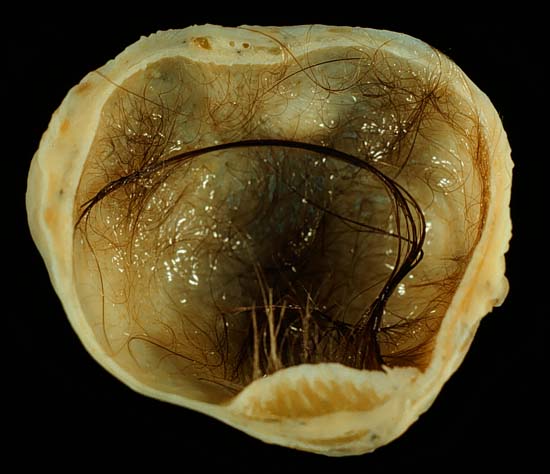
A mature teratoma is a grade 0 teratoma. They are highly variable in form and histology, and may be solid, cystic, or a combination of the two. A mature teratoma often contains several different types of tissue such as skin, muscle, and bone. Skin may surround a cyst and grow abundant hair . Mature teratomas generally are benign, with 0.17–2% of mature cystic teratomas becoming malignant.
Teratoma
A teratoma is a tumor made up of several types of tissue, such as hair, muscle, teeth, or bone. Teratomata typically form in the tailbone (where it is known as a sacrococcygeal teratoma), ovary, or testicle.
Symptoms may be minimal if the tumor is small. A testicular teratoma may present as a painless lump. Complications may include ovarian torsion, testicular torsion, or hydrops fetalis.
They are a type of germ cell tumor (a tumor that begins in the cells that give rise to sperm or eggs). They are divided into two types: mature and immature. Mature teratomas include dermoid cysts and are generally benign. Immature teratomas may be cancerous. Most ovarian teratomas are mature. In adults, testicular teratomas are generally cancerous. Definitive diagnosis is based on a tissue biopsy.
Treatment of coccyx, testicular, and ovarian teratomas is generally by surgery. Testicular and immature ovarian teratomas are also frequently treated with chemotherapy.
Teratomas occur in the coccyx in about one in 30,000 newborns, making them one of the most common tumors in this age group. Females are affected more often than males. Ovarian teratomas represent about a quarter of ovarian tumors and are typically noticed during middle age. Testicular teratomas represent almost half of testicular cancers. They can occur in both children and adults. The term comes from the Greek word for "monster" plus the "-oma" suffix used for tumors.
Teratomas can cause an autoimmune illness called Anti-NMDA receptor encephalitis. In this condition, the teratomas may contain B cells with NMDA-receptor specificities.
After teratoma removal surgery, a risk exists of regrowth in place, or in nearby organs.
A mature teratoma is a grade 0 teratoma. They are highly variable in form and histology, and may be solid, cystic, or a combination of the two. A mature teratoma often contains several different types of tissue such as skin, muscle, and bone. Skin may surround a cyst and grow abundant hair . Mature teratomas generally are benign, with 0.17–2% of mature cystic teratomas becoming malignant.
Recent media
Recent media